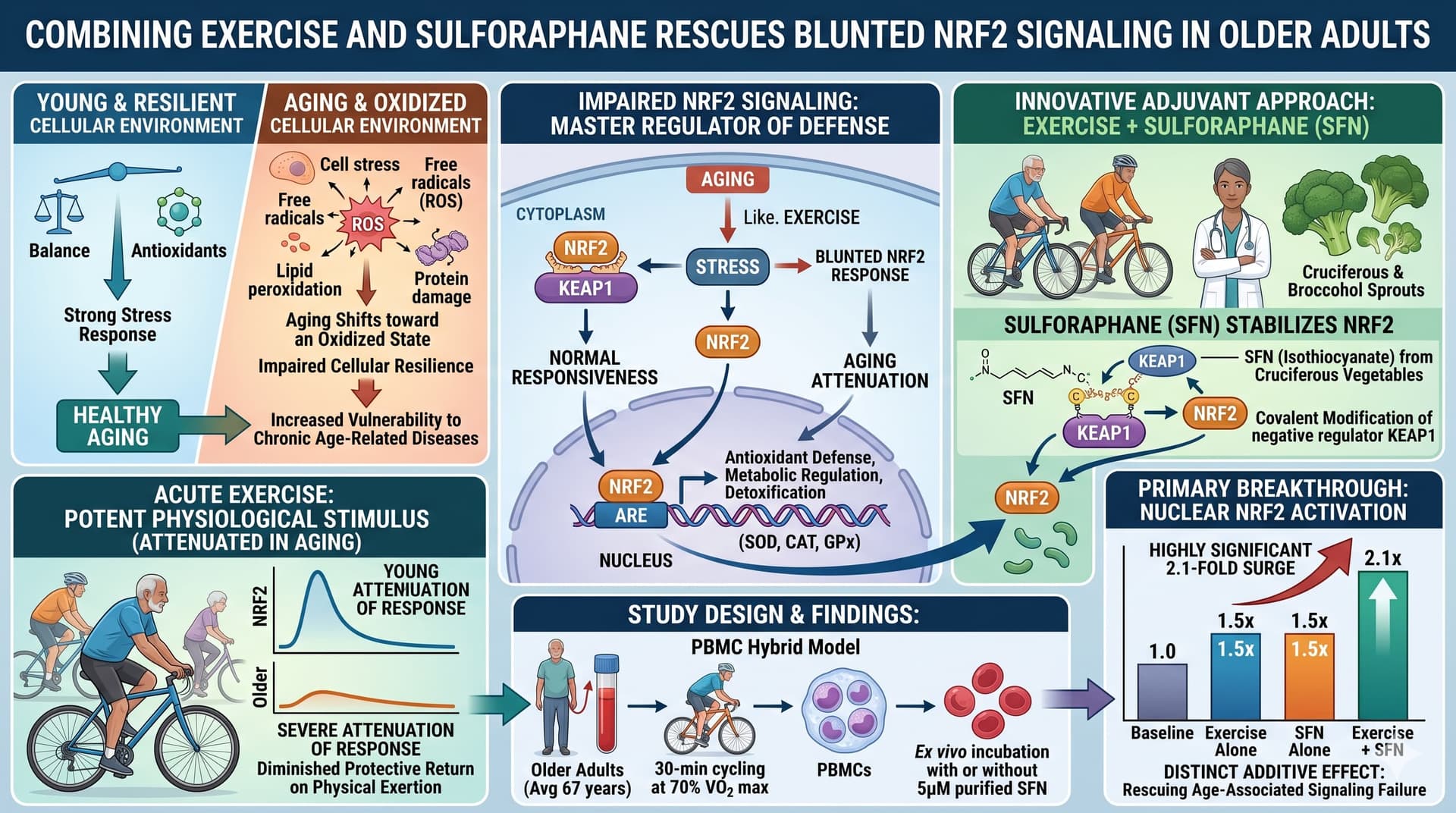
Aging fundamentally alters cellular resilience, progressively shifting the cellular environment toward an oxidized state and blunting key stress response pathways. Central to this decline is the impairment of nuclear factor erythroid 2-related factor 2 (NRF2) signaling, a master transcription factor orchestrating antioxidant defense, metabolic regulation, and detoxification. While acute physical exercise typically serves as a potent physiological stimulus to trigger adaptive NRF2 signaling, this response becomes severely attenuated in older organisms. Consequently, older populations experience a diminished protective return on physical exertion, compounding their vulnerability to chronic age-related diseases.
To address this deficit, researchers explored an innovative adjuvant approach combining acute exercise with sulforaphane (SFN), an isothiocyanate derived from cruciferous vegetables known to stabilize NRF2 by covalently modifying its negative regulator, KEAP1. The investigators recruited twenty-five older adults with a mean age of 67 years to execute a 30-minute cycling protocol at 70 percent of their maximal oxygen consumption (VO2 max). Using a sophisticated hybrid model, peripheral blood mononuclear cells (PBMCs) were isolated from blood drawn immediately before and after exercise, then incubated ex vivo with or without 5 micromolar of purified molecular-grade SFN.
The primary breakthrough emerged at the master regulator level: while exercise alone or sulforaphane alone produced modest 1.5-fold increases in nuclear NRF2 activation, the combined intervention triggered a highly significant 2.1-fold surge. This demonstrates a distinct additive effect, indicating that physical exertion and the phytochemical compound engage complementary cellular mechanisms to rescue age-associated signaling failure. Curiously, this synergy did not carry through to the downstream transcription of specific antioxidant defense genes (NQO1, HO-1, GR, and GCLC). In these readouts, the combined treatment mirrored sulforaphane alone, which robustly upregulated all targets. A subsequent dose-response experiment resolved this paradox, revealing a strict “ceiling effect” where the 5 micromolar SFN dose sat at the absolute peak of a hormetic curve for three of the four genes. Consequently, any further transcriptional induction from exercise was blocked by saturation.
Actionable Insights
-
Targeted Pathways for Anti-Aging: Stacking cruciferous-derived sulforaphane with moderate-intensity aerobic exercise can systematically amplify master NRF2 redox signaling in older individuals, successfully overriding the molecular blunting typical of aging tissues.
-
Strict Hormetic Dosing Protocol: Longevity biohackers must avoid mega-dosing sulforaphane due to a stark, biphasic hormetic curve. Because 5 micromolar represents a saturating ceiling concentration that causes a downward trend in downstream target genes at higher doses, a lower target range of 1 to 2 micromolar is optimal when combined with exercise to avoid toxicity and yield superior synergistic gene transcription.
-
Strategic Timing Optimization: Maximizing the therapeutic index requires aligning the peak plasma concentrations of oral SFN supplementation with the transient oxidative stress window produced during a workout session.
-
Universal Gender Application: Dosing and stacking regimens do not require sex-specific adjustments in older populations; when exogenous hormone use is absent, both older men and women exhibit identical molecular sensitivities and signaling outcomes.
Source:
- Paywalled Paper: Sulforaphane improves exercise‑induced NRF2 signaling in older adults: an in vivo‑ex vivo approach
- Institution: Department of Biological Sciences, Northern Arizona University, United States. Co-investigators collaborated from the University of Washington and Villanova University.
- Journal Name: GeroScience (Published October 2025).
- Impact Evaluation: The impact score of this journal is 5.6, evaluated against a typical high-end range of 0–60+ for top general science, therefore this is a High impact journal.
Related Reading:
- Sulforaphane: how to supplement? Forms, dose, brands, timing
- How to Increase Sulforaphane in your Diet, Cancer Prevention, etc
- Sulforaphane & The Skin Longevity Protocol
- The Newest Endurance Supplement Is a Broccoli Shot. Does It Work? (Outside)
- Sulforaphane inhibits mTOR in an NRF2-independent manner
- Sulforaphane Stimulates Cells to Dump Microplastics, in a Human