Can't Exercise? Sulforaphane from Broccoli Sprouts Reverses Frailty in Aging Mice

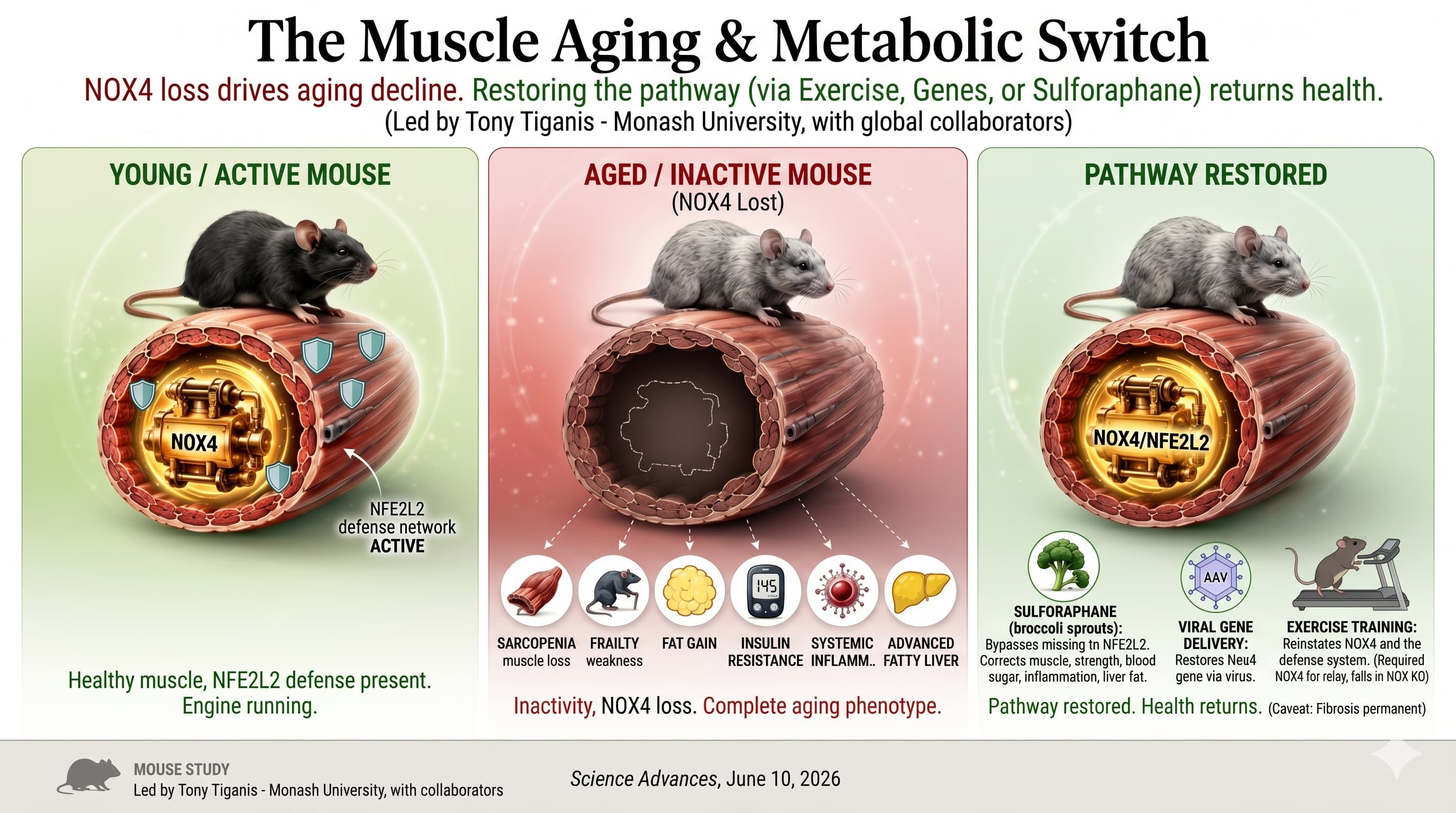
Aging skeletal muscle loses the ROS-generating enzyme NOX4, which cripples the NFE2L2 (Nrf2) antioxidant defense system that exercise normally switches on; deleting NOX4 in mice triggers full-blown sarcopenia, frailty, insulin resistance, and even liver disease — all reversible by restoring NOX4 or by giving the broccoli compound sulforaphane.

Everyone knows exercise keeps you younger. This paper claims to pin down one of the molecular reasons why — and to show what happens when that mechanism breaks.

The central character is NADPH oxidase 4 (NOX4), an enzyme tucked inside muscle fibers that, paradoxically, produces a “good” reactive oxygen species: hydrogen peroxide. When muscles contract during exercise, NOX4 generates a controlled burst of H2O2. That burst is a signal, not damage. It activates NFE2L2 (also called Nrf2), a master switch that turns on hundreds of protective genes — antioxidant enzymes, mitochondrial-building programs, and protein-clean-up machinery. This is “adaptive homeostasis”: a stressor that makes you more resilient.

The team, led by Tony Tiganis at Monash University in Australia, with collaborators across Europe and the US, first showed in both aged humans and aged mice that NOX4 protein quietly disappears from muscle with age. As it goes, so does the entire NFE2L2 defense network, and oxidative damage to proteins piles up.

To prove cause rather than coincidence, they genetically deleted NOX4 from mouse muscle. The result was striking: these mice didn’t just age — they aged badly. By 20 months they showed overt sarcopenia (muscle wasting), measurable frailty, fat gain, whole-body insulin resistance, systemic inflammation, and — unexpectedly — advanced fatty liver disease that doesn’t normally appear in chow-fed mice.

Then comes the hopeful half. The crippled phenotype was rescued three ways. First, exercise training in normal aging mice reinstated NOX4 and the whole defense system — but the same exercise did nothing in NOX4-deficient mice, proving NOX4 is the required relay. Second, re-inserting the Nox4 gene via a virus reversed the damage. Third, and most translationally interesting, sulforaphane — the compound enriched in broccoli sprouts that activates NFE2L2 directly, bypassing the missing NOX4 — corrected nearly everything: muscle mass, strength, blood sugar, inflammation, and liver fat. Notably, it could not reverse established liver fibrosis, a reminder that some damage hardens into permanence.

The Big Idea: the well-known decline of NFE2L2 antioxidant defense in aging may not be an immutable feature of getting old. It may be substantially downstream of physical inactivity, working through NOX4. That reframes a “hallmark of aging” as partly a behavioral consequence — and suggests a pharmacological shortcut for people who cannot exercise.

This is a mechanism paper in mice and cells, not a human trial. But it offers an unusually clean molecular story for why sitting still accelerates decline.

Actionable Insights

The single most defensible take-home is unchanged but newly mechanized: resistance and endurance exercise is the intervention here. In 12-month-old mice, five weeks of treadmill training (3×/week) restored muscle NOX4 mRNA and protein, plus Nfe2l2, Sod2, and Nqo1 expression, back to or above 6-month-old levels — effectively reversing the molecular signature of inactivity. Effect-size caveat: the paper reports fold-changes and significance, not standardized effect sizes, so the human-translatable magnitude is unquantified.

For those who genuinely cannot exercise, the sulforaphane thread is the actionable pharmacological lead. The dose used in mice (2 mg/kg IP injection) does not translate directly to oral human dosing. The authors lean on a real human anchor (ref 102): a concentrated broccoli-sprout extract taken once daily for 12 weeks lowered HbA1c in type-2 diabetics on metformin. That is the only human efficacy signal in this paper’s orbit, and it is metabolic, not muscular.

Bottom line: this paper strengthens the “movement is non-negotiable” message and offers sulforaphane as a plausible-but-unproven adjunct. This paper supports sulforaphane as a potential exercise-mimetic for people who can’t (or don’t) exercise (frail, sedentary, NOX4-depleted). It provides no evidence that sulforaphane helps an already-exercising person preserve muscle.

Source:

  • Open Access Paper: A decline in skeletal muscle NOX4 abrogates exercise-induced adaptive homeostasis and exacerbates biological aging
  • Institution: Monash University (Monash Biomedicine Discovery Institute), with collaborators at University of Valencia/CIBERFES (Spain), Sorbonne Université/Institut de Myologie (France), Rutgers (USA), Karolinska Institutet & Swedish School of Sport and Health Sciences (Sweden), Centenary Institute/UTS (Australia), University of Birmingham (UK).
  • Lead Country: Australia.
  • Journal: Science Advances (AAAS).
  • Impact Evaluation: The impact score of this journal is 13.9 (Clarivate JCR 2025 release; CiteScore ~19.6), therefore this is a High impact journal.

Related Reading:

Actionable Intelligence

The Translational Protocol

Human Equivalent Dose (HED) — BSA normalization, FDA guidance

Mouse dose used: 2 mg/kg, intraperitoneal, 3×/week. Two conversions matter, and both carry large caveats.

The route-of-administration correction that breaks the calculation. The mouse dose was intraperitoneal (≈100% systemic delivery, bypassing first-pass gut/liver metabolism). Oral human sulforaphane bioavailability is highly variable and route-degraded.

Honest verdict: the BSA math lands at a trivially small ~11 mg systemic / ~30 mg oral equivalent. This is well within what concentrated broccoli-sprout supplements deliver. But BSA allometric scaling is a starting-dose safety tool, not an efficacy-equivalence tool — it does not guarantee the target tissue (skeletal muscle NFE2L2) sees a pharmacodynamically active concentration. The paper’s own human anchor (Axelsson 2017) used a far larger dose to move HbA1c.

Approximate routine for a 70 kg person

Framed strictly as “what the human evidence used,” not as a recommendation:

  • Target: ~25–30 mg of delivered, bioavailable sulforaphane per day.
  • Frequency: once daily was sufficient in the glucose trials. However — given sulforaphane’s ~1.8 h plasma half-life, if the goal were to mimic the pulsatile NFE2L2 activation the muscle paper describes, split dosing (e.g., ~13 mg twice daily) is the more mechanistically rational schedule. The trials didn’t test this; it’s inference from PK.
  • Formulation is the critical variable: the dose must specify delivered sulforaphane, with active myrosinase co-present (or pre-converted stabilized SFN). Glucoraphanin-only products without myrosinase can yield a small and erratic fraction of the labeled amount — so a label reading “150 µmol glucoraphanin” is not equivalent to “150 µmol sulforaphane.” This is where most consumer products fail.
  • Timing: with food reduced GI side effects in the safety data; raw/uncooked context favors absorption (heat destroys myrosinase).

Three honest caveats before anyone acts on this

  1. This dose moves HbA1c, not muscle. The 26.6 mg figure is validated for hepatic glucose / glycemic endpoints in diabetics. There is zero human dosing data for the muscle/sarcopenia endpoint in this Science Advances paper — you’d be borrowing a metabolic-trial dose and assuming it transfers to skeletal muscle NFE2L2. That assumption is untested. [Confidence: High]
  2. The benefit was population-restricted. Even for glucose, the significant effect was in the obese, dysregulated T2D subgroup — those with BMI ≥30 on broccoli sprout extract showed a 1.4% HbA1c decrease vs placebo, with no benefit across the whole poorly-controlled group. A metabolically healthy 70 kg person may see little or nothing. Healio
  3. As discussed in the prior turn, layering this on top of effective exercise has no supporting data and a plausible hormesis concern.

Bottom line: the human-anchored dose is ~150 µmol ≈ 26.6 mg delivered sulforaphane/day (ideally split, with active myrosinase). That’s the number the literature supports — for glucose control in dysregulated diabetics, not yet for muscle aging in anyone.

Cautionary Notes:

  1. BSA scaling is a safety/starting-dose tool, not an efficacy-equivalence tool. It tells you a roughly comparable systemic exposure, not that human skeletal muscle NFE2L2 will respond the way mouse muscle did. The target tissue is the unvalidated link.
  2. The mouse model was a total NOX4 knockout rescue. Sulforaphane was compensating for complete loss of the upstream enzyme. A normally-aging human still has partial NOX4. Whether that means a human needs less (partial axis intact) or more (sulforaphane was carrying the whole load in the mouse) is genuinely unknown — the dose-response relationship doesn’t transfer cleanly.
  3. The cell-vs-plasma concentration gap persists. The mechanism studies use 5–20 µM; humans reach ~0.1–2 µM plasma. A BSA-matched dose doesn’t resolve whether muscle tissue ever sees a pharmacodynamically active concentration.
  4. No human muscle endpoint exists. Every number here is extrapolation; the paper provides no human muscle dosing data at all.

I normally wouldn’t cover a paper focused on nematode worms, but this seemed to dovetail well with the earlier article above, so thought I’d point people to it.

Two Kitchen-Cabinet Compounds Keep Aging Worms Moving — But Together They Don’t Add Up

Curcumin and sulforaphane each preserved late-life mobility in aging nematodes by switching on different molecular maintenance programs; combining them broadened the genetic response but produced no extra movement benefit, hinting at a performance ceiling rather than true synergy.

Turmeric’s curcumin and broccoli’s sulforaphane are perennial favourites in the longevity-supplement world, usually sold on the strength of antioxidant marketing rather than functional data. A new preprint from the Buck Institute, Thorne HealthTech and Magnitude Biosciences puts both to a stricter test: not whether they extend life, but whether they keep an organism moving as it ages — the kind of functional outcome that, in humans, predicts mortality better than chronological age.

Using an automated camera platform that tracks thousands of worms continuously for a week, the team screened nine natural products and then zeroed in on curcumin, sulforaphane, and their combination. All three improved mobility after the day-2 peak, when worms normally begin their decline. The interesting twist is that the two compounds did not do the same job. Sulforaphane drove the biggest gains in speed and total distance travelled. Curcumin did less for speed but kept worms active for more total hours.

When the researchers sequenced the worms’ RNA, the division of labour became clearer. Sulforaphane flipped on a battery of glutathione and detoxification genes — the classic signature of the conserved SKN-1/Nrf2 stress-defence pathway. Curcumin instead reshaped lipid and sphingolipid metabolism and quietly dialled down a set of innate-immune genes, consistent with reduced background inflammation. The combination kept features of both and added a layer of its own, producing roughly twice as many differentially expressed genes as either compound alone.

Here is the headline finding for anyone hoping that “stacking” supplements multiplies benefit: at the level of actual movement, the combination performed about the same as sulforaphane by itself. The molecular response broadened, but the functional payoff did not. The authors interpret this as the two compounds engaging overlapping-but-distinct maintenance programs that converge on a shared ceiling.

The work is mechanistically rich and methodologically modern, but it is an unreviewed preprint in worms, funded and co-authored by a supplement company that sells these exact ingredients. It measures healthspan proxies, not lifespan, over seven days, with only two biological replicates for the behavioural arm. Treat it as a well-constructed hypothesis generator about combination design, not as evidence that any human should change their cabinet.

Source:

1 Like