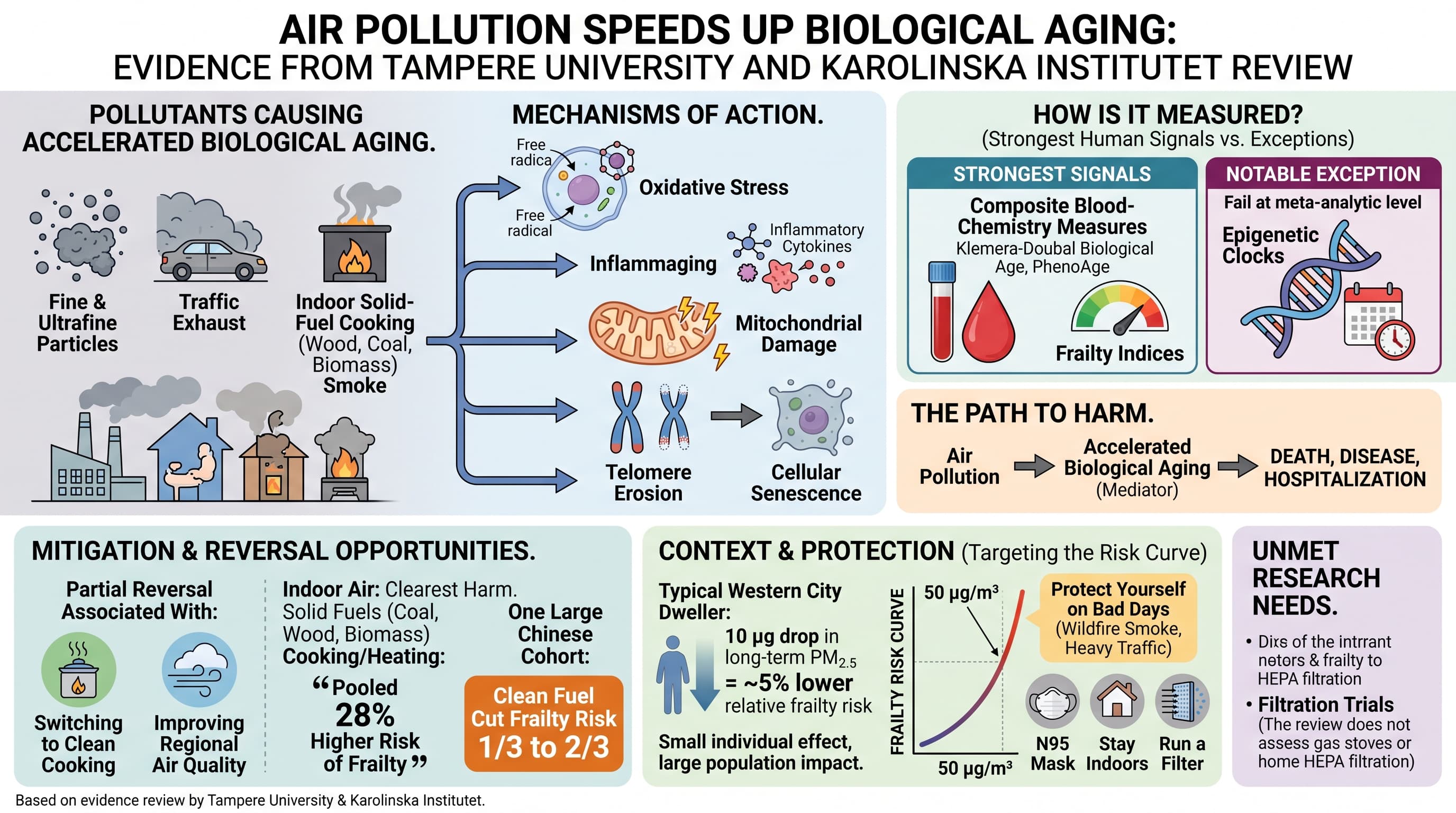
This review from Tampere University and Karolinska Institutet brings together evidence that air pollution speeds up biological aging itself, not just damage to one organ at a time. Fine and ultrafine particles, traffic exhaust and smoke from indoor solid-fuel cooking are linked to oxidative stress, inflammaging, mitochondrial damage, telomere erosion and cellular senescence. The strongest human signals appear in composite blood-chemistry measures (Klemera-Doubal biological age, PhenoAge) and frailty indices. Epigenetic clocks are the notable exception: they fail at the meta-analytic level. The authors argue that biological aging partly mediates the link between pollution and death, disease and hospitalization. Switching to clean cooking fuels and improving regional air quality are associated with partial reversal. Get N95 masks if you live in an area where forest fires are common.
Most people think of air pollution as a lung problem, or at most a heart problem. A new review from researchers in Finland and Sweden argues that this view is too narrow. They propose that fine particles, traffic exhaust and smoke from indoor cooking fires act on the machinery of aging itself. On this account, pollution pushes the whole body toward an older physiological state instead of damaging one organ at a time.
Parinaz Poursafa and Juulia Jylhävä collected epidemiological and laboratory work across every major way scientists now measure biological age. That range runs from DNA methylation clocks and telomere length to blood-chemistry composites and frailty scores. Anyone who follows geroscience will recognize the proposed mechanism. Particles loaded with transition metals and polycyclic aromatic hydrocarbons generate reactive oxygen species. That oxidative load damages mitochondrial DNA, activates the NLRP3 inflammasome, shifts methylation patterns, erodes telomeres and pushes cells into senescence. Senescent cells then release inflammatory signals that push neighboring cells into the same state, so the damage can outlast the exposure.
The more useful finding concerns which measures actually detect this effect. The ones that respond most reliably to pollution are the least glamorous: Klemera-Doubal biological age, blood-based PhenoAge and frailty indices. All of them are built from routine markers such as CRP, albumin, glucose and white cell count. The fashionable epigenetic clocks hold up worse on close inspection. A 2026 meta-analysis of 18 studies and more than 363,000 people found no significant pooled association between long-term pollution and acceleration of the Horvath clock or GrimAge. This held even though most individual studies reported positive results. That pattern usually points to heterogeneity, small-study effects or publication bias rather than a hidden true effect.
Magnitude matters. In the UK Biobank, where the air is relatively clean, an interquartile rise in fine particles was tied to about three weeks of extra biological age. Among older Chinese adults, each additional 10 micrograms of PM2.5 per cubic meter raised frailty risk by about 5 percent. Some headline figures are much larger, such as three extra years of biological age per interquartile rise in ultrafine particles. That figure comes from a single cross-sectional study of COPD patients and should not be generalized.
The review’s boldest claim is that biological aging sits on the causal path from dirty air to disease. In the authors’ own analysis of two cohorts, aging measures statistically accounted for roughly a tenth to a half of the link between pollution and death. Mediation analysis of observational data is fragile, however. Income, smoking and chronic illness all track with both pollution exposure and faster aging.
There is some encouraging news. Chinese households that switched from coal or wood to clean cooking fuel showed slower biological aging and much lower frailty risk. Regions where air quality improved saw slower frailty progression. None of these comparisons were randomized.
The central idea is plausible and important: pollution looks less like a list of separate diseases and more like a general accelerant of aging. The evidence that it moves molecular clocks, the tests biohackers actually buy, is still unconvincing.
Actionable Insights
Indoor air is the part you control, and it shows the clearest harm. Cooking or heating with solid fuels (coal, wood, biomass) carried a pooled 28 percent higher risk of frailty. In one large Chinese cohort, switching to clean fuel cut frailty risk by a third to two thirds. This review does not assess gas stoves or home HEPA filtration. The authors list filtration trials as an unmet research need.
For a typical Western city dweller, the numbers are modest. Each 10 microgram drop in long-term PM2.5 was associated with about 5 percent lower relative frailty risk. If your baseline risk were 15 percent, that change would take it to about 14.3 percent. For one person this is small, but across a population it is large.
The risk curve steepened above about 50 micrograms per cubic meter. Protecting yourself on bad days, such as wildfire smoke or heavy traffic, targets the steepest part of that curve. An N95 mask, staying indoors and running a filter all apply here.
Regular physical activity weakened the frailty risk from solid-fuel exposure and increased the benefit of switching fuels.
Do not use consumer epigenetic clock tests to track pollution effects. At the population level, the noise exceeds the signal.
Wildfire smoke is biomass combustion, so it is chemically close to the household wood and coal smoke the authors discuss than to traffic exhaust. It is rich in organic carbon, black carbon and PAHs, all of which have high oxidative potential.
Context and Source
- Open Access Paper: Aging in the air we breathe: Mechanisms and consequences of air pollution exposure for biological aging, Published 19 August 2026.
- Institutions: Tampere University (Faculty of Medicine and Health Technology); Karolinska Institutet; University of Oulu
- Countries: Finland and Sweden
- Journal: Ageing Research Reviews
- Impact evaluation: The impact score of this journal is 15.5, evaluated against a typical high-end range of 0 to 60+ for top general science, therefore this is a High impact journal.