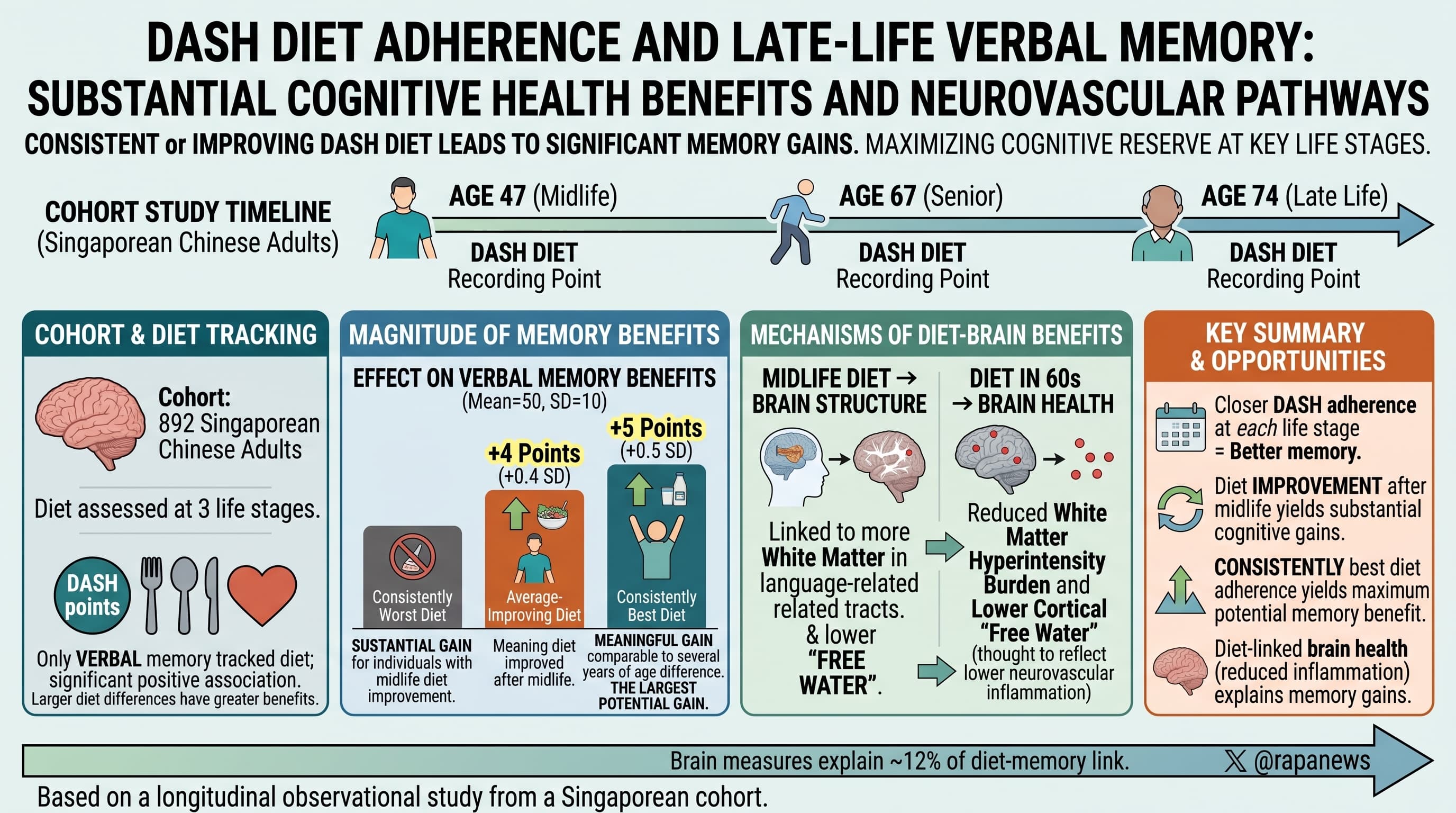
A Singaporean cohort of 892 Chinese adults, whose diets were recorded at around ages 47, 67 and 74, found that closer adherence to the DASH diet at each life stage was linked to better verbal memory in their 70s. Of the seven cognitive domains tested, verbal memory was the only one that tracked diet. Midlife diet was linked to more white matter volume in language-related tracts. Diet in the 60s was linked to less white matter hyperintensity burden and lower cortical “free water,” an MRI marker thought to reflect neurovascular inflammation. Each brain measure statistically explained about 12% of the diet and memory link. People who improved a poor or average diet after midlife had better memory than those whose diets stayed poor. The effects are modest, the design is observational, and the paper is a preprint that has not been peer reviewed.
Most of what we know about diet and the ageing brain comes from studies that ask people what they ate once and then check on them a few years later. That design cannot tell you whether the diet you ate at 45 still matters at 75, or whether it is too late to change course at 65. A team at the National University of Singapore had an unusual resource for answering those questions. They drew on the Singapore Chinese Health Study, which enrolled more than 63,000 adults in the 1990s, and followed a subset of 892 people for up to 28 years.
Diet was scored against the DASH pattern, originally designed to lower blood pressure. It rewards fruit, vegetables, whole grains, nuts, legumes and dairy and penalises red and processed meat and sugary drinks. Scores were recorded in midlife (ages 44 to 55), early old age (61 to 73) and late life (68 to 82). In late life, participants completed nine cognitive tests covering seven domains and had detailed brain scans.
The headline result is narrow but consistent. Better DASH adherence at every stage went with better verbal memory, which here means the ability to learn and recall a spoken word list. Midlife diet still predicted memory when all three diet measurements were entered into the same model, which suggests that eating habits from two decades earlier carry information that later diet does not fully capture. Processing speed, attention, executive function, visuospatial skill, visual memory and language showed no significant links.
The brain scans suggest two different routes, depending on timing. Midlife diet was linked to larger white matter volume in the long association tracts, such as the arcuate and superior longitudinal fasciculi, that carry language signals across the brain. Diet in the 60s was linked to two other signs of healthier brain tissue: fewer white matter lesions around the basal ganglia, a classic marker of small vessel disease, and lower free water in frontal and occipital cortex. The authors read this as a story in which a good diet builds structural reserve in midlife and dampens vascular and inflammatory damage later.
The most practical finding concerns people who changed their diet. Participants who began with low or average diet quality in midlife but improved it afterwards had better late-life verbal memory than those who stayed low. The “average-improving” group was statistically indistinguishable from the consistently high group on memory and cortical free water, though not on white matter volume.
The caveats are large. This is an association study, so wealthier or more health-conscious people may simply eat better and also have better memory. Only about 2% of the original cohort returned for the brain scans, and survivors are healthier than those who dropped out. The diet questionnaire shrank from 165 items at baseline to 21 items later, which complicates comparisons across time. The brain and memory measures were taken on the same day, so the “mediation” cannot establish which came first. The effects are small, roughly a tenth of a standard deviation in memory score for each standard deviation of diet quality.
Still, the direction is consistent with trial data showing that DASH lowers blood pressure and with large cohort data on midlife diet and cognition. The message is modest but useful: diet quality seems to matter across adulthood, and improving it after midlife is associated with better outcomes.
Actionable Insights
The practical message: move your eating toward a DASH-style pattern at any age. That means more vegetables, fruit, whole grains, legumes, nuts and dairy, and less red and processed meat and sugary drinks. Improving from an average diet after midlife was linked to memory scores close to those of lifelong healthy eaters.
How big is the benefit? Memory scores were scaled so the average is 50 and a typical spread (one standard deviation) is 10 points. Each additional DASH point in midlife was linked to about 0.22 extra memory points. Moving one typical step up in diet quality (about 4.6 DASH points) works out to roughly 1 memory point, or about 0.1 standard deviations. That is small for an individual. Going from the consistently worst diet group to the consistently best was linked to roughly 5 points, or about half a standard deviation (estimated from the paper’s figures). That is a meaningful difference, similar to the memory gap between people several years apart in age. The “average-improving” group scored about 4 points above the consistently poor group (about 0.4 standard deviations).
Treat these as upper-bound estimates from observational data. Blood pressure control is the most plausible pathway, so pair the diet with blood pressure monitoring. The study could not score sodium, so it cannot tell you anything about salt reduction.
Context and Source
- Open Access Paper: Diet Quality from Midlife to Later Life Relates to Late-Life Brain Health and Verbal Memory in the SG70 Cohort
- Institutions: Yong Loo Lin School of Medicine, National University of Singapore (Centre for Sleep and Cognition; Healthy Longevity Translational Research Programme); Institute for Human Development and Potential, A*STAR; Ng Teng Fong General Hospital
- Country: Singapore
- Journal: bioRxiv (preprint server), Not Peer Reviewed
Related Reading:
- The Four-Week Reset: Dietary Shifting Flips the Switch on Biological Age Markers
- Centenarian Diets Deconstructed: Molecular Pathways and Microbial Shifts Driving Exceptional Human Longevity
- The Pilot Light of Aging: How Your "Healthy" Diet May Be Fueling Silent Inflammation
- Dietary Advanced Glycation End Products as Active Drivers of Biological Aging
- Best Diet Confirmed by 5,248,916 Person-Year Study - Youtube Stanfield
- Diet and Healthspan - Uncertain but High Value