chatGPT:
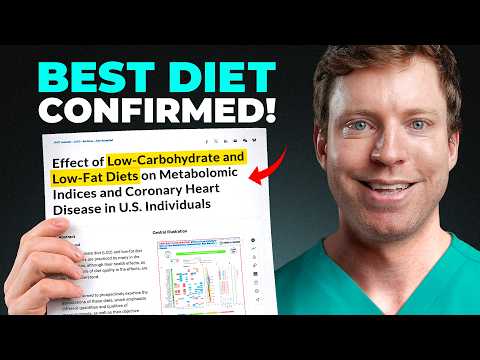
Below is a cleaned-up version of the transcript you provided, followed by a summary and critique. The underlying study discussed in the video appears to be the February 2026 JACC paper by Wu et al. on low-carbohydrate and low-fat diet quality and coronary heart disease risk. It used nearly 200,000 participants from the Nurses’ Health Studies and Health Professionals Follow-Up Study, with 5,248,916 person-years of follow-up and 20,033 CHD cases. The key finding was that healthy versions of both low-carb and low-fat diets were associated with lower CHD risk, while unhealthy versions were associated with higher risk. (Harvard Chan School of Public Health)
Tidy transcript
Chapter 1: Which Diet Is Best?
A new study that tracked over 5 million person-years of follow-up has confirmed the best diet for your health. And this is such a relief after all of the flip-flops.
So we had the fat-free craze in the ’90s. Then we had the low-carb Atkins explosion in the early 2000s. Now there are keto influencers and high-protein cheese puffs on grocery shelves. There have been decades of nutrition advice, and billions in revenue racked up by a food industry only too eager to cash in on these trends.
And people are still confused. So which diet is best when it comes to heart health? Should we aim for low fat, or should we target low carbs? And has this whole debate just been a distraction?
The conversation around diet and heart health began decades ago, in the 1950s. A dramatic shift was happening, and suddenly everyone was talking about heart disease. In England, two Oxford researchers were carefully examining official records and documented a shocking increase in deaths from heart attacks and strokes. They were killing adults in 1945 at a rate 15 times greater than in 1921. The same pattern was playing out in the US. Deaths from heart disease were quite rare in 1900, and then they became the leading cause of death by the mid-century. So there was an urgent need to understand what exactly was going on.
One theory that emerged identified diet as a key culprit. Specifically, it suspected that eating more saturated fat produced higher LDL cholesterol levels in the blood, and that higher LDL cholesterol was an essential ingredient for plaque accumulation within blood vessel walls.
Chapter 2: The Seven Countries Study
A researcher by the name of Ancel Keys put this theory on the map through a groundbreaking research project. He set out to find groups of people living in different places who had very different dietary patterns. In particular, he was interested in how much fat they ate.
He ended up assembling a massive data set of 16 cohorts of healthy men from selected populations across seven countries, including several in Europe plus the US and Japan. It was called the Seven Countries Study, and the first findings dropped in 1970. In that study, heart disease was linked to blood cholesterol levels, and those in turn were linked to saturated fat in the diet.
Numerous studies continued to examine the data over the years as the cohorts aged, and the relationship held. A 25-year follow-up saw the same strong link between saturated fat intake and heart disease. So Ancel Keys’ research pointed to saturated fat, not just any fat, as the problematic element in the diet. But the nuance was easily lost, and guidelines often recommended slashing total fat intake — fat of any kind.
A statement from the American Heart Association in 1986 pushed a reduction of saturated fat and total fat, and recommended replacing those fat calories with complex carbs. And when the flawed food pyramid was released in 1992, it proclaimed the same message. It guided consumers to minimize all fats. It also graphically represented refined carbs as the foundation for a healthy diet, which is wild.
This picture dominated for decades: that the best way to beat heart disease was to eat low fat. But in the background, other researchers were quietly exploring an alternative story.
Chapter 3: Alternative Theory: Sugar as the Culprit
At the same time that Ancel Keys was launching the Seven Countries Study, a British researcher named John Yudkin was poring over statistics related to heart disease deaths. Just like Keys, he spotted an interesting link between heart disease rates and dietary patterns. But what jumped out from the data he was looking at was not fat, or even saturated fat. It was sugar.
Yudkin’s focus on carbs instead of fat as the driver of heart disease did not gain much traction at the time. But in the late 1980s, a landmark lecture began to change the conversation. It was delivered by Gerald Reaven, who was receiving the prestigious Banting Award for diabetes research. In that lecture, he argued that insulin resistance was intimately linked to heart disease and related problems like high blood pressure. And the driver of insulin resistance, at least in animal studies, was a high-sugar diet.
By the year 2000, more important observational evidence was starting to come in from human studies. A cohort of about 75,000 women had been followed for 10 years, and the researchers looked at the relationship between heart disease and glycemic load. Glycemic load is a measure of how much food impacts blood sugar levels. A high glycemic load raises blood sugar more sharply. At the top of the list of foods with a high glycemic index are things like white rice, white potatoes, white bread, and sugary drinks.
The results were stark. Diets with the highest glycemic loads were associated with double the risk of heart disease, even after taking into account other common risk factors. And as this research was happening in the background, a cardiologist by the name of Dr. Robert Atkins popularized a new narrative.
Chapter 4: The Atkins Diet and the Low-Carb Narrative
His book, The Diet Revolution, sold millions of copies. It painted carbs as the enemy when it came to heart disease and weight loss, and it advocated minimizing them in the diet. But fat consumption, according to Atkins, was no problem.
So we ended up with two competing pictures. One says low fat is the key to heart health. The other says it is low carb. And this debate actually suited the food industry nicely. They have been all too happy to play along with trends that focus on specific macronutrients. When low fat was the focus, they lined the shelves with low-fat products. We can see the same today with low carb. And more recently, it is now the high-protein craze.
But this whole approach is missing something profoundly important, as we will see in a moment.
It seems like it should be easy to figure out which of these positions is correct. But as the actual data has come in, the picture has been messy. The results have been mixed.
For example, one massive randomized clinical trial that included nearly 50,000 participants with follow-up data of 8 years looked at the impact of reducing total fat intake. And that is important: it looked at total fat intake, not just saturated fat. The impact of reducing total fat intake turned out to be extremely modest. Heart disease risk did not budge, even though there were some improvements in risk factors.
On the other hand, a different trial put low-fat and low-carb diets head to head. Those on the low-carb diet lost more weight over a 6-month follow-up period, but there did not appear to be any advantage in terms of heart disease risk metrics.
All of these mixed results prevented any clear winner from emerging, and the debate continued, while the food industry cashed in on the confusion.
And all of this probably should not be a surprise, because there is a serious problem that has often muddied the waters when it comes to studies investigating the links between these diets and heart health.
Chapter 5: The Problem with “Low-Fat” and “Low-Carb” Labels
The problem is this: low fat and low carb are just broad descriptions that can be applied to many different kinds of eating patterns.
A low-fat diet, for instance, could mean a person is anchoring their meals in things like chickpeas and vegetables. A low-carb meal, on the other hand, could be salmon, avocado, and spinach — or it could be eggs fried in butter with a big side of bacon.
Of course, we would expect profoundly different health outcomes with these different kinds of diets. It is not just the mix of macronutrients that matters. The quality of those macronutrients matters too. And past studies on diet and heart health have often not paid careful attention to that distinction, even though it is obviously critical.
Chapter 6: The New Study: Quality Over Quantity
That brings us to the new study we are looking at in this video, because it was specifically crafted to fill this gap in the literature.
The authors examined data from around 200,000 people from three separate cohorts. These cohorts were tracked for a really long time — around 30 years each — so it is a huge data set. Critically, they used food questionnaires to distinguish diets not only in terms of macronutrient quantity but also macronutrient quality. They divided the diets into healthy and unhealthy versions of both low-fat and low-carb diets.
In the analysis, “healthy” meant, for example, plant-based foods versus animal products, or whole grains versus refined grains.
So overall, which dietary pattern won? Was it low fat or low carb? Leaving diet quality aside for a second, the lowest-carb diets had a 5% elevated risk of heart disease compared to those with the highest carb intakes. Those with the lowest-fat diets had a 7% risk reduction compared with the highest-fat intakes. So low fat seems to be the number one winner here, but the effects are relatively modest.
All of that changes when we look at diet quality. The picture changes radically.
Those who stuck to the healthy versions of the low-carb diet had a 15% lower risk of heart disease compared to those furthest away from that eating pattern. A high-quality low-fat diet showed nearly the same benefit, cutting risk by about 13%. The unhealthy versions of both diets raised risks to a similar degree. What is more, the healthy versions of both diets were linked to lower triglycerides, less inflammation, and other markers of better metabolic health.
Chapter 7: Conclusions and Key Takeaways
Before looking at how all this applies to us, let me mention some quick caveats. First, this is an observational study, so it cannot tell us with much confidence about causation. It also did not look at more extreme diets like a keto diet with exceptionally low carb intake. And finally, it does not mean it never makes sense to think about the macronutrient intakes of our diet. It just suggests that, for most people, that is unlikely to be the most helpful thing to concentrate on.
So what is the big lesson? We need to stop focusing on low fat or low carb. Macronutrient quantity does not appear to be the key factor when it comes to heart health. Instead, we have to focus on food quality.
We need to prioritize plant-based proteins like chickpeas, lentils, and beans over animal sources. We want to prioritize whole foods over processed foods, and unsaturated fats over saturated or trans fats. Both low-carb and low-fat dietary patterns can work if we get the quality right.
Returning to fat for a moment, there is one aspect of this study likely to be controversial in the comment section of this video: the fact that the authors placed animal-based food sources in the unhealthy category. This reflects a common understanding that animal products are more problematic for heart health because of their saturated fat content as well as their lack of fiber. But you will find plenty of people online who claim that this is just a myth.
So what is the true story when it comes to saturated fat and heart disease?
Note: the transcript you pasted ends here, mid-transition into the next section.
Summary
The video argues that the long-running “low-fat versus low-carb” debate misses the main point. It walks through the historical nutrition debate: Ancel Keys and the case against saturated fat, John Yudkin and later Gerald Reaven’s emphasis on sugar and insulin resistance, and then the cultural rise of the Atkins-style low-carb movement.
Its central claim is that the real determinant of heart-health benefit is diet quality, not merely whether a diet is low in fat or low in carbohydrate. Using the new JACC study as its anchor, the video says:
- merely eating lower fat was associated with a modest reduction in CHD risk;
- merely eating lower carb was associated with a modest increase in CHD risk overall;
- but healthy versions of either pattern were associated with lower CHD risk;
- unhealthy versions of either pattern were associated with higher CHD risk. (PubMed)
That is broadly faithful to the paper. In the published results, the highest versus lowest healthy low-carb score was associated with a hazard ratio of 0.85 for CHD, and the healthy low-fat score with 0.87. Unhealthy low-carb and low-fat patterns were associated with hazard ratios of 1.14 and 1.12, respectively. Overall low-carb was 1.05, while overall low-fat was 0.93. (PubMed)
Critique
This is a good, clear video overall. It gets the study’s main message right: food quality matters more than simplistic macro tribalism. It also correctly flags that the study is observational and therefore not proof of causation. That is an important caveat, and the narrator deserves credit for including it rather than overselling certainty. (PubMed)
That said, there are several places where the framing is stronger than the evidence.
First, the opening line says the study has “confirmed the best diet for your health.” That is too strong. The study did not identify one universally best diet. It showed that healthier versions of both low-carb and low-fat patterns were associated with lower coronary risk, and that unhealthy versions of both were associated with higher risk. In fact, the paper’s own conclusion is about the “critical role of diet quality,” not a single winning diet. (Harvard Chan School of Public Health)
Second, the video slightly compresses a more nuanced set of categories into a simpler healthy/unhealthy binary. The published analysis distinguished not only healthy and unhealthy patterns, but also overall, animal-based, and vegetable-based low-carb and low-fat scores. That matters, because “low carb” in the paper is not one thing; it depends heavily on whether carbs are displaced by plant foods or by animal-derived fat and protein. (PubMed)
Third, the handling of animal foods is directionally aligned with the paper, but a bit blunt. The Harvard press release summarizes the healthier pattern as being rich in high-quality plant-based foods and low in animal products, and the unhealthy pattern as richer in refined carbohydrates plus animal fats and proteins. But that does not mean every animal food is equally harmful, nor that the study can cleanly isolate red meat, fish, fermented dairy, eggs, or minimally processed poultry from one another. The paper is about dietary patterns, not a final verdict on each individual animal food. (Harvard Chan School of Public Health)
Fourth, the video’s historical section is helpful but somewhat simplified. It implies a fairly clean “fat camp versus sugar camp” story. Real nutrition science is messier. LDL cholesterol, apoB-containing lipoproteins, insulin resistance, body weight, food processing, fiber intake, and replacement nutrient all matter. The current study does not really adjudicate the old Keys-versus-Yudkin battle; it mostly says that low-quality refined carbs and low-quality animal-heavy dietary patterns both perform worse than higher-quality dietary patterns. (PubMed)
Fifth, there are ordinary limitations of large cohort nutrition studies that deserve emphasis:
- food-frequency questionnaires are useful but imperfect;
- residual confounding is always possible;
- healthier eaters often differ in many other ways from less healthy eaters;
- the cohorts are largely U.S. health professionals, so generalizability has limits. (PubMed)
Sixth, the video is fair to note that the paper does not address very extreme ketogenic diets. That matters because internet debate often centers on exactly those diets, whereas this study examined broader low-carb scoring patterns in free-living cohorts, not tightly controlled keto interventions. (PubMed)
Bottom line
The video’s main takeaway is sound: for heart health, “low fat” and “low carb” are not very informative labels on their own; what matters much more is whether the diet is built from high-quality foods. That is consistent with the new paper. (Harvard Chan School of Public Health)
The weakest part is the headline-style framing that the study has finally “confirmed the best diet.” It really has not. A more accurate conclusion would be:
Healthy low-fat and healthy low-carb patterns both look beneficial for CHD risk, while unhealthy versions of both look harmful. Food quality appears more important than macro quantity.
If you want, I can also turn this into the same format you often use: summary / novelty / critique / practical implications.