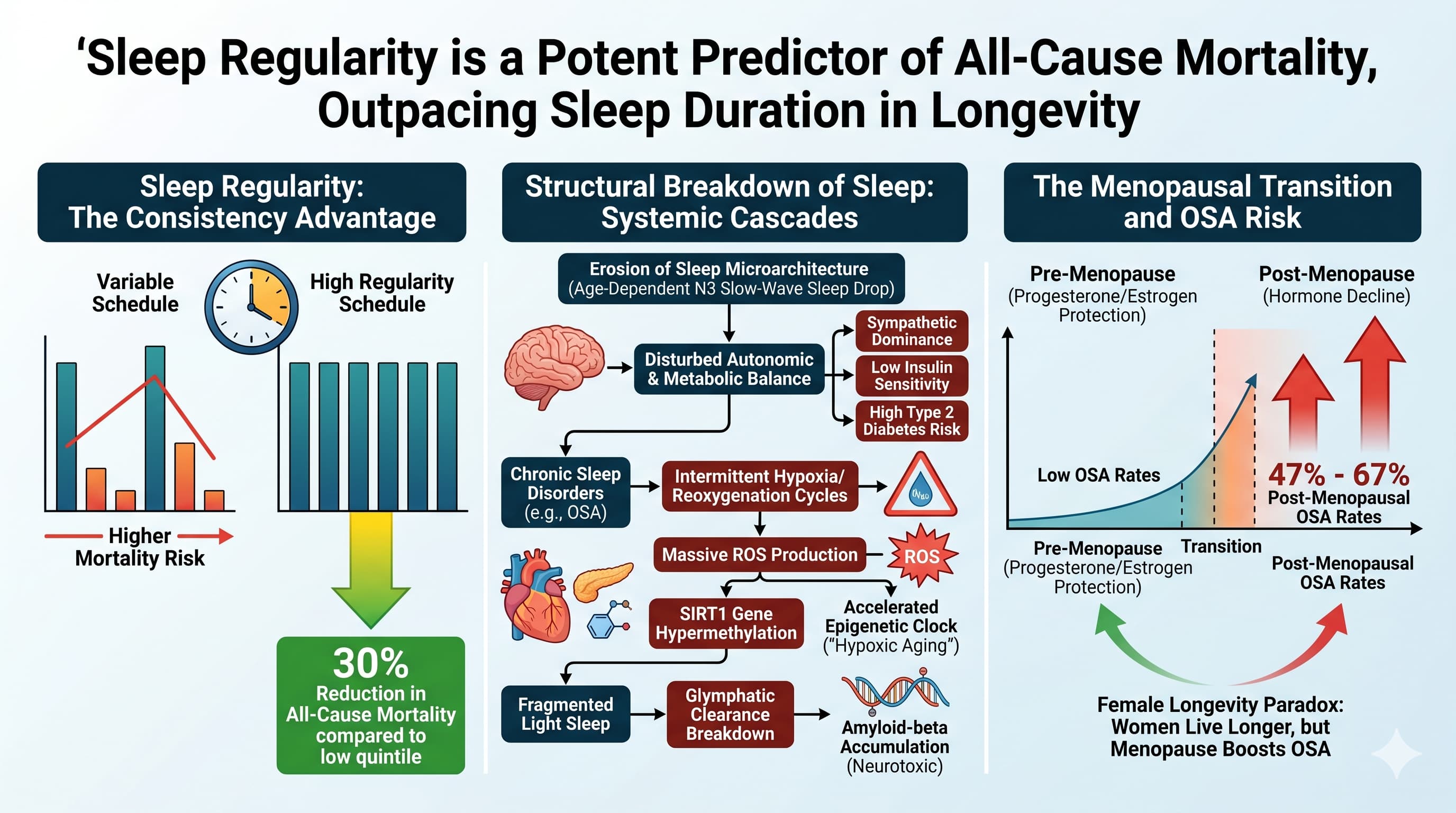
Why Sleep Regularity Beats Sleep Duration as the Ultimate Predictor of Longevity

Gerontological research has traditionally treated sleep deterioration as a passive consequence of growing old. However, emerging macro-epidemiological and mechanistic data flip this script, revealing that age-related sleep fragmentation and circadian dampening act as primary, aggressive accelerants of biological aging. As the human brain ages, the master circadian pacemaker—the suprachiasmatic nucleus (SCN)—undergoes structural and functional decay. This neurological decline dampens the amplitude of core body temperature rhythms and blunts nighttime melatonin peaks, forcing a progressive phase-advance that drives older adults toward early evening sleepiness and fragmented, low-efficiency nocturnal sleep.

The truly paradigm-shifting insight from recent large-scale cohort analyses is that sleep regularity—maintaining a highly consistent day-to-day sleep-wake schedule—is a significantly more potent predictor of all-cause mortality than total sleep duration. Individuals tracking in the highest quintile of sleep regularity exhibit a clean 30% reduction in all-cause mortality compared to those with highly variable routines. Conversely, structural erosion of sleep microarchitecture delivers severe systemic blows. The sharp, age-dependent drop in slow-wave sleep (N3) directly disrupts autonomic and metabolic balance, inducing a shift toward sympathetic dominance, reducing insulin sensitivity, and elevating the risk of type 2 diabetes.

Simultaneously, chronic sleep disorders introduce devastating pathophysiological cascades. Obstructive sleep apnea (OSA) triggers repetitive cycles of intermittent hypoxia and reoxygenation, generating massive waves of reactive oxygen species that hypermethylate the SIRT1 gene, effectively accelerating the epigenetic clock. This “hypoxic aging” is compounded by a profound breakdown in glymphatic clearance during fragmented light sleep, allowing neurotoxic aggregates like amyloid-beta to accumulate. Crucially, the data exposes a stark female longevity paradox: while women live longer, the menopausal transition strips away the upper-airway protective benefits of progesterone and estrogen, causing post-menopausal OSA rates to skyrocket to between 47% and 67%. Ultimately, sleep can no longer be viewed as a luxury; it is a highly malleable, structural column of healthspan execution.

Actionable Insights

  • Enforce Strict Sleep-Wake Timing: Prioritize the Sleep Regularity Index by going to bed and waking up at identical times every single day. This behavioral anchor stabilizes circadian phase alignment and lowers all-cause mortality risk by 30%, completely independent of total sleep duration.
  • Aggressively Cool the Sleep Environment: Keep bedroom ambient temperatures strictly at or below 22 degrees Celsius (71.6 degrees Fahrenheit). Total sleep time remains stable up to this threshold but drops precipitously above it, causing an absolute loss of 60 minutes of sleep as ambient temperatures climb to 30 degrees Celsius.
  • Widen the Evening Fasting Window: Complete your final meal at least 6 hours before your calculated sleep midpoint. Every hour delayed significantly inflates the odds of short sleep by 30%, sleep latency by 14%, and chronic insomnia by 11%.
  • Eliminate Artificial Light and Noise at Night: Achieve absolute black-out conditions and mitigate ambient sound pollution. Nighttime light exposure directly suppresses melatonin amplitude, while even minor localized ambient noise increases the odds of severe sleep disturbance up to nearly three-fold.
  • Screen for Obstructive Sleep Apnea and Deploy CBT-I: Bypass high-risk sedatives and Z-drugs, which relax airway muscles and compound fall risks. Treat chronic insomnia via Cognitive Behavioral Therapy for Insomnia (CBT-I) to safely boost slow-wave power, and aggressively manage any underlying hypoxic burden with Continuous Positive Airway Pressure (CPAP) therapy.

Source:

  • Paywalled Paper: Sleep health in the older adults: Architecture, circadian changes, and
    common sleep disorders
  • Affiliated Institutions: University Sleep Disorders Center, Department of Medicine, College of Medicine, King Saud University, Riyadh, Saudi Arabia; Government Hospitals, Manama, Bahrain; Department of Psychiatry, College of Medicine and Health Sciences, Arabian Gulf University, Manama, Bahrain; etc.
  • Journal Name: Ageing Research Reviews.
  • Impact Evaluation: The impact score of this journal is 13.1, evaluated against a typical high-end range of 0–60+ for top general science, therefore this is a High impact journal.
Related Reading:

1 Like

Thanks for the read and the Actionable Insights. While I try to follow most of those, my struggle is needing to urinate usually at least 2X a night (sometimes more). I can usually fall asleep right after going, but my sleep is still being disrupted. Not sure what long-term effect this may be having on healthspan.

1 Like

I remember seeing this article in The NY Times:

Is Waking Up to Pee Normal?

Experts weigh in on what the urge means, and what you can do to curb it.

What can I do to reduce nocturia?

While the effects of aging aren’t reversible, there are simple lifestyle changes you can make.

Improving your sleep hygiene, for example, can help limit the number of times you wake up at night. One key step is staying clear of tea, coffee and alcohol in the evenings, since they not only disrupt sleep but also cause your body to produce more urine, Dr. Huang said.

More generally, be mindful of what you eat and drink before bed. A good rule of thumb is to avoid water and other fluids two to four hours before bed, although it’s fine to take a few sips with medication or if you’re thirsty.

Some fruits and vegetables, like asparagus, celery, watermelon and grapes, have high water content and are also known to make people urinate more. And decreasing your daily sodium intake can also help, since salt causes fluid retention.

If your ankles and legs are swollen, you could also wear compression stockings to prevent fluid from building up, Dr. Markland said; keeping them elevated can also help.

For people with overactive bladders, she suggests pelvic floor exercises to strengthen this muscle, helping control unwanted bladder contractions.

A doctor might be able to treat any underlying medical condition or review any prescription drugs you’re taking. There are even medications that can help regulate bladder and kidney function, Dr. Huang said, although they don’t work for all patients, and some can cause serious side effects.

Often, it takes a combination of small changes to discover what works for you. “Nocturia doesn’t lend itself to a single magic bullet,” Dr. Huang said.

Full article: https://archive.ph/TRUJP#selection-863.0-929.151

1 Like

The Wake-Up Call: Sleep Fragmentation, Not Just Duration, Drives Cognitive Aging

A premier study has exposed a critical flaw in how we evaluate sleep and its relationship to brain decay. For decades, the public health narrative has focused almost exclusively on sleep duration—the classic “eight hours a night” paradigm. However, new data reveals that sleep fragmentation, specifically an objective metric known as Wake After Sleep Onset (WASO), serves as a far more sinister predictor of multi-domain cognitive decline in older adults.

The research utilized baseline data from the Investigating Gains in Neurocognition in an Intervention Trial of Exercise (IGNITE) study, tracking 589 cognitively unimpaired individuals aged 65 to 80. By cross-referencing subjective data from the Pittsburgh Sleep Quality Index (PSQI) with objective data from 24-hour wrist actigraphy trackers, the investigators mapped sleep characteristics against five distinct core cognitive domains: episodic memory, processing speed, working memory, executive function, and visuospatial performance.

The findings challenge standard assumptions. High objective sleep fragmentation (elevated WASO) was robustly associated with worse performance across all five cognitive domains, showing the strongest negative correlations with working memory and visuospatial processing. Conversely, short subjective sleep duration (perceiving that one slept less than 6 hours) independently predicted poor performance across the exact same domains.

Crucially, when both metrics were factored into the same statistical models, they both remained independently associated with cognitive impairment. This implies that actigraphy and self-reports are tracking entirely different neurobiological phenomena. Actigraphy catches the physical tossing and turning of sleep fragmentation , while subjective logs capture long periods of still wakefulness—such as lying frozen in bed with insomnia—that motion sensors mistake for deep sleep.

Furthermore, the study uncovered a striking age-dependent inflection point. For individuals under 70, subjective sleep metrics carried the most weight in predicting memory decline. But for those aged 70 to 80, subjective complaints lost their predictive reliability; instead, objective sleep fragmentation and frequent night awakenings became the dominant indicators of structural cognitive degradation.

Actionable Insights

  • Track and Minimize WASO: Do not just optimize for total time in bed; prioritize sleep continuity by monitoring Wake After Sleep Onset (WASO) via consumer wearables or clinical actigraphy. Accumulating high WASO is an independent risk factor for accelerated cognitive decline across all major domains, regardless of total sleep duration.

  • Maintain Subjective Duration Above 6 Hours: If your self-reported sleep duration falls below 6 hours, take aggressive corrective action. Short subjective sleep is a powerful proxy for long periods of still wakefulness and perceived poor sleep quality, which independently correlate with impaired episodic memory, processing speed, and executive function.

  • Pivot to Objective Metrics Past Age 70: Recognize that subjective sleep perception degrades with advancing age. If you or a patient are over 70, do not rely on the self-reported feeling of a “good night’s sleep”; deploy objective tracking devices to verify that underlying sleep fragmentation is not masking silent cognitive erosion.

  • Optimize for Glymphatic Clearance: Sleep fragmentation disrupts standard progression through deep slow-wave sleep cycles. Prioritize behavioral and environmental interventions (e.g., thermal regulation, alcohol elimination, and dark environments) designed to safeguard deep sleep continuity, maximizing the brain’s glymphatic clearance of neurotoxic beta-amyloid aggregates.

Source:

  • Open Access Paper: Self‑report and actigraphy measures of sleep and domain‑specific cognitive performance in older adults
  • Institutions: AdventHealth Research Institute (Neuroscience Orlando), University of Pittsburgh, Northeastern University, University of Illinois at Urbana-Champaign, University of Kansas (USA); Murdoch University (Australia).
  • Country: United States and Australia.
  • Journal Name: GeroScience.
  • Impact Evaluation: The impact score of this journal is 5.6 (Journal Impact Factor), evaluated against a typical high-end range of 0–60+ for top general science, therefore this is a High impact journal within the specialized fields of gerontology, aging biology, and longevity medicine.

Source: https://x.com/foundmyfitness/status/2061514388897497352?s=20

Struggle sleeping? These three common sleep habits tied to signs of brain aging, U of A study finds

The researchers identified three sleep behaviors distinctly associated with a marker of brain aging in healthy people: sleeping outside the recommended seven-to-nine-hour range, frequent daytime napping and sleeplessness. All three were linked to greater volume of white matter lesions, areas of damage in the brain that can accumulate with age and are tied to a higher risk of dementia, including Alzheimer’s disease.

Another new sleep study:

Locking In Bedtimes May Shield Aging Brains Better Than Rigid Daily Workouts

Researchers tracking 120 community-dwelling Japanese adults aged 80 to 96 years for an entire year discovered that day-to-day sleep schedule consistency correlates significantly with preserved cognitive function, whereas total physical activity regularity shows no such benefit. Using a novel mathematical metric based on the Wasserstein distance, the study evaluated continuous wearable device recordings against clinical markers of healthy aging. The data demonstrate that keeping a predictable 24-hour sleep schedule, specifically avoiding erratic shifts in evening bedtimes and midday rest periods, aligns with higher cognitive scores and better chair-rise physical performance. In contrast, requiring exercise to happen at the exact same clock time each day failed to yield protective associations and even correlated with lower handgrip strength.

Public health recommendations have long emphasized cumulative numbers, instructing older adults to hit minimum targets for daily steps and nightly sleep hours. Yet two people who log identical durations can possess wildly different physiological routines. One individual might wake up and sleep at predictable hours, while another experiences shifting schedules that continuously disrupt the master circadian clock. To discover whether day-to-day behavioral stability matters independently of volume, investigators in the Japan Healthy Aging Study monitored 120 high-functioning octogenarians and nonagenarians across 46,720 person-days of minute-level wearable tracking.

Instead of relying on standard deviations or snapshots that miss temporal order, the authors applied the Wasserstein distance, a distribution-matching algorithm also called the earth mover’s distance. This tool calculates the mathematical work required to morph one day of behavioral patterns into the next. Participants with highly consistent 24-hour sleep distributions scored significantly higher on the Japanese version of the Montreal Cognitive Assessment. Time-stratified analysis revealed that stability during evening and midday periods proved most protective for lower-body power, while morning wake consistency showed minimal association.

The physical activity findings upended conventional dogma. All-day consistency in moderate-to-vigorous exercise showed no meaningful link to cognitive or mobility outcomes. When older adults locked themselves into rigid midday exercise routines, their handgrip strength declined. In aging physiology, circadian alignment requires a steady anchor for sleep and rest, but daylight movement thrives on opportunistic flexibility. An older adult who exercises when feeling energized, rather than adhering to an invariant schedule, demonstrates adaptive physical capacity and preserved environmental engagement.

Actionable Insights The primary takeaway is that maintaining a predictable sleep-wake rhythm yields tangible functional dividends in late life, while your physical movement schedule can remain flexible.

  • Prioritize bedtime stability: Focusing on going to bed within a tight, consistent window is more consequential than forcing a rigid wake-up alarm. Every 1-unit increase on a 10-point normalized sleep regularity scale raises the odds of ranking in the top tier of cognitive functioning by 68% (odds ratio 1.68; 95% confidence interval 1.04 to 2.72). When evaluated using absolute theoretical bounds, high sleep regularity increases these odds by 163% (odds ratio 2.63; 95% confidence interval 1.29 to 5.33).

  • Protect midday rest windows: Midday sleep regularity, whether that means reliably taking a midday nap or reliably staying awake without micro-sleeps, correlates with nearly three times greater odds of better lower-body physical performance on repeated sit-to-stand tests (odds ratio 2.78 to 2.80). But, other studies suggest naps are not good: Breaking the Nap Habit: How Kicking the Afternoon Snooze Safeguards the Aging Brain

  • Avoid forced exercise schedules: Do not impose rigid clock hours on physical exertion. Older adults with the most invariant midday exercise schedules suffered a 61% reduction in the odds of maintaining high grip strength (odds ratio 0.39; 95% confidence interval 0.22 to 0.71). Cumulative activity volume matters, but daily timing should follow natural physical readiness and social opportunities.

Context/Source

Part 2: The Biohacker Analysis

Study Design Specifications

  • Type: Prospective observational clinical cohort study.
  • Subjects: Human participants. The cohort included 120 community-dwelling Japanese older adults (48% female; median age 84 years, range 80 to 96 years) who completed one full year of continuous tracking between Visit 1 and Visit 2, contributing 46,720 person-days of sleep records and 28,180 person-days of physical activity records. Inclusion required independence or minimal part-time assistance (Care Level 1 or below).

Biomarker Data (Effect Size Extraction) The primary outcomes evaluated cognitive capacity via the Japanese Montreal Cognitive Assessment (MoCA-J; range 0 to 30), lower-extremity power via the 5-Times Sit-to-Stand test (5xSTS; seconds), and cardiovascular or muscular frailty via dominant-hand grip strength (kg).

  • Cognitive Function (MoCA-J): Participants in the highest cognitive tertile (scores 25.0 to 30.0) exhibited a median Sleep Wasserstein Regularity (SWR) of 3.11 compared to 1.51 in the lowest tertile (scores 5.0 to 22.0), representing a 106% absolute difference in median regularity score. In fully adjusted multivariable models (Model 2, controlling for age, sex, BMI, median daily sleep duration, smoking, alcohol, caffeine, care level, and active clinical treatments), each 1-unit increase in min-max normalized SWR yielded an odds ratio (OR) of 1.68 (95% CI: 1.04 to 2.72) for being in Tertile 3 versus Tertile 1. In continuous ordinary least squares regression, each standardized unit increase in SWR generated an unadjusted beta of 1.08 points on the MoCA-J scale (95% CI: 0.45 to 1.72; p = 0.0009; FDR q = 0.003). Under absolute theoretical scaling, the effect size expanded to an OR of 2.63 (95% CI: 1.29 to 5.33; p = 0.008; FDR q = 0.045).

  • Physical Function (5xSTS): All-day SWR trended positively with sit-to-stand speed (Tertile 3 OR = 1.71; 95% CI: 0.95 to 3.08), but failed to clear classical significance. When segmented temporally, higher midday SWR (08:00 to 15:59) strongly predicted superior 5xSTS times (Model 2, Tertile 3: OR = 2.78; 95% CI: 1.49 to 5.18; Tertile 2: OR = 2.80; 95% CI: 1.49 to 5.24). Evening SWR demonstrated extreme numerical associations (Model 2, Tertile 3: OR = 359.6; 95% CI: 8.5 to 1500) driven by small-cell subgroup instability rather than realistic physiological scaling.

  • Handgrip Strength & Activity Regularity (AWR): All-day physical activity regularity (AWR) failed to correlate with MoCA-J (OR = 1.18; 95% CI: 0.68 to 2.04) or 5xSTS (OR = 0.90; 95% CI: 0.60 to 1.34). In midday segmented analyses, high physical activity regularity correlated inversely with grip strength (Model 2, Tertile 3: OR = 0.39; 95% CI: 0.22 to 0.71), representing a 61% reduction in the odds of being in the strongest grip category.

Critical Limitations

  • Reverse Causality: The observational design cannot verify directionality. Early neurodegenerative changes in the locus coeruleus or SCN may disrupt bedtime consistency long before clinical MoCA-J deficits emerge [Confidence: High]. When baseline cognitive scores were added to Model 2, the association between SWR and MoCA-J attenuated to OR = 1.43 (95% CI: 0.82 to 2.49; p = 0.204), confirming that sleep regularity tracks baseline cognitive competence rather than driving 12-month rate-of-change.

  • Subgroup Instability and Outliers: The extreme odds ratios observed for evening sleep regularity and chair-rise performance (OR = 312.4 to 359.6) reveal numerical instability caused by low event counts across stratified tertiles.

  • Wearable Algorithmic Limits: Sleep detection relied on commercial Fitbit Inspire 2 photoplethysmography and accelerometry. While accurate for gross binary sleep-wake determination, consumer wrist devices overestimate moderate-to-vigorous physical activity and cannot reliably parse slow-wave from REM sleep stages, forcing the investigators to collapse all sleep stages into a single binary metric.

  • Cohort Homogeneity: The sample was restricted to 120 healthy, highly educated, long-lived Japanese adults with low baseline comorbidity (over 70% had no disease under active medical care). These findings cannot be generalized to younger populations, shift workers, or populations with established cardiometabolic disease.

  • Missing Biomarkers: The authors collected biological blood samples at baseline and follow-up but omitted metabolomic, inflammatory (such as hsCRP or IL-6), and epigenetic clock markers from this analysis. Correlating Wasserstein stability scores directly against deep biological aging clocks remains unaddressed.

1 Like

Not only that but I’d say limit water also, and if thirsty just sip a bit.

I’ve realized that when I don’t drink anything after 5PM I never wake up.