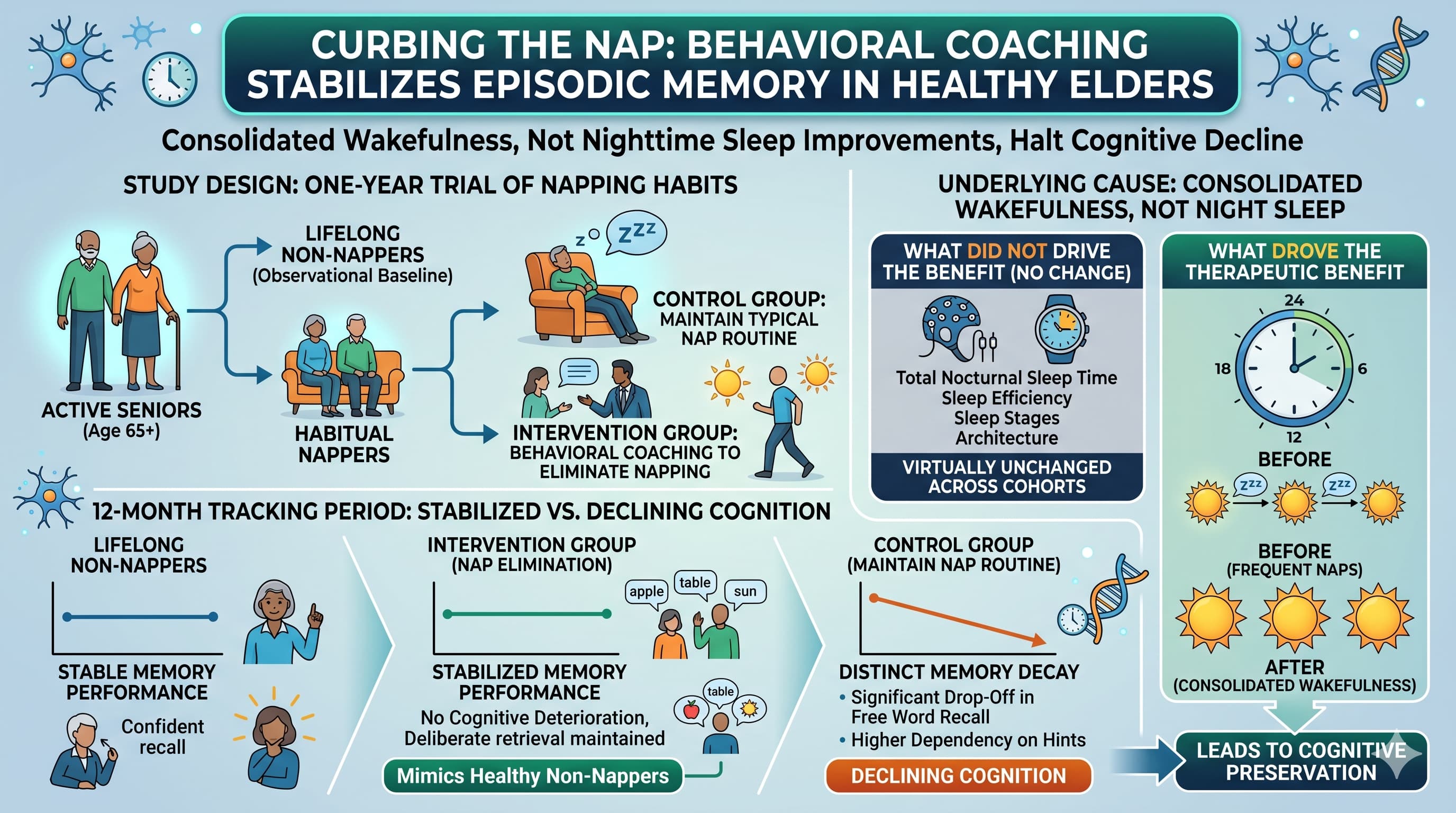
Aging frequently destabilizes the body’s internal clock, fragmenting nocturnal sleep and driving many older adults to adopt regular afternoon naps. While historically viewed as a benign or even restorative strategy to combat daytime fatigue, a landmark 12-month randomized controlled trial demonstrates that frequent daytime napping may actively accelerate cognitive decline. The study reveals that breaking a well-anchored nap habit through behavioral coaching can halt a downward slide in verbal episodic memory, preserving cognitive performance in healthy older adults.
The clinical trial investigated whether habitual napping functions as a harmless compensatory mechanism or mirrors an underlying decay of the master circadian clock. To isolate the effects, researchers tracked healthy retired adults over a one-year period. Habitual nappers were split into two arms: an intervention group that underwent cognitive-behavioral coaching to progressively eliminate daytime napping, and a control group that maintained their typical napping routines. A parallel cohort of lifelong non-nappers served as an observational baseline.
Over the 12-month tracking period, participants who maintained their regular afternoon naps exhibited a distinct, statistically significant drop-off in free word recall. To compensate for this memory decay, they grew increasingly dependent on contextual hints and external cues to retrieve information. Conversely, those who successfully restricted their daytime napping experienced no such cognitive deterioration; their deliberate memory retrieval strategies stabilized, mimicking the performance profiles of the lifelong non-nappers.
Intriguingly, polysomnography and actimetry data confirmed that this cognitive preservation did not stem from improvements in nighttime sleep architecture, efficiency, or duration. Total nocturnal sleep time and sleep-stage composition remained virtually unchanged across all cohorts. Instead, the therapeutic benefit was driven entirely by the consolidation of daytime wakefulness. Daytime sleep intrusions trigger a form of cognitive fragmentation, generating unstable shifts between alertness and drowsiness that disrupt the neural continuity required to sustain memory consolidation. By enforcing a solid, uninterrupted block of daytime wakefulness, nap restriction builds cognitive resilience against age-related neurobiological vulnerability.
Actionable Insights
- Re-evaluate Regular Napping: Treat frequent, long afternoon naps (defined as sessions exceeding 30 minutes, practiced three or more times per week) as an early warning sign of circadian clock weakening rather than a health-promoting behavior.
- Consolidate Daytime Wakefulness: If you are an older adult experiencing subtle memory slips or heavy daytime sleepiness, actively eliminate daytime sleep episodes to keep the brain continuously engaged and resilient against cognitive fragmentation.
- Strictly Cap Necessary Naps: If a daytime nap is entirely unavoidable due to acute sleep debt, restrict the duration strictly to 15 to 20 minutes. This prevents the brain from entering deeper slow-wave sleep stages that fracture diurnal rest-activity rhythms.
- Deploy Behavioral Restructuring: Utilize structured daytime routines and behavioral adjustments—modeled on Cognitive Behavioral Therapy for Insomnia (CBT-I)—to progressively eliminate daytime rest periods over a four-week period.
- Maintain Environmental and Cognitive Stimulation: Substitute typical napping windows with light physical movement (e.g., brisk walking) or high-engagement cognitive tasks to reinforce the body’s primary wakefulness cycle and protect hippocampal retrieval pathways.
Source:
- Paywalld Paper: Breaking the nap habit: one‑year nap restriction mitigates memory decline in older adults
- Institutions: Chronobiology & Cognition Laboratory, GIGA-Research, CRC-Human Imaging Unit, and the Psychology and Neuroscience of Cognition Research Unit (PsyNCog), University of Liège, Liège, Belgium.
- Country: Belgium.
- Journal Name: GeroScience.
- Impact Evaluation: The impact score of this journal is 5.4, evaluated against a typical high-end range of 0–60+ for top general science, therefore this is a High impact journal.