Gerontological research has traditionally treated sleep deterioration as a passive consequence of growing old. However, emerging macro-epidemiological and mechanistic data flip this script, revealing that age-related sleep fragmentation and circadian dampening act as primary, aggressive accelerants of biological aging. As the human brain ages, the master circadian pacemaker—the suprachiasmatic nucleus (SCN)—undergoes structural and functional decay. This neurological decline dampens the amplitude of core body temperature rhythms and blunts nighttime melatonin peaks, forcing a progressive phase-advance that drives older adults toward early evening sleepiness and fragmented, low-efficiency nocturnal sleep.
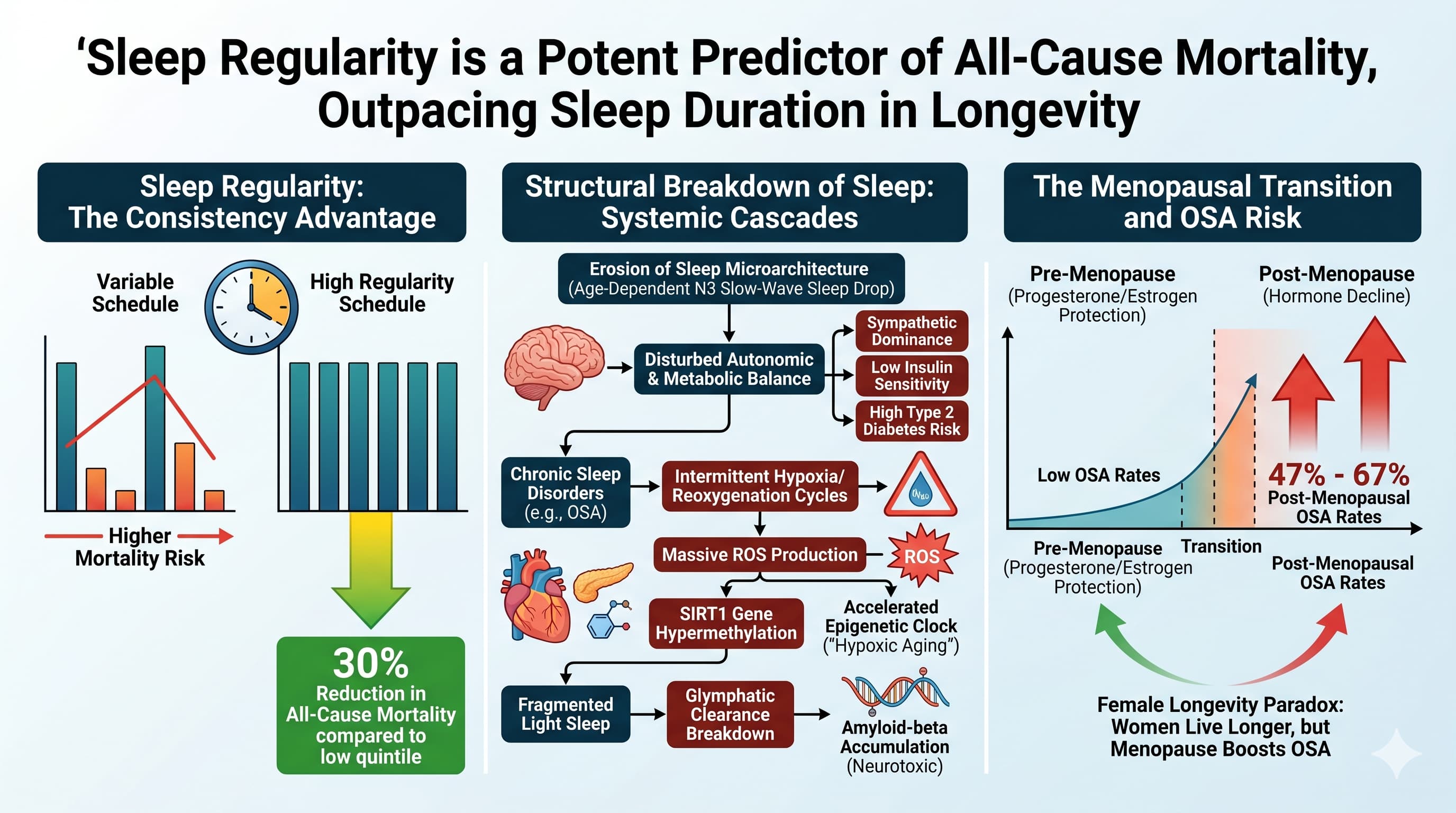
The truly paradigm-shifting insight from recent large-scale cohort analyses is that sleep regularity—maintaining a highly consistent day-to-day sleep-wake schedule—is a significantly more potent predictor of all-cause mortality than total sleep duration. Individuals tracking in the highest quintile of sleep regularity exhibit a clean 30% reduction in all-cause mortality compared to those with highly variable routines. Conversely, structural erosion of sleep microarchitecture delivers severe systemic blows. The sharp, age-dependent drop in slow-wave sleep (N3) directly disrupts autonomic and metabolic balance, inducing a shift toward sympathetic dominance, reducing insulin sensitivity, and elevating the risk of type 2 diabetes.
Simultaneously, chronic sleep disorders introduce devastating pathophysiological cascades. Obstructive sleep apnea (OSA) triggers repetitive cycles of intermittent hypoxia and reoxygenation, generating massive waves of reactive oxygen species that hypermethylate the SIRT1 gene, effectively accelerating the epigenetic clock. This “hypoxic aging” is compounded by a profound breakdown in glymphatic clearance during fragmented light sleep, allowing neurotoxic aggregates like amyloid-beta to accumulate. Crucially, the data exposes a stark female longevity paradox: while women live longer, the menopausal transition strips away the upper-airway protective benefits of progesterone and estrogen, causing post-menopausal OSA rates to skyrocket to between 47% and 67%. Ultimately, sleep can no longer be viewed as a luxury; it is a highly malleable, structural column of healthspan execution.
Actionable Insights
- Enforce Strict Sleep-Wake Timing: Prioritize the Sleep Regularity Index by going to bed and waking up at identical times every single day. This behavioral anchor stabilizes circadian phase alignment and lowers all-cause mortality risk by 30%, completely independent of total sleep duration.
- Aggressively Cool the Sleep Environment: Keep bedroom ambient temperatures strictly at or below 22 degrees Celsius (71.6 degrees Fahrenheit). Total sleep time remains stable up to this threshold but drops precipitously above it, causing an absolute loss of 60 minutes of sleep as ambient temperatures climb to 30 degrees Celsius.
- Widen the Evening Fasting Window: Complete your final meal at least 6 hours before your calculated sleep midpoint. Every hour delayed significantly inflates the odds of short sleep by 30%, sleep latency by 14%, and chronic insomnia by 11%.
- Eliminate Artificial Light and Noise at Night: Achieve absolute black-out conditions and mitigate ambient sound pollution. Nighttime light exposure directly suppresses melatonin amplitude, while even minor localized ambient noise increases the odds of severe sleep disturbance up to nearly three-fold.
- Screen for Obstructive Sleep Apnea and Deploy CBT-I: Bypass high-risk sedatives and Z-drugs, which relax airway muscles and compound fall risks. Treat chronic insomnia via Cognitive Behavioral Therapy for Insomnia (CBT-I) to safely boost slow-wave power, and aggressively manage any underlying hypoxic burden with Continuous Positive Airway Pressure (CPAP) therapy.
Source:
-
Paywalled Paper: Sleep health in the older adults: Architecture, circadian changes, and
common sleep disorders - Affiliated Institutions: University Sleep Disorders Center, Department of Medicine, College of Medicine, King Saud University, Riyadh, Saudi Arabia; Government Hospitals, Manama, Bahrain; Department of Psychiatry, College of Medicine and Health Sciences, Arabian Gulf University, Manama, Bahrain; etc.
- Journal Name: Ageing Research Reviews.
- Impact Evaluation: The impact score of this journal is 13.1, evaluated against a typical high-end range of 0–60+ for top general science, therefore this is a High impact journal.