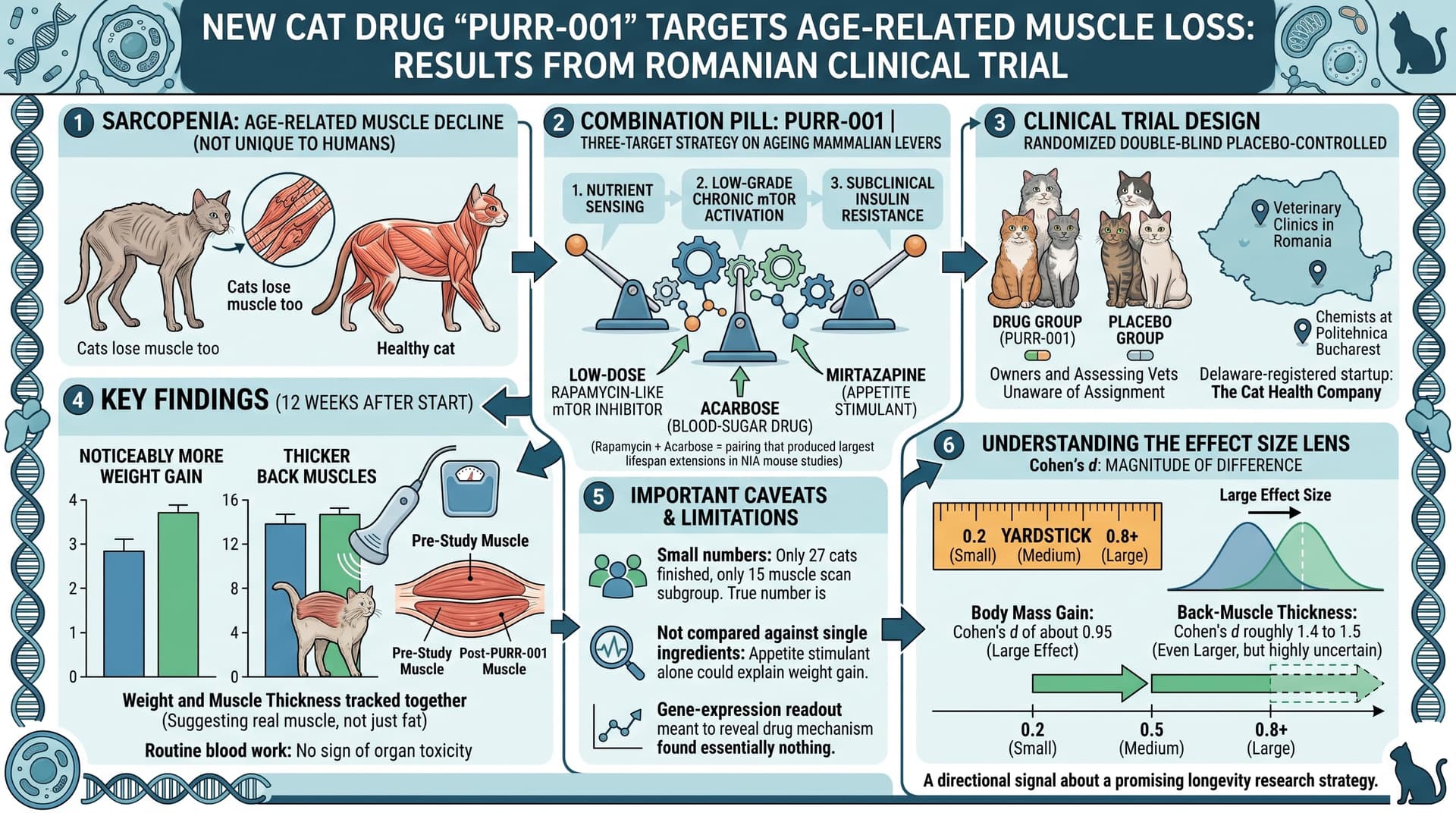
A small randomized, double-blind, placebo-controlled trial reports that PURR-001, a once-weekly oral capsule combining a low-dose rapamycin analog, mirtazapine, and acarbose, produced a larger gain in body mass and back-muscle thickness than placebo in elderly sarcopenic cats over 12 weeks. Treated cats gained about 7.4 percent body mass versus 1.1 percent on placebo, and their epaxial (spinal) muscle height rose about 22.8 percent versus 9.0 percent. Blood safety markers stayed stable.
Muscle wasting in old age is one of the most reliable signatures of biological aging, and it is not unique to humans. Cats lose muscle too, and until now no drug had been formally tested against the age-related version of that decline, known as sarcopenia. A team backed by a Delaware-registered startup called The Cat Health Company, working with veterinary clinics in Romania and chemists at Politehnica Bucharest, set out to change that with a candidate they call PURR-001.
The big idea is deliberately unglamorous. Rather than betting on a single miracle molecule, the researchers built a combination pill that pokes at three connected levers of mammalian aging at once: nutrient sensing, low-grade chronic activation of the growth pathway mTOR, and subclinical insulin resistance. The active ingredients are a low dose of a rapamycin-like mTOR inhibitor, the appetite stimulant mirtazapine, and the blood-sugar drug acarbose. Two of these, rapamycin and acarbose, are the same pairing that has produced some of the largest lifespan extensions on record in the US National Institute on Aging’s mouse testing program, which is almost certainly why they appear here together.
Thirty-five elderly cats were randomly assigned to the drug or a matching placebo, and neither owners nor assessing vets knew which was which. Twelve weeks later, the cats on PURR-001 had gained noticeably more weight and, in a smaller subgroup scanned by ultrasound, thicker back muscles. The two measures tracked together, which is what you would hope to see if real muscle, not just fat, was being added. Routine blood work showed no sign of organ toxicity.
There are important caveats. Only 27 cats finished, the muscle-scan group was just 15 animals, and the study never tested whether the three-drug cocktail beats any single ingredient. A blood gene-expression readout meant to reveal the drug’s mechanism found essentially nothing. One treated cat died of severe pancreatitis, judged unrelated by the vets. Still, as a first controlled demonstration that feline age-related muscle loss is pharmacologically movable, it is a genuine opening rather than a conclusion.
Insights
The honest first message is that this is a cat study, and nothing here has been shown to work in humans. What it offers is a directional signal about a strategy that longevity researchers already find promising.
To see how big the reported effect actually is, effect size is the useful lens. Effect size asks not just whether a difference is real, but how large it is relative to the natural spread between individuals. A common yardstick is Cohen’s d, where roughly 0.2 is small, 0.5 is medium, and 0.8 or above is large. For body mass gain, the gap between drug and placebo works out to a Cohen’s d of about 0.95, a large effect. For back-muscle thickness it is even larger, roughly 1.4 to 1.5, though that came from only 15 cats so the true number is uncertain.
In plain terms, a typical 3.5 kg elderly cat on the drug gained roughly a quarter of a kilogram, versus almost nothing on placebo. The take-home for people is conceptual; combining several modest interventions that each nudge a different aging pathway may beat searching for one blockbuster, and preserving muscle is worth prioritizing as any mammal ages.
Context and Source
- Open Access Paper: A randomized double-blind placebo-controlled clinical trial of a multi-target therapeutic against primary age-related feline sarcopenia: PURR-001.
- Institution and country: The Cat Health Company (Wilmington, Delaware, United States), with clinical work conducted through veterinary clinics in Bucharest, Romania, and formulation work at the National University of Science and Technology Politehnica Bucharest, Romania. The trial was registered with ANSVSA, Romania’s veterinary regulatory agency.
- Journal name and impact evaluation: None. This is a self-hosted preprint
Related Reading:
- Two New Studies on Rapamycin: For Cats and Dogs, Treatment of Cardiomyopathy
- Targeting mTOR with Rapamycin Across Species: How Hypertrophic Cardiomyopathy Reversal in Cats Informs Human Cardiac Aging and Longevity (Healthspan)
- How do I give my cat rapamycin tablet
- An Old Antidepressant Just Extended Mouse Lifespan by 17%. Here's Why Calcium May Be the Hidden Clock of Aging
- How Do I Get Rapamycin for My Dog?
- Inside the Dog Aging Project: What It’s Teaching Us About Longevity (Siim Land / Daniel Promislow)