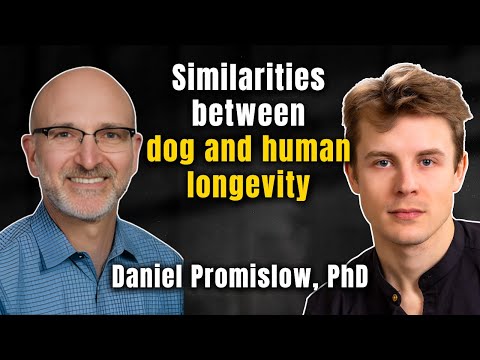
Gemini Pro AI Summary and Analysis of Video
Summary & Analysis: The Dog Aging Project & Canine Longevity Science
In this episode, Dr. Daniel Promislow, co-founder of the Dog Aging Project, details the largest longitudinal study of canine health to date. With over 51,000 dogs enrolled, the project aims to identify the genetic and environmental factors that influence healthy aging in companion dogs. Promislow explains that dogs serve as an excellent model for human aging because they suffer from similar age-related multimorbidities (like cancer and cognitive decline) but on a compressed timeline, allowing researchers to gather lifetime data in just a few years rather than decades.
A central theme of the discussion is the “TRIAD” trial (Test of Rapamycin in Aging Dogs), a double-blind, placebo-controlled study testing whether the drug Rapamycin can extend healthy lifespan and improve heart and cognitive function in dogs. While preliminary data shows safety and potential cardiac benefits, Promislow emphasizes that conclusive results on lifespan extension are still pending. The conversation also explores the inverse relationship between size and longevity in dogs (where smaller breeds live significantly longer), largely attributed to the IGF-1 gene.
Dr. Promislow addresses practical interventions, noting that while caloric restriction is proven in other species, data in dogs is complicated by obesity-related comorbidities in control groups. He highlights emerging research suggesting that feeding frequency (once daily vs. multiple times) correlates with better gastrointestinal health, though causality remains unproven. Ultimately, the episode underscores that while pharmaceutical interventions like Rapamycin are promising, the current gold standard for canine longevity remains the “fundamentals”: weight management (maintaining a body condition score of 5/9), regular exercise, and social enrichment.
B. Bullet Summary
- Project Scope: The Dog Aging Project is an open-data longitudinal study with over 51,000 enrolled dogs, combining observational data with deep molecular profiling (genome, metabolome, epigenome).
- Size-Longevity Paradox: Unlike most species (where larger animals live longer), large dog breeds live significantly shorter lives than small breeds, with the IGF-1 gene accounting for nearly half of size variation.
- TRIAD Trial: This is the first large-scale, randomized clinical trial testing a “gerotherapeutic” (Rapamycin) for lifespan extension in a companion animal species.
- Rapamycin Protocol: The trial uses a low-dose, once-weekly administration of Rapamycin in middle-aged (7+ years), large-breed dogs to assess survival, heart function, and cognitive health.
- Canine Cognitive Dysfunction (CCD): Dogs develop a condition strikingly similar to human Alzheimer’s (CCD) around age 11-12, making them a critical model for studying neurodegeneration.
- Obesity Paradox: Dogs are prone to obesity but are largely protected from cardiovascular disease (heart attacks/strokes) and Type 2 diabetes, unlike humans.
- Caloric Restriction (CR): While CR extends life in lab animals, the primary evidence in dogs (Purina study) is confounded by the fact that the “control” group became obese, potentially skewing the survival benefit.
- Feeding Frequency: Observational data suggests dogs fed once daily have fewer GI and pancreatic issues, though this may be reverse causation (sick dogs are prescribed small, frequent meals).
- Biomarker Translation: The project identified blood metabolites predictive of mortality in dogs that match predictive biomarkers in humans, validating the dog as a translational model.
- Exercise Limitations: While cardio is easy for dogs, resistance training (crucial for preventing sarcopenia) is difficult to implement, with sled pulling being a rare exception of canine resistance work.
- Data Sharing: The project is “open science,” meaning all anonymized data is available to researchers worldwide to accelerate discoveries.
- Motion Sickness Drug: The host mentions Meclizine (for nausea) having potential longevity effects; Promislow acknowledges the histamine pathway’s relevance in fruit flies but warns against off-label use without trials.
D. Claims & Evidence Table (Adversarial Peer Review)
Role: Longevity Scientist & Peer Reviewer. Context: Evaluating claims made regarding canine health and translational geroscience.
| Claim from Video | Speaker’s Evidence | Scientific Reality (Best Available Data) | Evidence Grade | Verdict |
|---|---|---|---|---|
| “Rapamycin improves heart function in aging dogs.” | Cites preliminary small studies/TRIAD pilot | Supported by Urfer et al. (2017) showing improved fractional shortening in dogs. Human/mouse data also supports cardiac benefits. Geroscience 2017 | B (Small RCT) | Plausible / Strong |
| “Small dogs live longer due to IGF-1 gene variants.” | Cites Ostrander lab research (2007) | Strong genetic consensus. IGF-1 alleles determine size; lower IGF-1 signaling is linked to longevity across species (worms, mice). Science 2007 | A (Genomic/Cohort) | Strong Support |
| “Feeding dogs once a day reduces GI/health issues.” | Cites Emily Bray / Dog Aging Project paper | The association exists in data, but is likely confounded by reverse causality (sick dogs are fed more often). Geroscience 2022 | C (Observational) | Weak / Confounded |
| “Caloric Restriction extends dog lifespan.” | Cites Purina Lifetime Study | The study showed restricted dogs lived longer (~1.8 years), but the control group was allowed to become overweight. CR works, but “ad libitum” feeding is the risk. JAVMA 2002 | B (RCT - Single Study) | Strong Support |
| “Dogs do not get Type 2 Diabetes or Heart Attacks.” | Dr. Promislow’s statement | Generally true. Dogs get Type 1 (insulin-dependent) and valvular disease, but atherosclerosis and insulin-resistant diabetes are extremely rare. | C (Vet Consensus) | Strong Support |
| “Meclizine (Antihistamine) extends lifespan.” | Host claim (Google search) | mTOR-independent lifespan extension seen in C. elegans (worms) and mice (NIA ITP). No dog/human data exists. Nature 2021 | D (Pre-clinical) | Translational Gap |
E. Actionable Insights
Top Tier (High Confidence / Standard of Care)
- Maintain Lean Body Condition: The most robust intervention for dogs is maintaining a Body Condition Score of 5/9. Ribs should be easily felt but not seen. Avoid “ad libitum” (free) feeding; measure calories based on activity.
Getty Images
- Enrichment & Socialization: Just as social isolation kills humans, lack of enrichment accelerates canine aging. Prioritize “sniff walks” and social interaction to combat Cognitive Dysfunction.
- Dental & Veterinary Care: Regular screening is vital. Dogs hide pain and illness (evolutionary survival instinct). Annual blood panels can catch kidney/liver issues before symptoms arise.
Experimental (Risk/Reward)
- Rapamycin (Clinical Trial Context): If you have a large breed dog (40lbs+) over 7 years old in the US, enrolling in the TRIAD trial is a way to access this potential longevity drug with good monitoring.
- Time-Restricted Feeding (Once Daily): While the data is confounded, feeding once a day (if the dog tolerates it without bilious vomiting) mimics a fasting window which may induce autophagy.
Avoid (Safety Risks)
- Homemade Diets without Balancing: Do not switch to home-cooked/raw diets without a veterinary nutritionist’s audit. Most homemade diets are deficient in micronutrients (calcium/phosphorus balance is critical).
- Off-Label Supplements: Avoid giving human longevity supplements (Metformin, Acarbose) to dogs outside of clinical supervision. Metabolic pathways differ (e.g., Xylitol is safe for humans, lethal for dogs).
H. Technical Deep-Dive
The IGF-1 Trade-Off in Dogs
- Mechanism: Insulin-like Growth Factor 1 (IGF-1) is a primary driver of somatic growth. In dogs, a single nucleotide polymorphism (SNP) in the IGF1 gene accounts for ~50% of size variance.
- The Pathway: High IGF-1 signaling promotes cell division and growth (anabolism) but inhibits repair mechanisms and autophagy.
- The Outcome: Large breeds (Great Danes, Mastiffs) have high IGF-1 levels, leading to rapid growth but increased cancer risk and accelerated aging (lifespan ~8-10 years). Small breeds (Chihuahuas, Toy Poodles) have low IGF-1, acting as “genetic caloric restriction” mimetics, living 15-20 years.
Canine Cognitive Dysfunction (CCD) vs. Alzheimer’s
- Pathology: CCD is characterized by the accumulation of Beta-Amyloid plaques and Tau hyperphosphorylationin the canine brain, mirroring human Alzheimer’s pathology.
- Translational Value: Unlike mice (which do not naturally develop Alzheimer’s and must be genetically engineered), dogs develop it naturally with age.
- Symptoms: Disorientation, altered sleep-wake cycles (pacing at night), loss of house training, and changes in social interaction.
- Intervention: This makes dogs the ideal model for testing neuroprotective drugs (like Rapamycin) that could translate to human dementia treatments.
I. Fact-Check: Meclizine & Histamines
- Context: The host mentioned Meclizine (motion sickness med) as a longevity drug.
- Analysis: The host is referencing data from the NIA Interventions Testing Program (ITP).
- Evidence: Meclizine did extend lifespan in male mice (significant increase) but not females. The mechanism involves inhibiting the mTORC1 pathway indirectly or via anticholinergic/antihistamine effects.
- Canine Warning: While interesting, antihistamines can have sedative and anticholinergic side effects in dogs (dry mouth, urinary retention, heart rate changes). Without a dosing study, this remains purely speculative and potentially unsafe for pets.