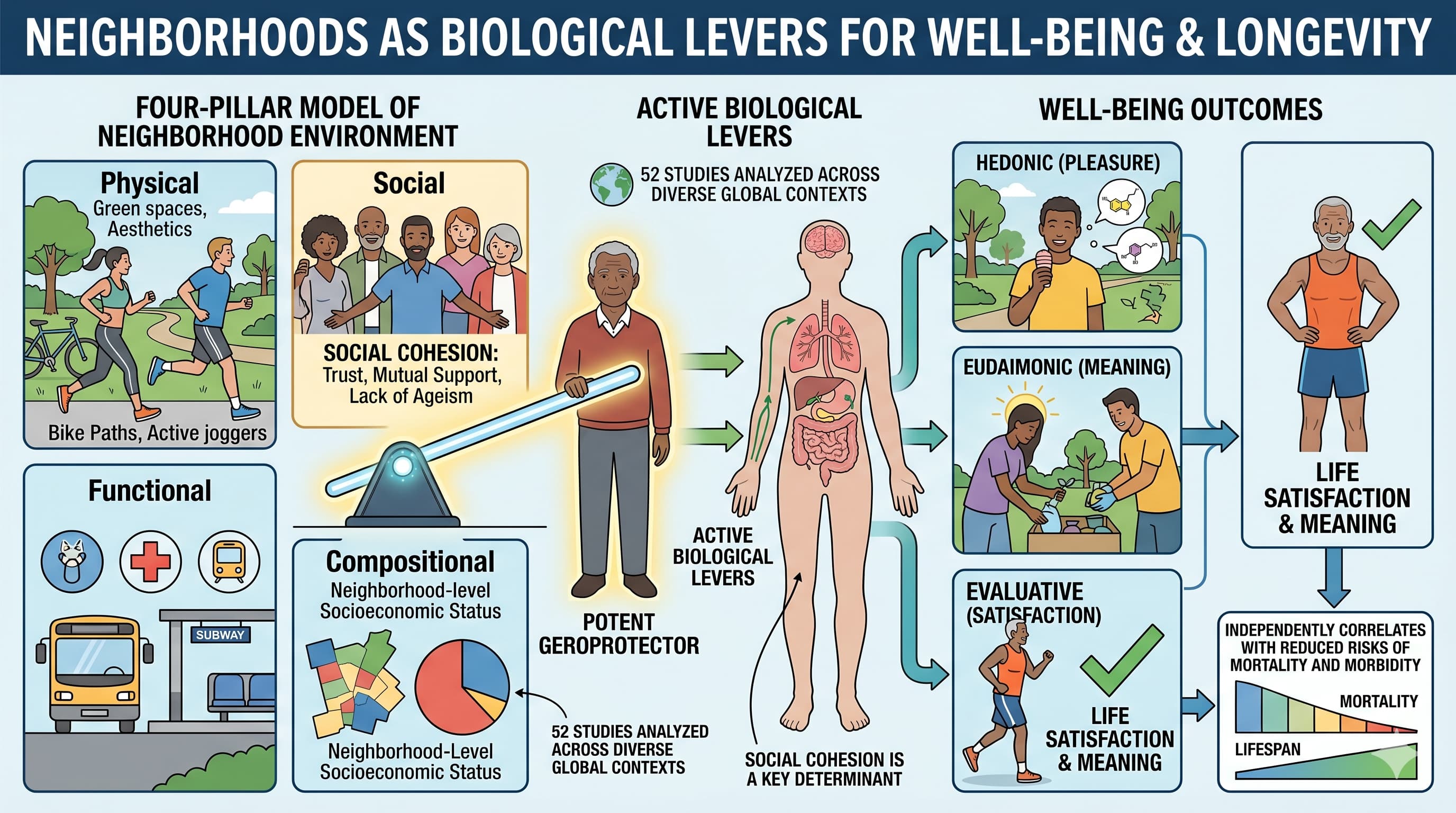
As global populations age, the traditional “deficit-focused” medical model—which views aging primarily as a series of declines to be managed—is being challenged by a more proactive “flourishing” framework. A new systematic scoping review published in Ageing Research Reviews argues that the neighborhoods we inhabit are not just passive backdrops for our lives but active biological levers that dictate hedonic (pleasure), eudaimonic (meaning), and evaluative (satisfaction) well-being.
The review, which analyzed 52 studies across diverse global contexts, introduces a four-pillar model of the neighborhood environment: Physical (green spaces, aesthetics), Social (cohesion, lack of ageism), Functional (access to healthcare and transport), and Compositional (neighborhood-level socioeconomic status). While much longevity research focuses on intracellular pathways, this paper highlights that social cohesion is perhaps the most potent environmental “geroprotector”. Older adults in neighborhoods with high trust and mutual support reported significantly higher life satisfaction and meaning, which independently correlates with reduced risks of mortality and morbidity.
The “Big Idea” here is the shift toward ageing-in-place as a psychological and functional necessity. The environment exerts its influence through two primary mechanisms: Agency (the capacity to act and navigate) and Belonging (emotional attachment to place). However, the paper warns that the benefits are not linear. For example, “blue spaces” like rivers and lakes show consistent benefits, but the value of “green spaces” depends more on quality and safety than sheer quantity. As we move toward 2050, where one in five people will be over 60, optimizing these “flourishing districts” will be as critical as any pharmaceutical intervention for public health sustainability.
Actionable Insights for Longevity Optimization
-
Prioritize Social Capital over Amenities: When selecting a residence for longevity, prioritize neighborhood cohesion and perceived safety over high-end recreational amenities. High social trust provides a “buffer” against age-related stressors and is more strongly linked to eudaimonic well-being (purpose) than physical infrastructure.
-
Essential Service Proximity: For those 80+, proximity to healthcare and essential services (banks, groceries) becomes a primary driver of life satisfaction.
-
Exposure to Natural “Blue and Green” Features: Regular engagement with high-quality green and blue spaces promotes “restoration” and offsets urban-density stressors. Quality—defined by cleanliness and aesthetic appeal—is more impactful than total acreage.
-
Combat Environmental Ageism: Actively engaging in neighborhoods that lack “perceived ageism” is critical, as negative stereotypes in one’s immediate surroundings have a fourfold greater negative impact on well-being than poor service accessibility.
Source:
- Open Access Paper: Neighbourhood environments and later life flourishing: A systematic scoping review
- Institution: Institute for Global Health, University College London.
- Country: United Kingdom.
- Journal Name: Ageing Research Reviews, June 2026
- Impact Evaluation: The CiteScore of this journal is 24.5 (2024 data) and the Impact Factor is approximately 13.1, therefore this is a High impact journal.
Related Reading:
- Neuro-Urbanism: Engineering the Environment for Cognitive Longevity
- The Social Life Extension: Why Connection is a Mechanical Pillar of Brain Reserve
- Inside the top 5 places in the world where people live the longest —past 100
- Eric Topol interviews Dan Buettner on Blue Zones and some controversies
- Netflix: Live to 100, Secrets of the Blue Zones (new streaming show)
- The Ageism Tax: Why Your Subjective Age May Be Truncating Your Lifespan