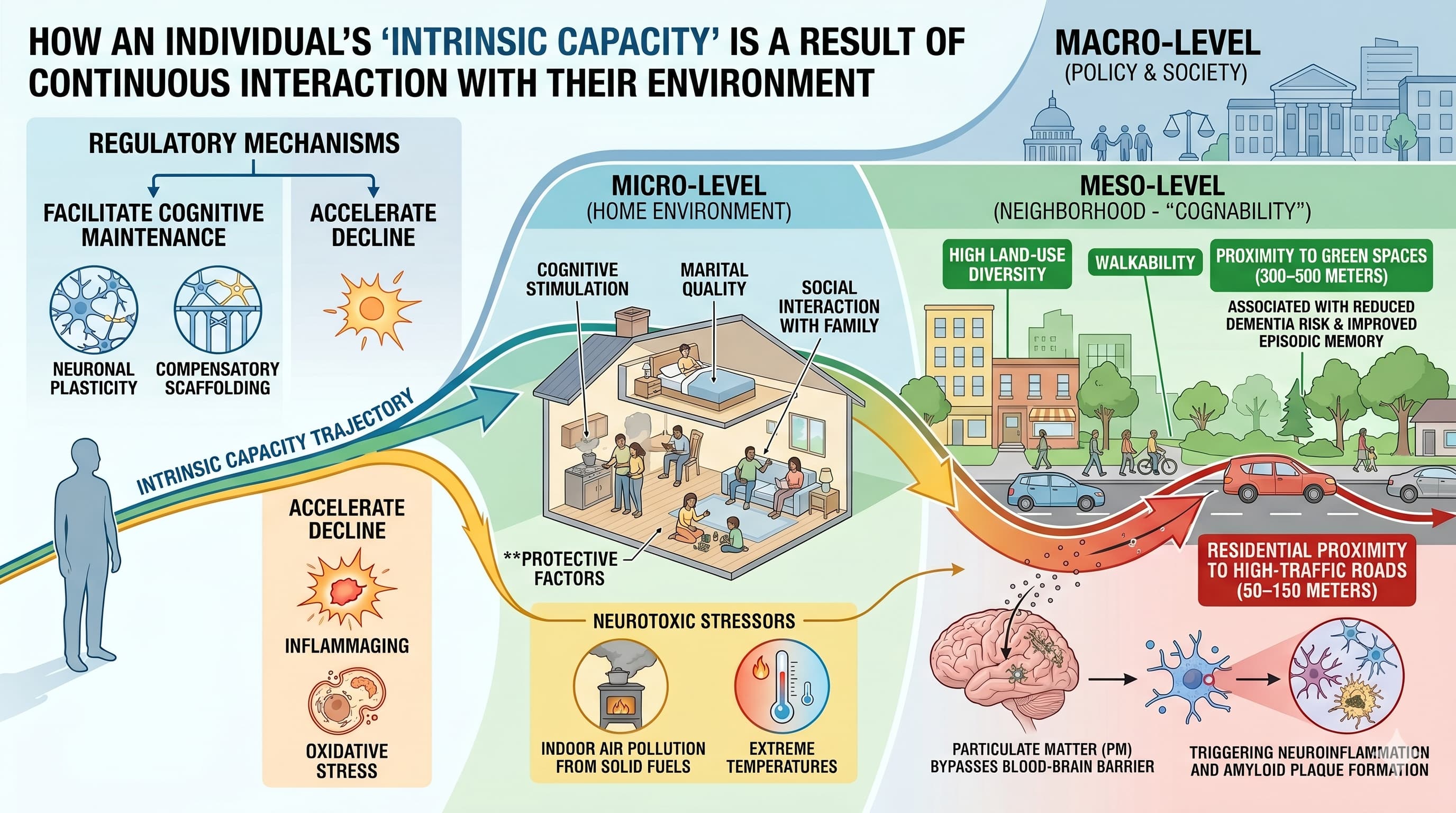
The traditional view of cognitive aging—a slow, inevitable biological decline—is being challenged by a more dynamic ecological model. This narrative review, published in May 2026, posits that an individual’s “intrinsic capacity” is not a fixed trajectory but a result of continuous interaction with their environment. Researchers identify three critical layers—micro, meso, and macro—that either facilitate “cognitive maintenance” through neuronal plasticity and compensatory scaffolding or accelerate decline via inflammaging and oxidative stress.
At the micro-level , the home environment serves as the primary theater for daily cognitive stimulation. While marital quality and social interaction with family are protective, physical factors like indoor air pollution from solid fuels and extreme temperatures are significant, often overlooked neurotoxic stressors. Moving to the meso-level , the review highlights “cognability”—the neighborhood’s capacity to support cognitive health. High land-use diversity, walkability, and proximity to green spaces (within 300–500 meters) are associated with reduced dementia risk and improved episodic memory. Conversely, residential proximity to high-traffic roads (within 50–150 meters) introduces particulate matter (PM) that can bypass the blood-brain barrier, triggering neuroinflammation and amyloid plaque formation.
Finally, the macro-level addresses the societal “gerontological dividend”. The authors argue that ageism—whether self-inflicted or institutional—acts as a psychological barrier that reduces participation in health-promoting behaviors, thereby inducing chronic stress and cortisol-mediated hippocampal atrophy. To maximize the human capital of an aging global population, the review suggests that public policies must shift from the “medicalization of aging” toward proactive environmental design that fosters autonomy and intellectual engagement. Ultimately, cognitive health in 2026 is viewed as a “dynamic emergence” requiring intervention at every scale of human habitation.
Actionable Insights
To optimize cognitive longevity, the following evidence-based interventions are identified:
-
Intellectual Complexity: Engage in “novel, complex, and sustained experiences”. This includes learning new languages, computer programming, or acquiring complex motor skills (e.g., photography, theater) to force neural reorganization and bilateral frontal “scaffolding”.
-
Environmental Toxin Mitigation: Minimize exposure to particulate matter (PM). Ensure residential ventilation occurs 6–8 times per week if living in high-pollution areas. Avoid living within 150 meters of highways to reduce neurotoxic risks.
-
Bio-Acoustic and Visual Optimization: Seek “blue” and “green” spaces. Residing within 300 meters of green infrastructure is linked to lower cardiovascular events and vascular dementia.
-
Physical Conditioning: Adhere to a “longevity dose” of exercise: 3–5 days of moderate-intensity aerobic activity per week, plus 2–3 sessions of resistance training. This regimen improves neurotrophic factor production and reduces systemic inflammatory cytokines.
-
Dietary Defense: Prioritize a diet high in antioxidants, folate, and vitamins D and E (vegetables, fruits, fish) to protect against the oxidative stress and “inflammaging” that drive synaptic disruption.
Source:
- Open Access Paper: Effect of Environment on the Cognition of Older Adults: A Narrative Review
- Institution: Research Unit on Gerontology, FES Zaragoza, National Autonomous University of Mexico.
- Country: Mexico.
- Journal Name: Brain Sciences (MDPI), Published: 2 May 2026
- Impact Evaluation: The impact score (CiteScore) of this journal is 4.4, evaluated against a typical high-end range of 0–60+ for top general science, therefore this is a Medium impact journal.