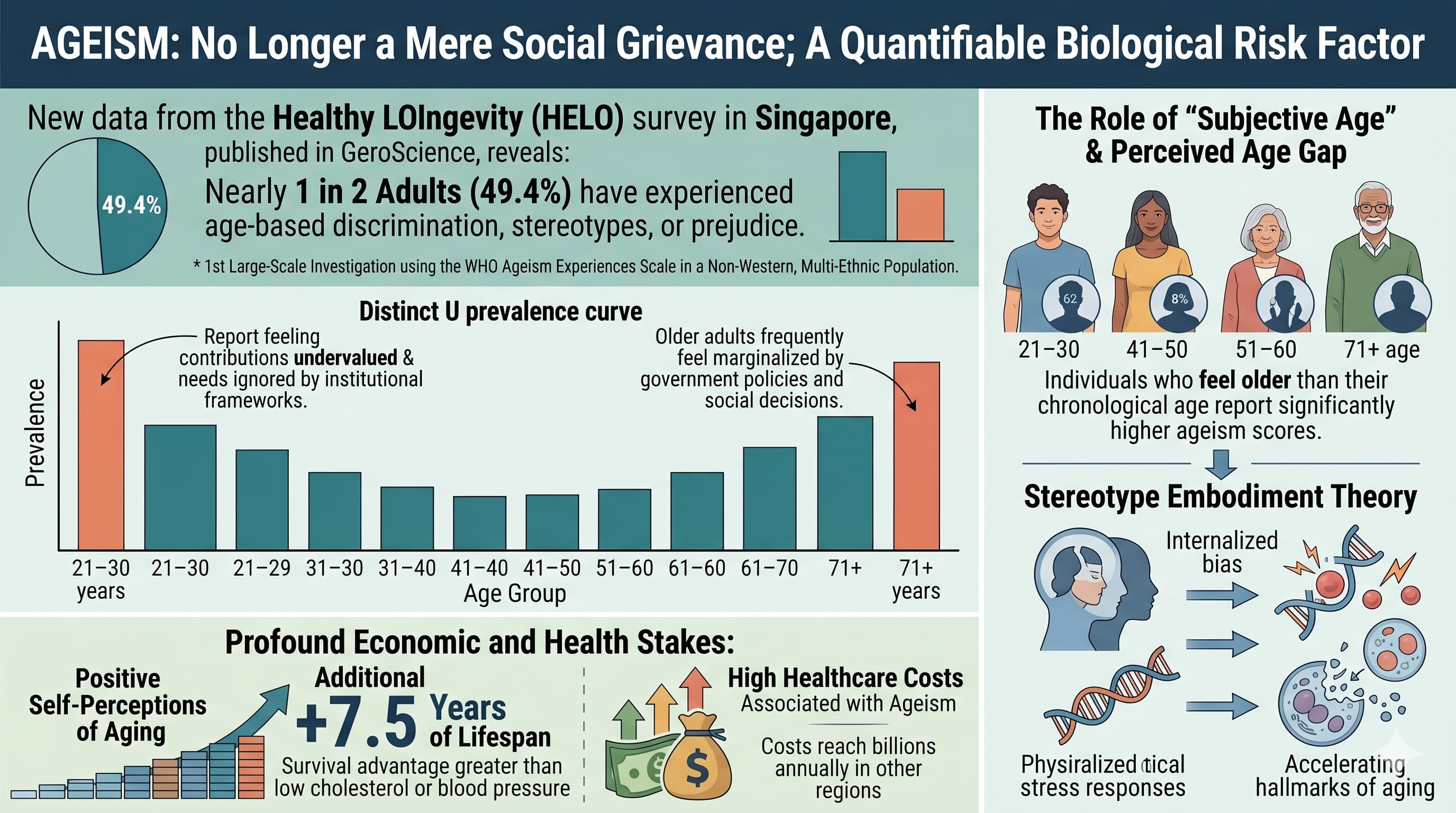
Ageism is often dismissed as a social annoyance, but new data from Singapore suggests it is a pervasive public health crisis that strikes at both ends of the adult life course. In a nationally representative survey of over 3,000 individuals, researchers found that nearly 50% of the population has experienced age-based prejudice, with the highest prevalence appearing among the youngest (21–30 years) and the oldest (71+ years) cohorts. This study, published in GeroScience , marks the first large-scale application of the World Health Organization (WHO) Ageism Experiences Scale in a non-Western context, revealing that the biological and economic costs of ageism are a global phenomenon.
The “Big Idea” here isn’t just about being “anti-old.” The research highlights a critical psychological metric: the perceived age gap. Individuals who feel older than their chronological age reported significantly higher levels of ageism. This subjective perception was one of the strongest predictors of experiencing age-based bias, independent of actual chronic disease status. This aligns with the Stereotype Embodiment Theory , suggesting that societal prejudice isn’t just external—it is internalized, becoming a self-fulfilling prophecy that can physically accelerate the aging process.
Economically, the stakes are massive. Previous data cited in the study estimates that ageism adds US $63 billion to annual US healthcare costs and has cost the US economy US $850 billion in lost productivity. In Singapore, while gender inequality is low, men actually reported slightly higher ageism scores than women, potentially due to competitive pressures in the “breadwinner” role. Ultimately, the paper argues that if we want to optimize healthspan, we must address the social determinants of aging. Positive beliefs about aging are not just “woo-woo” psychology; they are associated with an additional 7.5 years of lifespan , a survival advantage that outweighs low cholesterol or even smoking cessation.
Actionable Insights
To maximize longevity, one must treat age-related mindset as a modifiable risk factor. The data indicates that “feeling old” is not merely a symptom of decline but a driver of experienced bias and subsequent health deterioration.
-
Mindset Intervention: Actively challenge internalized stereotypes. Because positive age beliefs can add roughly 7.5 years to your life, cognitive reframing of aging as a period of growth rather than decay is a high-leverage longevity “hack”.
-
Socioeconomic Buffer: Recognize that lower education and income levels correlate with higher ageism scores. For those in lower-SES brackets, seeking out community-based intergenerational programs and “Active Ageing Centers” can mitigate the isolation that fuels ageist perceptions.
-
Policy Participation: Younger adults should note that “policy neglect” was their highest reported ageism factor. Engaging in policy discussions and representation can reduce the feeling of being “valueless” to society.
-
Subjective Age Tracking: Monitor your “subjective age.” If you consistently feel older than you are, it may be a leading indicator of social stress or internalized bias that requires lifestyle or psychological adjustment.
Source:
- Open Access Paper: Prevalence and determinants of ageism experiences in the Singapore population: insights from the HEalthy LOngevity (HELO) survey
- Institutions: NUS Academy for Healthy Longevity (Singapore), Yong Loo Lin School of Medicine (Singapore), Vrije Universiteit Amsterdam (Netherlands), University of Exeter (UK).
- Country: Singapore.
- Journal Name: GeroScience.
- Impact Evaluation: The impact score (CiteScore/JIF) of this journal is approximately 5.6 to 7.5, therefore this is a High impact journal in the specialized field of geroscience and aging research.