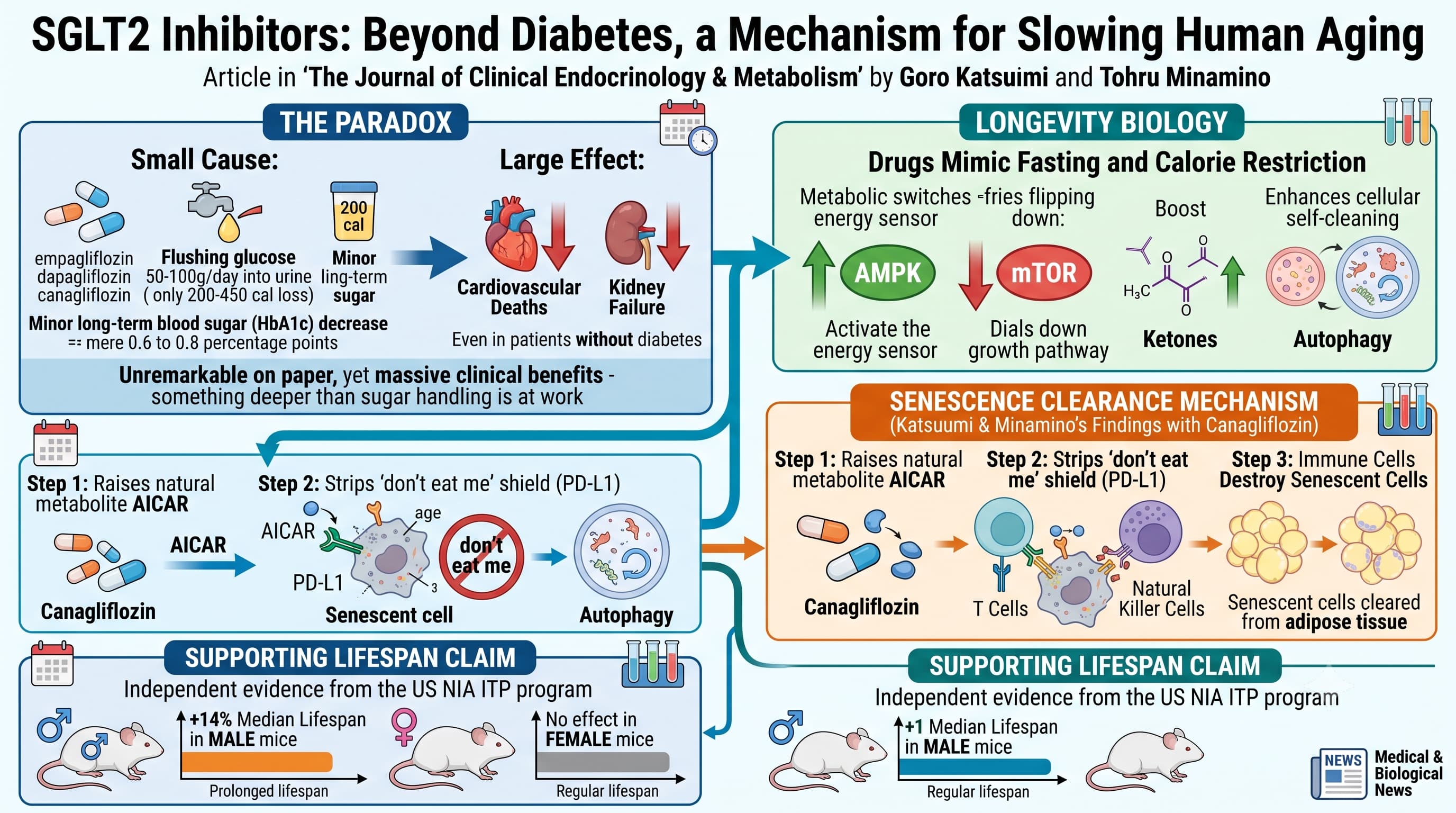
Two cardiologists from Juntendo University argue that SGLT2 inhibitors — a class of diabetes drugs that dump excess glucose into the urine — may double as anti-aging agents. They marshal a striking paradox: these drugs produce only small metabolic changes (a modest weight loss and a trivial drop in blood sugar) yet deliver outsized protection to the heart and kidneys. The authors propose the extra benefit comes from the drugs mimicking calorie restriction and, more provocatively, from clearing senescent “zombie” cells by recruiting the immune system.
A drug already in millions of medicine cabinets may do far more than lower blood sugar. Writing in The Journal of Clinical Endocrinology & Metabolism, Goro Katsuumi and Tohru Minamino make the case that SGLT2 inhibitors — sold as empagliflozin, dapagliflozin and canagliflozin — belong in the conversation about slowing human aging.
The big idea rests on a paradox the authors find impossible to ignore. These drugs flush 50 to 100 grams of glucose into the urine each day, a loss of only 200 to 450 calories, and they nudge long-term blood sugar (HbA1c) down by a mere 0.6 to 0.8 percentage points. On paper, that is unremarkable. Yet in landmark trials the same drugs cut cardiovascular deaths and kidney failure dramatically, and they help patients who do not even have diabetes. Small cause, large effect — which tells the authors that something deeper than sugar handling is at work.
Their explanation borrows from longevity biology. By starving cells of a little glucose, the drugs appear to flip the same metabolic switches as fasting and calorie restriction: activating the energy sensor AMPK, dialing down the growth pathway mTOR, boosting ketones and cellular self-cleaning (autophagy). The authors’ own laboratory adds a twist. In obese and prematurely aged mice, canagliflozin cleared senescent cells from fat tissue within a week — not by poisoning those cells directly, but by raising a natural metabolite called AICAR, which strips senescent cells of a “don’t eat me” shield (PD-L1) so that T cells and natural killer cells can destroy them.
Supporting the lifespan claim, an independent, rigorously controlled 3 year-long, US NIA ITP program found canagliflozin extended median lifespan in male mice by 14 percent — though, tellingly, it did nothing for females.
The authors are disciplined about the limits. No human trial has yet shown these drugs slow a validated aging clock (though these trials are underway); fewer heart attacks is not the same as younger biology. They flag some risks — ketoacidosis, muscle and bone loss in frail people.
Actionable Insights
What is evidenced today is disease benefit, and the magnitudes are worth knowing. Longevity benefits of SGLT2 inhibitors (like Canagliflozin) have been demonstrated in rigorous mouse studies as shown here, but have not yet been duplicated in human clinical studies (new $144 Million studies focused on this have been initiated).
- Cardiorenal protection (strong): In outcome trials, cardiovascular death fell with a hazard ratio near 0.62 in EMPA-REG (~38% relative risk reduction), and heart-failure hospitalization dropped roughly 25–35%. These are large, reproducible effects — the real reason to care about this drug class.
- Metabolic effects (small): Weight loss of only 2–4 kg and an HbA1c drop of 0.6–0.8 points — genuinely modest, plateauing within months.
- Liver fat: 10–30% reduction in hepatic steatosis in MAFLD/MASH.
- Lifespan (mouse, not human): +14% median in male mice only (~3.5–4 months on a ~28-month baseline); zero in females.
Context / Source
- Paywalled Paper: Dissecting out the unexpected effects of SGLT2 inhibitors on human aging.
- Type: Mini-review (narrative).
- Authors / Institution / Country: Goro Katsuumi and Tohru Minamino, Department of Cardiovascular Biology and Medicine, Juntendo University School of Medicine, Tokyo, Japan (Minamino also Niigata University).
- Journal: The Journal of Clinical Endocrinology & Metabolism (JCEM), Oxford University Press for the Endocrine Society. Published online 14 May 2026.
- Impact evaluation: JCEM’s 2024 Journal Impact Factor is approximately 4.7 (CiteScore 9.1), therefore this is a Medium-impact journal