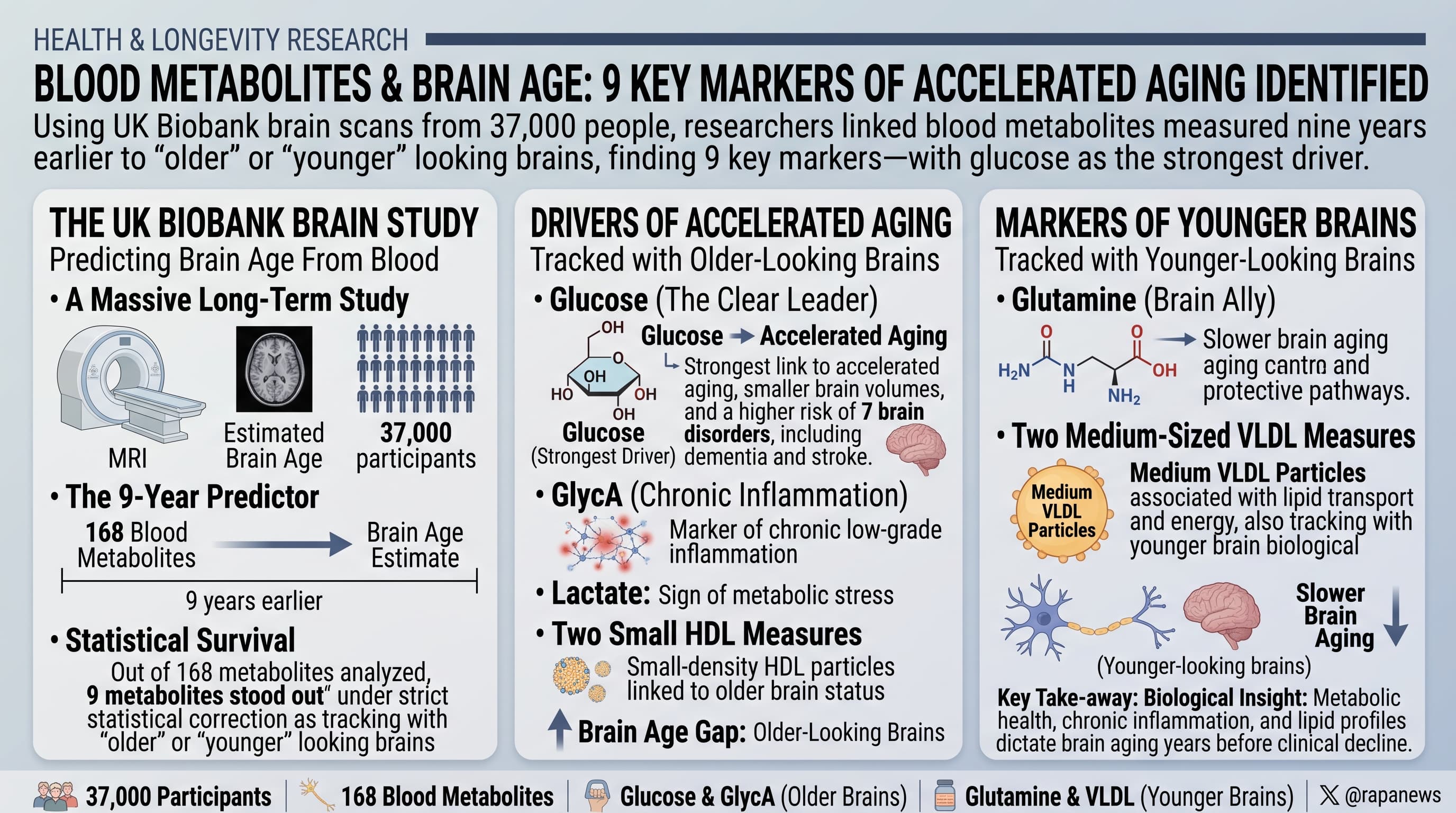
Researchers used UK Biobank brain scans to estimate a “brain age” for about 37,000 people, then asked which of 168 blood metabolites, measured roughly nine years earlier, tracked with brains that looked older than their owners. Nine metabolites survived strict statistical correction. Glucose was the strongest, and it was also linked to smaller brain volumes and a higher risk of seven brain disorders, including dementia and stroke.
Your brain has a birthday, and it also has an apparent age. Feed enough MRI scans into a machine learning model and it learns what a typical 55-year-old brain looks like. Show it a new scan and it guesses the age. The gap between that guess and the true age, called the brain age gap, has become a popular shorthand for how fast a brain is wearing out.
A team from Jilin University and China Medical University has now asked what in the blood predicts that gap. Using UK Biobank data, they built a brain age model from 1,079 measurements across six types of MRI scan, covering structure, wiring and activity. The model was typically off by a little over three years in healthy people.
They then looked at 168 blood metabolites in 21,780 participants. The blood was drawn about nine years before the scans, which gives the study a forward-looking quality: the blood chemistry came first, the brain picture later.
Nine metabolites stood out. Glucose was the clear leader. Close behind was GlycA, a marker of chronic low-grade inflammation. Lactate and two measures of small HDL particles also tracked with older-looking brains, while glutamine and two measures of medium-sized VLDL particles tracked with younger-looking ones.
Glucose kept appearing in the follow-up analyses. People with higher levels had less gray matter across dozens of cortical, subcortical and cerebellar regions. Over time they were more likely to develop all-cause dementia, Alzheimer’s disease, vascular dementia, Parkinson’s disease, stroke, depression and anxiety. The largest link was with vascular dementia, which hints that blood vessels may be the main route of damage.
To test cause and effect, the team used Mendelian randomization. This method uses gene variants that nudge glucose levels from birth as a natural experiment. People who inherit higher glucose also tended to have older-looking brains, which fits a causal story. The result was only nominally significant, though, and would not survive correction for the nine metabolites tested.
The size of the effect is modest. A person one standard step above average in glucose had a brain that looked about four months older. Comparing someone near the top of the range with someone near the bottom gives a difference of little more than a year. The brain age model itself is uncertain by about three years for any one person, so this signal is visible only across thousands of people.
Blood sugar was already on the list of modifiable dementia risk factors. This work adds brain imaging and genetic evidence that point the same way, and suggests the damage may start accumulating years before anything shows on a scan.
Actionable Insights
The practical message is familiar: keeping blood sugar in a healthy range appears to be good for the brain as well as the heart and kidneys.
How big is the benefit? Each standard step higher in glucose went with a brain that looked about 0.31 years older, roughly four months. The same step went with a 14 percent higher relative risk of dementia and a 20 percent higher relative risk of vascular dementia. Relative risk can sound large. As an illustration, if 3 in 100 similar people would develop dementia over a given period, a 14 percent increase means about 3.4 in 100.
What this supports: standard glucose management, especially if your fasting glucose or HbA1c is drifting toward the prediabetic range. Exercise, weight control, sleep and diet quality all have independent trial evidence for improving glucose control.
GlycA, an inflammation marker available on some commercial lipid panels, was the second most consistent signal and may be worth tracking.
Context/Source
- Paywalled Paper: Metabolomic signatures of brain aging: A multimodal and genetic study, Published: 24 June 2026.
- Institutions: School of Public Health, Jilin University (Changchun), and School of Public Health and Health Sciences Institute, China Medical University (Shenyang)
- Country: China, using UK data
- Journal: Molecular Psychiatry (Springer Nature), published online 24 June 2026
- Impact evaluation: The impact score of this journal is 10.1, evaluated against a typical high-end range of 0 to 60+ for top general science, therefore this is a High impact journal.
Related Reading:
- Beyond Blood Sugar: How Eight Classes of Diabetes Drugs Target the Hallmarks of Aging
- Cardiologists Name SGLT Inhibitors the Leading Geroprotector Candidate, Ahead of Rapamycin and Metformin
- Post-meal blood sugar spikes linked to increased Alzheimer's risk
- SGLT2 Inhibitor Drug that lowers blood sugar also reduces aging-related blood vessel dysfunction
- SGLT2i: The Diabetes Drug That Sweeps Out "Zombie" Cells: Peeing Out Sugar Slows Aging?