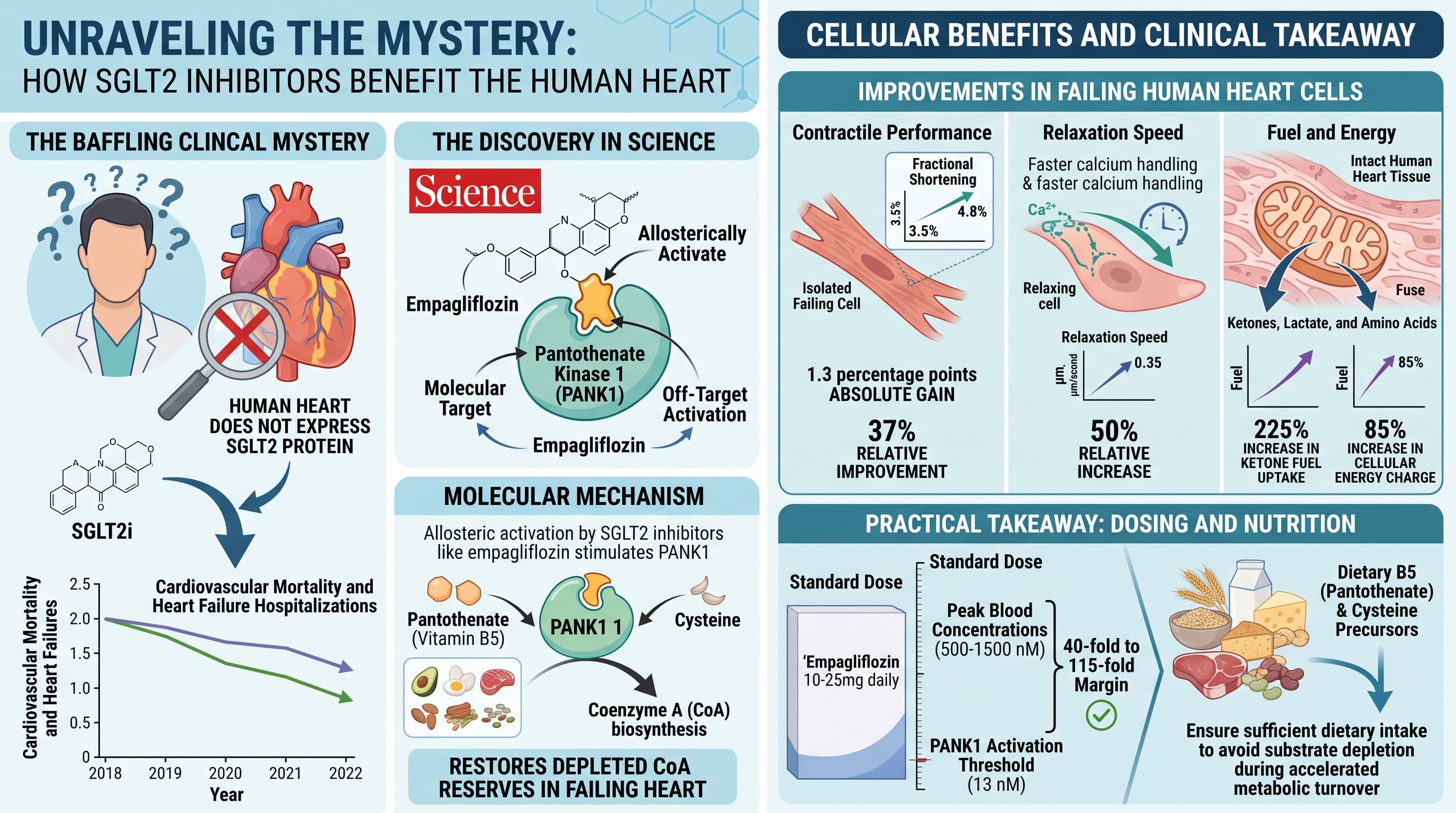
For over a decade, clinicians remained baffled by why sodium-glucose cotransporter 2 (SGLT2) inhibitors slashed cardiovascular mortality and heart failure hospitalizations, even though the human heart does not express the SGLT2 protein. A study published in Science uncovers the molecular target: SGLT2 inhibitors directly bind and allosterically activate pantothenate kinase 1 (PANK1), the rate-limiting enzyme in coenzyme A biosynthesis. In human heart tissue, this off-target activation restores depleted coenzyme A reserves, accelerates cellular fuel burning across ketones, lactate, and amino acids, and directly enhances myocardial contraction and relaxation velocities.
Cardiologists have spent the past decade celebrating a major clinical victory that they could not explain. SGLT2 inhibitors such as empagliflozin were engineered for type 2 diabetes to force the kidneys to dump excess glucose into urine. Large clinical trials subsequently demonstrated that these drugs caused dramatic reductions in heart failure hospitalizations and cardiac deaths, benefiting patients regardless of whether they had diabetes. Yet, the heart does not express SGLT2. Rodents lacking the transporter entirely still gain cardiac protection from the drugs, proving that the primary cardiac benefit does not rely on renal glucose excretion.
A research team at the University of Pennsylvania has identified the missing target. Rather than acting through secondary hormonal shifts or systemic changes, empagliflozin acts directly on myocardial tissue through an unexpected off-target mechanism.
To investigate, researchers developed an ex vivo system to perfuse functional blocks of human heart tissue taken directly from transplant recipients with failing hearts and organ donors. Perfusing these tissues with 700 nanomolar empagliflozin, a concentration matching standard clinical patient blood levels, immediately stimulated broad metabolic fuel consumption. The treated human heart muscle pulled significantly more ketones, lactate, and branched-chain amino acids from the perfusate and channeled them directly into the mitochondrial Krebs cycle, raising cellular ATP and overall energy balance.
Metabolomic tracing pointed to a specific biochemical bottleneck. Treated tissues showed a steep depletion of vitamin B5 (pantothenate) accompanied by an increase in phosphopantothenate. This specific shift highlighted pantothenate kinase 1 (PANK1), the rate-limiting pacemaker enzyme that cells use to synthesize coenzyme A (CoA). Failing human hearts suffer from severe metabolic starvation characterized by depleted pools of free CoA, the obligate cofactor required to burn fats, ketones, and carbohydrates.
Using structural modeling, cellular thermal shift assays, and biophysical scattering, the investigators proved that empagliflozin binds directly to the PANK1 homodimer. The drug slots into an allosteric pocket with an effective concentration (EC50) of roughly 13 nanomolar, well below standard human therapeutic blood levels. Binding causes the enzyme to fold into a more compact, active configuration, stimulating CoA production without blocking the catalytic core. Other approved gliflozins, including dapagliflozin and canagliflozin, demonstrated identical PANK1 stimulation, confirming a broad drug class effect.
In single-cell assays of failing human heart muscle cells, empagliflozin directly increased contractile force and accelerated muscle relaxation. When researchers chemically blocked the downstream CoA pathway, these improvements completely vanished. Conversely, synthetic PANK activators reproduced the identical benefits. These findings confirm that SGLT2 inhibitors treat heart failure by rescuing cardiac energy production at its molecular origin.
Actionable Insights
This discovery provides practical clarity for clinicians and health-conscious adults evaluating the cardiometabolic benefits of SGLT2 inhibitors.
In isolated failing human heart cells, empagliflozin produced substantial physical improvements. The drug increased fractional shortening by an absolute 1.3 percentage points, representing a 37 percent relative gain in contractile performance (moving from 3.5 percent to 4.8 percent). Relaxation speed improved by an absolute 0.35 micrometers per second, a 50 percent relative increase that reflects much faster calcium handling in exhausted muscle cells. In intact human heart tissue, the drug stimulated a 225 percent increase in ketone fuel uptake and elevated cellular energy charge by roughly 85 percent.
The primary practical takeaway is that standard clinical doses (such as 10 to 25 milligrams of empagliflozin daily) achieve peak blood concentrations between 500 and 1500 nanomolar. This provides a 40-fold to 115-fold margin above the 13 nanomolar threshold required to activate PANK1 and drive coenzyme A synthesis. Because PANK1 uses pantothenate (vitamin B5) and cysteine as essential raw ingredients to build coenzyme A, individuals taking SGLT2 inhibitors should ensure sufficient dietary intake of dietary B5 and cysteine precursors to avoid substrate depletion during accelerated metabolic turnover.
Context/Source
- Paywalled Paper: SGLT2 inhibitors activate pantothenate kinase in the human heart
- Institutions: Cardiovascular Institute, Department of Medicine, Department of Biochemistry and Biophysics, and Department of Physiology, Perelman School of Medicine at the University of Pennsylvania; Lewis Katz School of Medicine at Temple University; Children’s Hospital of Philadelphia
- Country: United States of America
- Journal Name: Science
- Journal Impact Evaluation: The impact score of this journal is 56.9, evaluated against a typical high-end range of 0–60+ for top general science, therefore this is an Elite impact journal.
Related Reading:
- Canagliflozin - Another Top Longevity Drug
- SGLT2 Inhibitor Canagliflozin eliminates senescent cells and alleviates pathological aging (in mice)
- Non-diabetics taking SGLT2 inhibitors (Jardiance, Invokana, etc.)—what is your experience?
- SGLT2i: The Diabetes Drug That Sweeps Out "Zombie" Cells: Peeing Out Sugar Slows Aging?