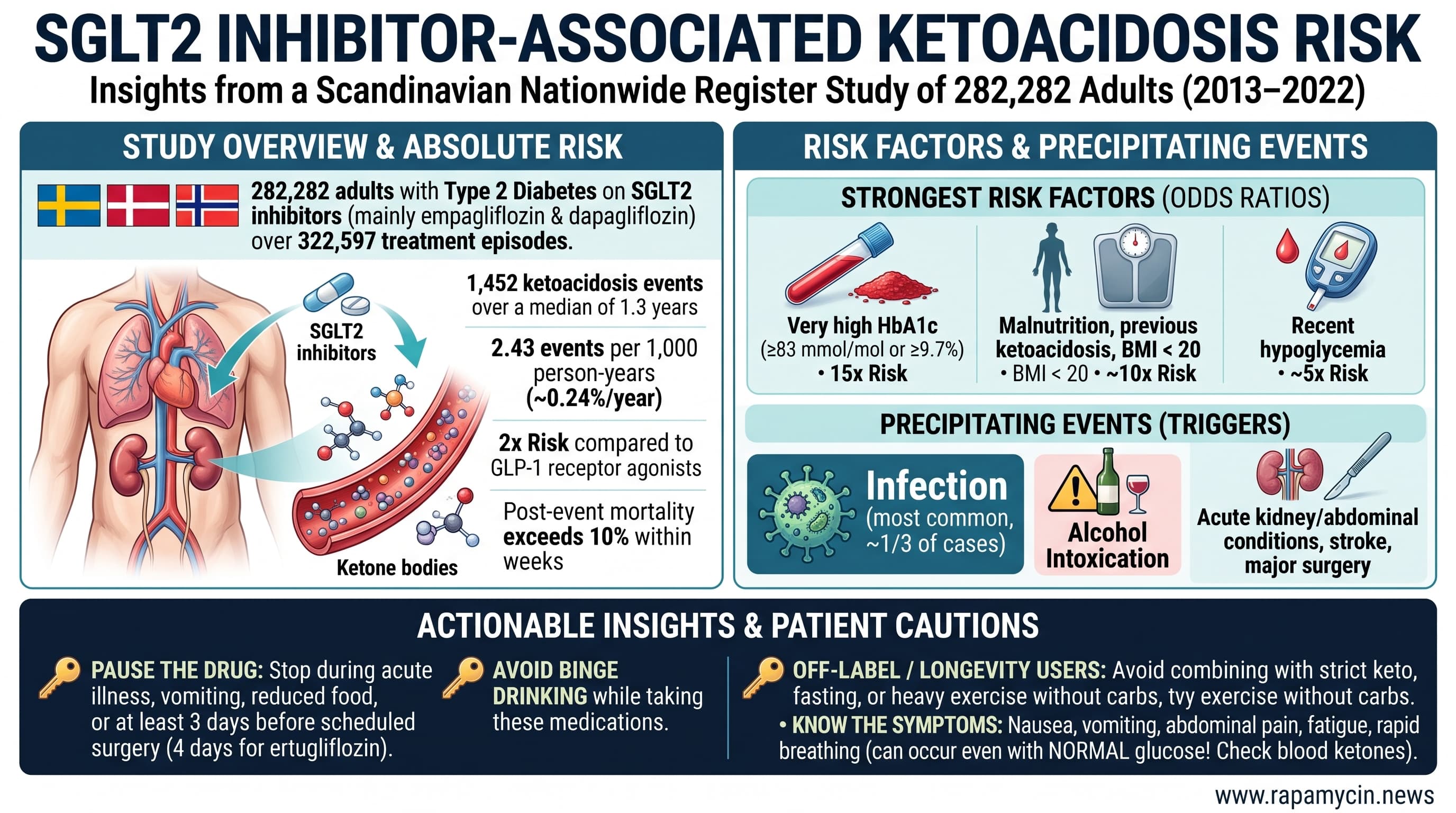
Researchers at Karolinska Institutet, Statens Serum Institut and Scandinavian partners used nationwide registers from Sweden, Denmark and Norway to study ketoacidosis in 282,282 adults with type 2 diabetes on SGLT2 inhibitors (mainly empagliflozin and dapagliflozin), covering 322,597 treatment episodes from 2013 to 2022. Over a median of 1.3 years, 1,452 ketoacidosis events occurred, 2.43 per 1,000 person-years. Risk was highest in the first six months but persisted for years. In a nested case-control analysis, the strongest risk factors were: Very high HbA1c (83 mmol/mol or higher, about 9.7%): odds ratio 15, Malnutrition, previous ketoacidosis and BMI under 20: odds ratios about 10, Recent hypoglycemia: odds ratio about 5. Infection was the most common precipitating event, present in about a third of cases. Alcohol intoxication, acute kidney events, acute abdominal conditions, stroke and major surgery showed the strongest associations.
SGLT2 inhibitors such as canagliflozin, empagliflozin and dapagliflozin have become cornerstone treatments for type 2 diabetes, heart failure and chronic kidney disease. They lower blood sugar by making the kidneys excrete glucose, and they reduce heart and kidney events. In longevity circles, interest grew after canagliflozin extended lifespan in male mice in the NIH Interventions Testing Program. Their main serious side effect is ketoacidosis, a dangerous buildup of acids in the blood. Because blood sugar may be only modestly elevated, it can be missed.
Clinical trials show the risk roughly doubles or triples with these drugs. Trials enrolled carefully selected patients and often excluded people with poor glucose control or prior ketoacidosis. This Scandinavian study looked at what happens in everyday practice, using the region’s comprehensive health registers.
Among more than 280,000 people with type 2 diabetes, ketoacidosis occurred at a rate of about 2.4 per 1,000 people per year, higher than in most trials. The risk peaked in the first six months but did not disappear afterward. Later periods still carried roughly two-thirds of the early risk. People who had been on diabetes medication for seven years or more were at higher risk, consistent with gradual loss of insulin production over time.
To identify who is most vulnerable, the researchers compared each person who developed ketoacidosis with up to ten similar users who did not. The clearest warning signs pointed to insulin deficiency:
- Very poor glucose control
- Malnutrition
- Low body weight
- Previous ketoacidosis
- Recent episodes of low blood sugar
Some of these patients may actually have had a slow-onset form of type 1 diabetes misclassified as type 2. Alcohol misuse, psychiatric illness, antipsychotic medications and pancreatic disease also raised risk. Living with a partner and higher BMI were associated with lower risk.
Acute events often set things off. Infection was present in nearly a third of cases. The strongest associations were with alcohol intoxication, acute kidney problems, acute abdominal conditions, stroke and major surgery, each linked to odds ratios of roughly 15 to 50. The authors caution that some of these figures are inflated, because healthy controls rarely visited a doctor and so would have had milder events recorded less often.
The consequences were serious. More than one in ten people died within weeks of ketoacidosis, though many deaths were probably driven by the underlying illness. A year later, insulin use had more than doubled, from 32% to 73%. Still, one in four continued their SGLT2 inhibitor.
A comparison with other diabetes drugs was revealing. Among users of DPP-4 inhibitors, which don’t raise ketoacidosis risk, the same risk factors carried similar weight. SGLT2 inhibitors seem to amplify a general vulnerability rather than create new risk factors. Compared with GLP-1 drugs, they roughly doubled overall ketoacidosis risk.
The study relies on diagnosis codes rather than blood test results, so some cases may be misclassified, and it cannot prove that each precipitating event came first. But its size, completeness and multi-country design make it the most detailed real-world picture yet. The authors’ advice is practical: assess risk throughout treatment, and tell patients to pause the drug during acute illness, before surgery and during periods of stress.
Actionable Insights
- Absolute risk is low for most people with diabetes. 2.43 events per 1,000 person-years is about 0.24% per year. The authors estimate the drug-attributable excess at roughly 0.12 to 0.16% per year, about 1 extra case per 625 to 833 people treated for a year.
- Risk varies enormously. Using the reported case-control distributions, I estimated approximate rates (computed, rough):
- HbA1c 83 or higher: about 10 per 1,000 per year (1%)
- HbA1c 52 or lower: about 0.8 per 1,000 per year
- Previous ketoacidosis or malnutrition: about 20 or more per 1,000 per year
- Pause the drug during acute illness, vomiting or reduced food intake, and before planned surgery. US labeling advises stopping canagliflozin, dapagliflozin and empagliflozin at least 3 days before, and ertugliflozin at least 4 days before scheduled surgery.
- Avoid binge drinking on SGLT2 inhibitors; alcohol intoxication carried the highest odds ratio (50, likely overstated).
- For healthy, insulin-sufficient people, ketoacidosis on an SGLT2 inhibitor is very rare. In the large trials that enrolled people without diabetes, there was one case among about 7,356 people on the drug (EMPA-KIDNEY), and none in the heart failure trials (DAPA-HF, DELIVER, EMPEROR-Reduced and EMPEROR-Preserved). In other words, zero cases in over 10,000 non-diabetic patients over a two year period, the approximate length of each of these studies.
- For off-label longevity users: this study covered only type 2 diabetes. Avoid combining SGLT2 inhibitors with strict ketogenic diets, prolonged fasting or heavy exercise without adequate carbohydrate. Know the symptoms: nausea, vomiting, abdominal pain, unusual fatigue and rapid breathing, even with normal glucose. Home blood ketone testing is inexpensive.
Context and Source
- Paywalled Paper: Ketoacidosis with SGLT2 inhibitors in routine clinical practice of type 2 diabetes: Scandinavian cohort and nested case-control study, published 1 September 2026.
-
Institutions:
- Centre for Pharmacoepidemiology, Karolinska Institutet, Stockholm
- Statens Serum Institut, Copenhagen
- Swedish National Diabetes Register and University of Gothenburg
- HUNT Research Center, NTNU, Norway
- Stanford University; Danish Cancer Institute
- Countries: Sweden, Denmark and Norway (with US co-authorship)
- Journal: The Lancet Diabetes & Endocrinology
- Impact evaluation: The impact score of this journal is approximately 40, evaluated against a typical high-end range of 0 to 60+ for top general science and medicine, therefore this is an Elite impact journal.
Related Reading:
- Cardiologists Name SGLT Inhibitors the Leading Geroprotector Candidate, Ahead of Rapamycin and Metformin
- Canagliflozin - Another Top Longevity Drug
- SGLT2i: The Diabetes Drug That Sweeps Out "Zombie" Cells: Peeing Out Sugar Slows Aging?
- Why Empagliflozin’s Cardiovascular Benefit May Start in Your White Blood Cells
- Empagliflozin - One Drug, Four Organs: Heart, Kidney, Liver and Arteries All Benefit
- SGLT2 Inhibitors Supercharge Human Hearts by Activating Pantothenate Kinase