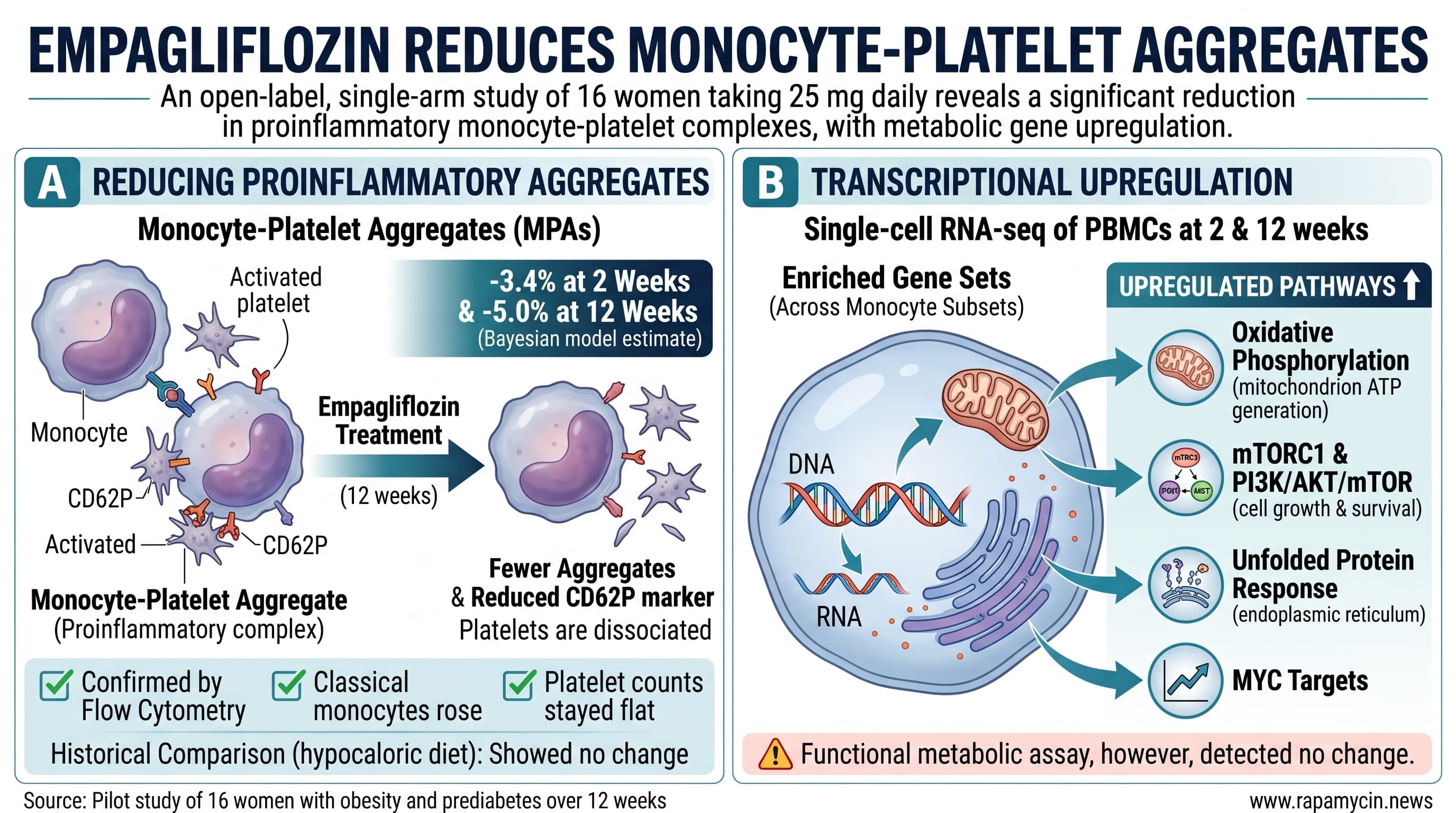
Sixteen women who were obese and had blood sugar levels on the edge of diabetes took empagliflozin, a common diabetes drug, every day for twelve weeks. Doctors drew their blood three times: before they started, after two weeks, and at the end. They were looking for a particular troublemaker in the blood. Platelets are the tiny cells that help blood clot, and when they get activated they sometimes stick to white blood cells called monocytes. The clumps they form stir up inflammation and have been tied to heart disease. The researchers used a technique that reads the genes of one cell at a time, and they went to real effort to prove these clumps were actual clumps and not just two cells accidentally measured together, including photographing them under a microscope. After twelve weeks on the drug, the clumps were noticeably less common, dropping by roughly 40 percent, and the platelets still attached to them looked less activated. Free monocytes went up as the clumps went down, and the total number of platelets stayed the same. A small group of four women who had tried cutting calories instead of taking the drug showed no such change.
SGLT2 inhibitors have an unexplained surplus. In the large cardiovascular outcome trials they prevent more heart failure hospitalizations and cardiovascular deaths than their effects on glucose, weight, or blood pressure can account for. The leading candidate explanation is that they do something to inflammation. Nobody has shown clearly what.
A Vanderbilt group went looking inside human immune cells. They took 16 women with obesity and prediabetes, gave them empagliflozin 25 mg daily for 12 weeks, and drew blood at baseline, 2 weeks, and 12 weeks. Eight of those sample sets went through single-cell RNA sequencing.
Their target was an object that is easy to miss. When platelets become activated, some of them latch onto circulating monocytes, forming a hybrid complex called a monocyte-platelet aggregate. These aggregates are more inflammatory than either partner alone and have been linked to cardiovascular disease.
Finding them in sequencing data is harder than it sounds, because a monocyte with a platelet stuck to it looks very much like two cells accidentally captured in one droplet, which is the field’s classic artifact. The team spent most of their effort ruling that out. They computationally excluded technical doublets. They built artificial aggregates by digitally fusing a platelet transcriptome to a monocyte transcriptome from the same person, and showed the real ones looked different. Then they went to the microscope and photographed platelets physically bound to monocytes.
Having established the population was real, the result was straightforward. After empagliflozin, these aggregates became less common. A Bayesian model put the reduction at 5.0 percentage points by 12 weeks, with a credible interval comfortably away from zero. Classical monocytes rose correspondingly, which is what you would expect if aggregates were simply dissociating back into free monocytes. Platelet frequency did not change. The platelet activation marker on the remaining aggregates fell too.
Four women from an earlier study who had done 14 weeks of calorie restriction instead showed no such change. The authors read this as evidence that the effect is drug-specific rather than a consequence of weight loss.
The transcriptional picture is where it gets interesting and slightly strange. Twelve weeks of empagliflozin pushed monocytes toward oxidative phosphorylation, which fits the standard immunometabolic story in which inflammatory cells run on glycolysis and quieter cells run on mitochondria. But the same analysis showed increased mTORC1 and PI3K/AKT/mTOR signaling, which is an anabolic growth program, not an obvious anti-inflammatory one. The authors describe this as a coordinated shift toward a more homeostatic phenotype, which is plausible but is an interpretation rather than a demonstration.
And the functional assay disagreed. When they measured actual metabolic activity and fuel dependence in these cells, empagliflozin changed nothing.
This is a pilot study of eight people, all women, all White, with no placebo arm and no randomization.
Actionable Insights
The study identifies a plausible mechanism. Empagliflozin reduced monocyte-platelet aggregates by roughly 40 percent in relative terms over 12 weeks, in a group of eight people. That is a reasonably large effect on the marker.
The effect appeared independent of weight and glucose. Aggregate frequency did not track either. For anyone taking an SGLT2 inhibitor primarily for metabolic reasons, this suggests an additional pathway is engaged. Note that with only seven or eight people, the study had almost no ability to detect such correlations even if they exist, so read this as unconfirmed rather than established.
The diet comparison is weaker than it sounds. Four people showed no change. Four people would not reliably show a change even if calorie restriction were genuinely effective. The conclusion that empagliflozin “uniquely” reduces these aggregates is not supported by that arm.
Timing matters. Most of the effect was present by 2 weeks and grew modestly by 12. This is a fast pharmacodynamic response, not a slow remodeling.
Context and Source
- Paywalled Paper: SGLT2 Inhibitor Empagliflozin Reduces Circulating Monocyte-Platelet Aggregates: A Pilot Study, published September 15, 2026
- Institutions: Vanderbilt University Medical Center and Vanderbilt University, Nashville, with the Tennessee Valley VA Healthcare System, UT Southwestern Medical Center, and the VA Geriatric Research Education Clinical Center
- Country: United States
- Journal: Circulation (American Heart Association / Lippincott Williams & Wilkins),
- Impact evaluation: The impact score of this journal is 38.6, evaluated against a typical high-end range of 0 to 60+ for top general science, therefore this is an Elite impact journal.
Related Reading:
- SGLT2i: The Diabetes Drug That Sweeps Out "Zombie" Cells: Peeing Out Sugar Slows Aging?
- Empagliflozin - One Drug, Four Organs: Heart, Kidney, Liver and Arteries All Benefit
- Low-Dose Canagliflozin Flips the Script on Who Gets a Brain Benefit
- Canagliflozin - Another Top Longevity Drug
- SGLT2 Inhibitor Head-to-Head Comparative Effectiveness