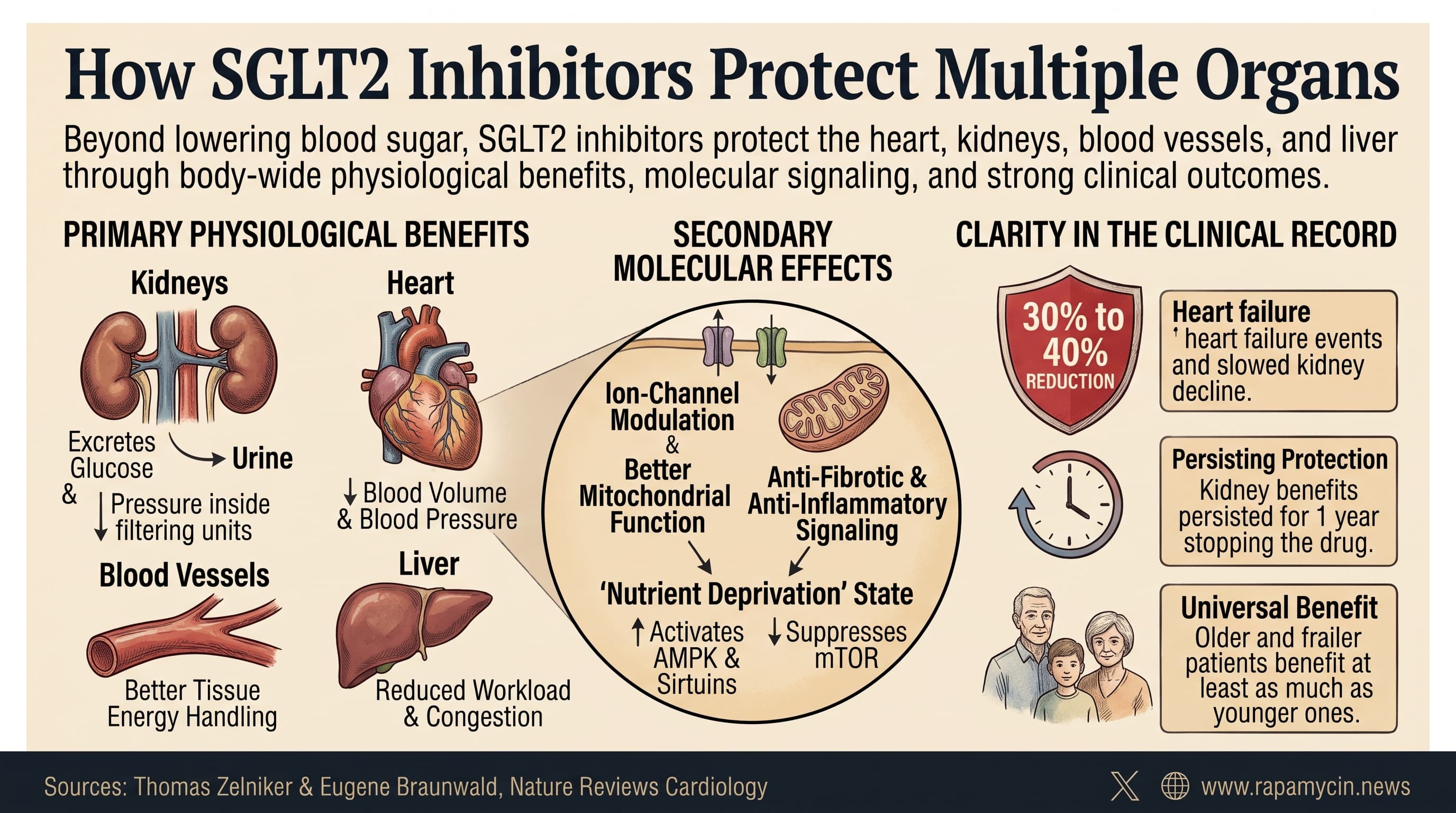
This Nature Reviews Cardiology article by Thomas Zelniker and the late Eugene Braunwald reviews how SGLT2 inhibitors, especially empagliflozin, protect the heart, kidneys, blood vessels and liver. SGLT2 inhibitors are drugs originally developed to lower blood sugar by making the kidneys excrete glucose. The authors argue that the earliest and most important benefits come from body-wide physiological changes: reduced blood volume and blood pressure, lower pressure inside the kidney’s filtering units, and better tissue energy handling. They frame the many molecular effects seen in animal and cell studies as largely secondary. These include ion-channel modulation, better mitochondrial function, anti-fibrotic and anti-inflammatory signaling, and a “nutrient deprivation” state that activates AMPK and sirtuins while suppressing mTOR.
A decade ago, a diabetes drug did something nobody expected. In 2015, the EMPA-REG OUTCOME trial showed that empagliflozin, a pill designed simply to make the kidneys flush sugar into the urine, cut cardiovascular deaths by more than a third in people with type 2 diabetes and heart disease. Hospital admissions for heart failure fell sharply, and the benefit appeared within weeks.
Ten years and more than 100,000 trial participants later, the drug class known as SGLT2 inhibitors has become a cornerstone of cardiology and kidney medicine. A new review by Thomas Zelniker of the Medical University of Vienna and the late Eugene Braunwald, one of the most influential cardiologists of the past century, sets out to explain why.
The honest answer is that nobody is entirely sure. The authors argue that the earliest effects are physical rather than molecular. The drugs make the body shed sugar and some sodium, which trims blood volume, lowers blood pressure by a few points and eases the load on the heart. In the kidney, extra sodium reaching a sensor called the macula densa signals the filtering units to lower their internal pressure, protecting them from slow damage caused by overwork. These changes begin within days, which fits how quickly the trial results diverged.
Downstream, the list of proposed mechanisms is long. In animal and cell studies, empagliflozin improves how heart cells handle sodium and calcium, blocks a leaky sodium current linked to arrhythmias, boosts mitochondrial energy production, reduces scarring and inflammation, and restores autophagy, the cell’s recycling system. The drug also pushes the body into a mild fasting-like state: insulin falls, fat burning rises and the liver produces ketones. Some researchers argue that this mimicry of scarcity switches on the same survival pathways triggered by calorie restriction, including AMPK and sirtuins, while turning down mTOR, the growth regulator that rapamycin targets.
The authors sensibly treat many of these molecular findings as secondary effects rather than primary causes. Some headline mechanisms, such as direct blockade of a sodium-hydrogen exchanger in heart cells, have been contradicted by other laboratories. Much of the evidence comes from diabetic mice and cell cultures exposed to concentrations that are hard to compare with human doses.
The clinical record is far clearer. Across trials in heart failure, chronic kidney disease and diabetes, SGLT2 inhibitors consistently reduced heart failure events and slowed kidney decline by roughly 30 to 40 percent. Kidney benefits in one large trial persisted for a year after patients stopped the drug. Older and frailer patients benefited at least as much as younger ones.
Not every trial succeeded. In patients who had just had a heart attack, empagliflozin did not reduce deaths or heart failure events overall, though it lowered heart failure hospitalizations. Trials in hospitalized COVID-19 patients were neutral. Side effects include genital yeast infections and, rarely, a dangerous form of ketoacidosis that can occur even when blood sugar is normal.
For the longevity community, the tantalizing question is whether a drug that mimics fasting and protects heart, kidney and liver might slow aging more broadly. So far, the best lifespan improvement evidence comes from mice: a related drug, canagliflozin, extended median lifespan by 14% in male but not female mice in a rigorous NIA testing program.
Both authors of this review have extensive financial ties to the manufacturers of SGLT2 inhibitors.
Actionable Insights
- Heart failure: In the large trials, the combined risk of cardiovascular death or heart failure hospitalization fell by 18 to 26 percent. Treating roughly 19 to 32 people for 1.5 to 2 years prevents one such event.
- Kidney disease: The risk of major kidney or heart outcomes fell by 28 to 39 percent. Treating about 19 to 26 patients for 2 to 2.5 years prevents one event.
Practical points for users:
- An early drop in kidney filtration of up to 30 percent is expected, usually reversible, and not a reason to stop.
- Pause the drug at least 3 days before major surgery and during acute illness, prolonged fasting or dehydration.
- Ketogenic diets, extended fasts and heavy alcohol use raise the risk of euglycaemic ketoacidosis, a dangerous acid buildup that can occur even with normal blood sugar.
- Genital yeast infections are the most common side effect, more often in women.
For healthy people considering off-label use for longevity: the key lifespan evidence is a 14 percent median lifespan gain in male mice given canagliflozin.
Context and Source
- Paywalled Paper: Cardioprotective properties of empagliflozin and other SGLT2 inhibitors
- Institutions: Medical University of Vienna; TIMI Study Group, Brigham and Women’s Hospital and Harvard Medical School
- Countries: Austria and USA
-
Journal: Nature Reviews Cardiology, published online 27 July 2026
Impact evaluation: The impact score of this journal is 50.2 (2025 Journal Impact Factor, Clarivate JCR 2026; five-year JIF 60.3), evaluated against a typical high-end range of 0-60+ for top general science, therefore this is an Elite impact journal.
Related Reading:
- Cardiologists Name SGLT Inhibitors the Leading Geroprotector Candidate, Ahead of Rapamycin and Metformin
- SGLT2i: The Diabetes Drug That Sweeps Out "Zombie" Cells: Peeing Out Sugar Slows Aging?
- Reprogramming the Aging Skin Vessel: Diabetes Drug Ipragliflozin Reins In “Shape-Shifting” Blood Cells
- Canagliflozin - Another Top Longevity Drug
- SGLT2 Inhibitors Supercharge Human Hearts by Activating Pantothenate Kinase