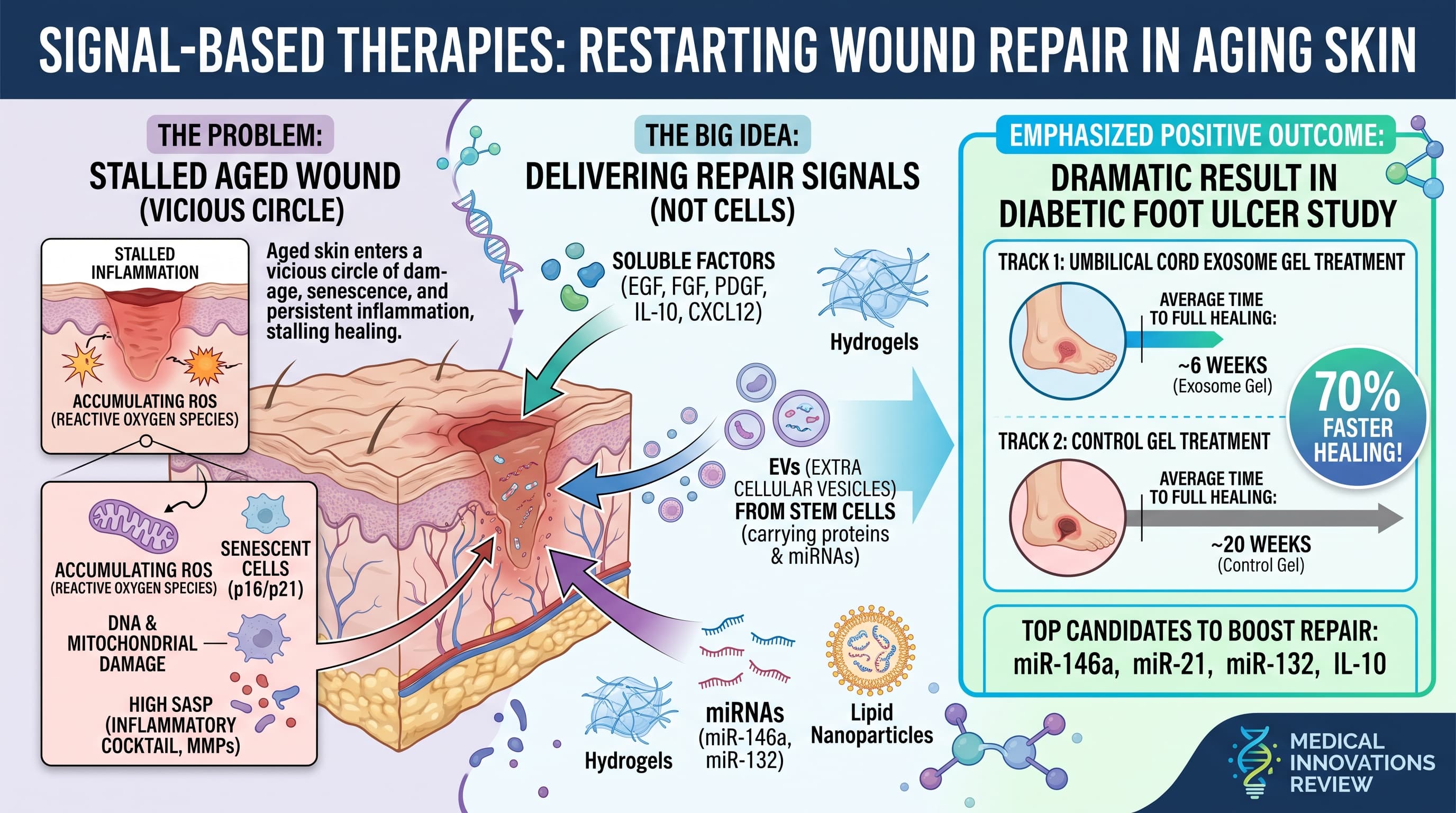
This narrative review from the University of Coimbra argues that aged skin heals poorly because oxidative stress, senescent cells, chronic inflammation, weak blood supply and broken cell-to-cell communication all reinforce each other. The authors propose three cell-free fixes: the secretome (the mix of growth factors, cytokines and chemokines that stem and other cells release), extracellular vesicles (EVs, including “exosomes”), and microRNA (miRNA) therapies. They pair these with smart delivery systems such as hydrogels, nanofibers, nanoparticles and microneedles that release their cargo in response to wound conditions. The mechanistic case is strong. The human evidence is thin.
Cut the skin of a 25-year-old and a 75-year-old and you will watch two very different repair jobs. The younger wound moves briskly from inflammation to rebuilding to remodelling. The older one often stalls, sometimes for months. This review sets out to explain why, and what might restart the process without transplanting living cells.
The authors describe aged skin as a system locked in a vicious circle. Skin loses antioxidant capacity with age, so reactive oxygen species build up. That damage harms DNA and mitochondria, which leak more oxidants. Stressed cells switch on the p16 and p53/p21 brakes and become senescent. Senescent cells then secrete an inflammatory cocktail, the SASP, which degrades collagen through enzymes called MMPs and pushes neighbouring cells toward senescence. Thinning blood vessels starve the tissue of oxygen, completing the loop. The result is a wound that cannot leave the inflammatory phase.
The Big Idea is that the repair signals, not the repair cells, are what matter. Stem cells injected into wounds mostly die, yet they still help, largely through what they secrete. So why not deliver the secretions directly? The review sorts candidates into three groups. First, soluble factors: EGF, FGF, PDGF, anti-inflammatory IL-10, and chemokines such as CXCL12. Second, EVs from mesenchymal stromal cells, adipose cells, umbilical cord and induced pluripotent stem cells, which carry proteins and miRNAs in a protective lipid shell. Third, miRNAs themselves. The authors name miR-146a, miR-21 and miR-132 as the best candidates to top up, and miR-155, miR-34 and miR-200 as candidates to block.
Delivery is the practical bottleneck. An aged wound is acidic, protease-rich, oxidant-rich and poorly perfused, which chews up delicate proteins and RNA. The newest platforms react to those conditions. One hydrogel falls apart only when MMP-9 reaches the high levels seen in diabetic wounds, releasing exosomes on demand. Another senses glucose and pH, generates oxygen and scavenges oxidants. Lipid nanoparticles carrying VEGF messenger RNA, the same basic technology behind mRNA vaccines, closed mouse wounds almost completely in nine days.
Timing matters too. In one mouse study, a tiny EV dose given twice daily outperformed single doses up to 100 times larger. Several agents, including IL-10 and an anti-CCL28 antibody, worked at low doses and failed or backfired at high ones. More is not better.
The sobering part is the clinical table. Only four registered human studies of secretome or EV products appear. One small uncontrolled study, one randomized trial in diabetic foot ulcers with a striking result, one burn trial that enrolled a single patient, and one well-designed trial in healthy volunteers that found no benefit at all. The only growth factor approved by the FDA for wounds, PDGF-based Regranex, has been available since the 1990s and has not transformed care.
For readers watching the booming consumer “exosome” market, this review is a useful reality check: the biology is plausible and the preclinical data are abundant, but the evidence that any of this works in an 80-year-old’s leg ulcer does not yet exist.
Actionable Insights
There is nothing here you can buy yet, that is proven to speed healing in older adults. Consumer “exosome” serums and injections are not FDA-approved drugs, and the review’s own evidence base is mostly mice.
The strongest human signal is one randomized trial in diabetic foot ulcers: umbilical cord exosome gel appeared to shorten average time to full healing from about 20 weeks to about 6 weeks. That is a dramatic difference, roughly 70% faster, but it comes from a single trial with notable dropout and needs replication.
For perspective, the approved PDGF gel raised complete ulcer closure from about 35% to about 50% of patients in its pivotal trial, meaning roughly one extra healed ulcer for every seven patients treated. That is a realistic ceiling for a single molecule.
Practical, lower-risk levers the paper touches on: regular exercise reversed slow wound healing in aged mice and prevents blood vessel cell senescence in humans. Because short-lived senescent cells help early healing, people using senolytics may reasonably pause them around surgery or significant wounds, and anyone on rapamycin should discuss perioperative holding with their surgeon, since mTOR inhibition is known to slow wound repair.
Context and Source
- Open Access Paper: Secretome and bioactive molecules for the enhancement of aged wound healing, published 17 September 2026
- Institutions: University of Coimbra (CIBB, CNC, MIA-Portugal, Faculty of Pharmacy, Faculty of Medicine, IIIUC), Coimbra University Hospital Centre Plastic Surgery and Burns Unit, and Sanfil Medical Group
- Country: Portugal
- Journal: Ageing Research Reviews
- Impact evaluation: Ageing Research Reviews has a 2025 Journal Impact Factor of 15.5 in the 2026 Journal Citation Reports release, is ranked Q1 in Cell Biology and Geriatrics & Gerontology, and has a CiteScore of 20.6. The impact score of this journal is 15.5, evaluated against a typical high-end range of 0 to 60+ for top general science (and roughly 0 to 20 for ageing and gerontology specialty journals), therefore this is a High impact journal.
Related Reading:
- The Skin That Refuses to Get Cancer: Naked Mole-Rat Skin Carries Its Own Bodyguard, and It Works Even on a Mouse
- More than Skin Deep: Leveraging Skin Health to Decelerate Biological Aging
- Old Cells, Thin Skin: A New Review Makes the Case for Senolytic Skincare
- Skin in the Game: Citrus Flavonoid Hesperetin Reverses Skin Aging via CISD2 Activation
- Reversing the Clock: Epigenetic Serum Lowers Skin Age by Two Years Across All Skin Tones
- Sulforaphane & The Skin Longevity Protocol