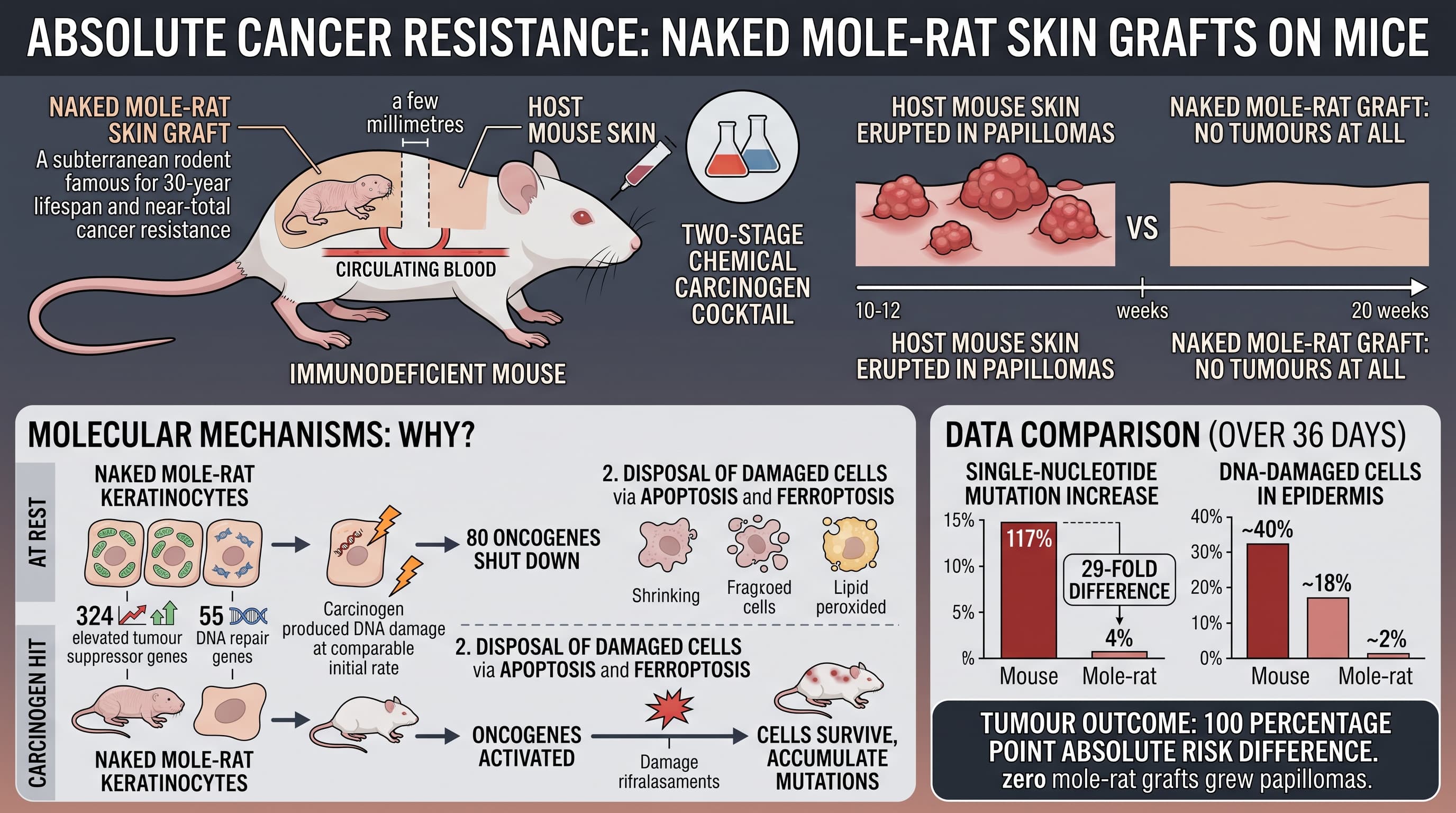
Researchers at Boston University and the University of Bradford took skin from naked mole-rats, the 30-year-living subterranean rodent famous for near-total cancer resistance, and grafted it onto immunodeficient mice. They then painted the animals with a two-stage chemical carcinogen cocktail that reliably produces skin tumours in mice within 10 to 12 weeks. The host mouse skin erupted in papillomas. The naked mole-rat graft sitting a few millimetres away, in the same animal, under the same chemical exposure and the same circulating blood, produced nothing at all for up to 20 weeks. Follow-up transcriptomics and whole-genome sequencing suggest why: naked mole-rat keratinocytes sit at rest with 324 tumour suppressor genes elevated relative to mouse keratinocytes, including 55 DNA repair genes, and when carcinogen hits, they respond by killing damaged cells through apoptosis and ferroptosis and by shutting down 80 oncogenes rather than switching them on. The mutations get made; the mutated cells do not survive.
For two decades the naked mole-rat has been longevity biology’s favourite outlier. It lives ten times longer than a mouse of similar size, and it almost never gets cancer. The standing explanation has leaned heavily on the animal’s peculiar internal environment: unusual high-molecular-weight hyaluronic acid filling its tissues, a modified INK4 tumour suppressor locus, blunted growth factor signalling, an odd immune system. Those are systemic explanations. They imply the animal protects its tissues.
This study inverts that logic. The Boston group cut skin from naked mole-rats and sewed it onto nude mice, then applied the classic two-stage chemical carcinogenesis protocol used to generate mouse skin tumours since the 1940s. The elegant part of the design is that each mouse became its own control. Host mouse skin and grafted mole-rat skin sat side by side, sharing a bloodstream, an immune system, a body temperature and an identical dose of carcinogen. Only the host skin developed tumours.
That result relocates the defence. Whatever protects the naked mole-rat from skin cancer travels with the tissue, and it does not need the animal.
The next question was whether the mole-rat skin simply avoids being mutated. It does not. Ten days after a single carcinogen dose, DNA damage markers rose in mole-rat epidermis just as they did in mouse epidermis. The difference appeared over the following weeks. In mouse skin, damage markers kept climbing and total single-nucleotide mutations rose by 117 per cent. In mole-rat skin, damage markers collapsed back toward baseline and mutations rose by roughly 4 per cent. The mutated cells had been removed.
Two removal mechanisms showed up in the gene expression data. One is ordinary programmed cell death. The other is ferroptosis, a form of iron-dependent, lipid-peroxidation-driven death that has only recently been connected to tumour suppression. As a reciprocal test, the team gave mice a ferroptosis-inducing drug, erastin, during carcinogen treatment, and tumour formation slowed.
Layered on top is a transcriptional posture. Even untreated, mole-rat skin cells run 324 tumour suppressor genes hotter than mouse cells do, six times more than the reverse comparison, and 55 of those govern DNA repair. On carcinogen exposure, mole-rat epidermis holds that elevated state and additionally silences 80 oncogenes spanning NF-kB, Wnt and receptor tyrosine kinase signalling. Mouse epidermis does the opposite, raising oncogenes and tumour suppressors together in an incoherent scramble.
The take-home for cancer biology is a shift in emphasis from mutation avoidance to mutated-cell elimination. The take-home for anyone hoping to buy this in a bottle is that no such bottle exists.
Insights
The naked mole-rat did not avoid getting mutated. Carcinogen produced DNA damage in its skin at a comparable initial rate to the mouse. What differed was disposal. Over 36 days, mouse skin accumulated a 117 per cent increase in single-nucleotide mutations; mole-rat skin accumulated 4 per cent, a roughly 29-fold difference. DNA-damaged cells fell from about 18 per cent to about 2 per cent of mole-rat epidermis over the same window, while rising to about 40 per cent in mouse skin. Tumour outcome was absolute: essentially every carcinogen-treated mouse grew papillomas, zero mole-rat grafts did. That is a 100 percentage point absolute risk difference, which is as large as an effect size can be, and it is why formal measures such as relative risk cannot even be computed here.
Practically, this reinforces that clearance capacity, not damage avoidance alone, is the lever. It also argues that sun exposure management remains the highest-value skin-cancer action available to humans, because human epidermis behaves like the mouse, accumulating mutant clones for life.
Context and Source
- Open Access Paper: Intrinsic anti-tumorigenic properties of the skin epithelium promote cancer resistance in naked mole-rats
- Institutions: Department of Dermatology, Boston University School of Medicine, Boston, Massachusetts, USA; Centre for Skin Sciences, Faculty of Life Sciences, University of Bradford, Bradford, UK
- Countries: United States and United Kingdom
-
Journal: iScience (Cell Press / Elsevier), 18 September 2026
Impact evaluation: The impact score of this journal is 4.5 (2025 Journal Impact Factor; CiteScore 7.4), evaluated against a typical high-end range of 0 to 60+ for top general science, therefore this is a Medium impact journal.