No Ceiling in Sight: More Fiber Tracks With Less Heart Disease Up to 35 Grams a Day

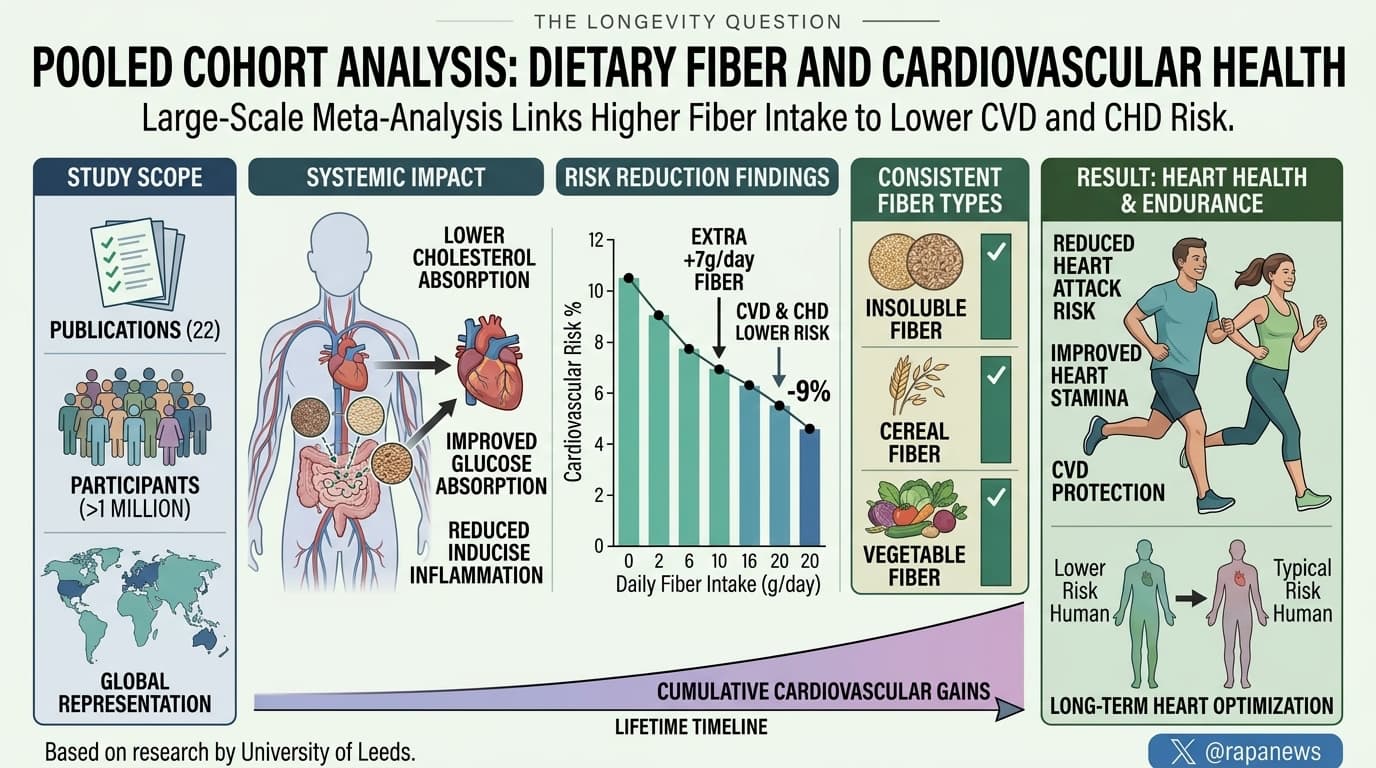
A University of Leeds team pooled 22 prospective cohort publications (well over a million participants across the US, Europe, Japan and Australia) to find out whether eating more dietary fibre tracks with lower cardiovascular risk, and by how much. Each extra 7 grams of total fibre per day was associated with a 9% lower risk of both cardiovascular disease (CVD) and coronary heart disease (CHD). Insoluble fibre and fibre from cereals and vegetables showed the most consistent associations. Soluble fibre, despite being the type with the clearest cholesterol-lowering mechanism, did not reach statistical significance.

For decades, “eat more fibre” has been one of the few pieces of dietary advice that nearly everyone agrees on. What has been missing is a clear answer to a simple question: how much more, and from where?

This 2013 BMJ meta-analysis tried to answer it by doing something earlier reviews had mostly avoided. Rather than comparing the highest fibre eaters with the lowest, the authors built a dose-response curve. They extracted results from prospective cohort studies that followed initially healthy adults for at least three years, estimated the risk slope within each study, and then combined the slopes.

The headline result is tidy. Every additional 7 grams of fibre per day was linked to a 9% lower risk of cardiovascular disease and a 9% lower risk of coronary heart disease. Seven grams is not a heroic amount. It is roughly one portion of whole grains plus a portion of beans or lentils, or two to four servings of fruit and vegetables. The risk curve kept sloping downward as intake rose, with no obvious plateau for total fibre, although data became thin above about 35 to 40 grams a day.

The more interesting story sits underneath the headline. Not all fibre behaved the same way. Insoluble fibre and cereal fibre showed the strongest associations with coronary disease, each around 16 to 18% lower risk per 7 grams. Vegetable fibre was consistently protective with almost no disagreement between studies. Fruit fibre helped for overall cardiovascular disease but not clearly for coronary disease specifically.

Soluble fibre, the viscous kind found in oats, psyllium and legumes, did not reach significance. That is awkward, because soluble fibre is the type with the best-documented mechanism: it binds bile acids and lowers LDL cholesterol in controlled trials. One reading is that soluble fibre intake was measured poorly or varied too little within populations. Another is that “fibre” in these cohorts is partly a marker for whole grain foods and the lifestyle that comes with them, rather than the active ingredient itself.

The authors are candid about this. Cohort data cannot separate fibre from the people who eat it: high fibre eaters exercise more, smoke less, drink less and weigh less. Most studies adjusted for these factors, and meta-regression did not find that adjustment choices explained the results, but residual confounding cannot be excluded. The authors also stress that their findings apply to fibre from food, not to fibre powders or fortified products.

The practical significance lies in scale. With average Western intakes sitting well below recommendations, a modest shift in diet applied across a population could translate into large absolute numbers of avoided heart attacks and strokes. This analysis was influential in the UK’s later move to raise its adult fibre recommendation to 30 grams per day.

The caveat that matters most for individuals: a 9% relative reduction is real but modest, and it rests on associations, not experiments. The direction is well supported. The exact size is not.

Actionable Insights

The core message is simple: add about 7 grams of fibre from whole foods to your day, and more if you can. That is roughly a bowl of oats plus a half cup of lentils, or several servings of vegetables and whole fruit.

How big is the benefit? Each 7 gram step was linked to 9% lower relative risk. In real terms, if your 10-year chance of a heart attack or stroke is 10%, one 7 gram step would lower it to about 9.1%. That means roughly 9 fewer events per 1,000 people over 10 years, or about 111 people needing to make the change for one to benefit. Doubling the increase to 14 grams (for example, going from 15 to 29 grams a day) lowers relative risk by about 17%, to roughly 8.3%, or 17 fewer events per 1,000.

For an individual, the effect of one step is small. Across a lifetime and a population, it adds up.

Prioritize whole grains, vegetables and legumes. Cereal and insoluble fibre had the strongest signals. Do not assume a fibre supplement delivers the same effect; this study did not test that, and the authors explicitly caution against it.

These numbers assume the association is causal, which is likely but not proven.

Context and Source

  • Open Access Paper Dietary fibre intake and risk of cardiovascular disease: systematic review and meta-analysis
  • Institution: Nutritional Epidemiology Group, School of Food Science and Nutrition, and Centre for Epidemiology and Biostatistics, University of Leeds
  • Country: United Kingdom
  • Journal: The BMJ, published 19 December 2013
  • Impact evaluation: The impact score of this journal is 42.7 (2024 Journal Impact Factor, released 2025; CiteScore 20.4), evaluated against a typical high-end range of 0 to 90+ for top general medical journals, therefore this is an Elite impact journal.
3 Likes

The Grain Defence: Cereal Fibre and Whole Grains Track With Steadily Lower Colorectal Cancer Risk

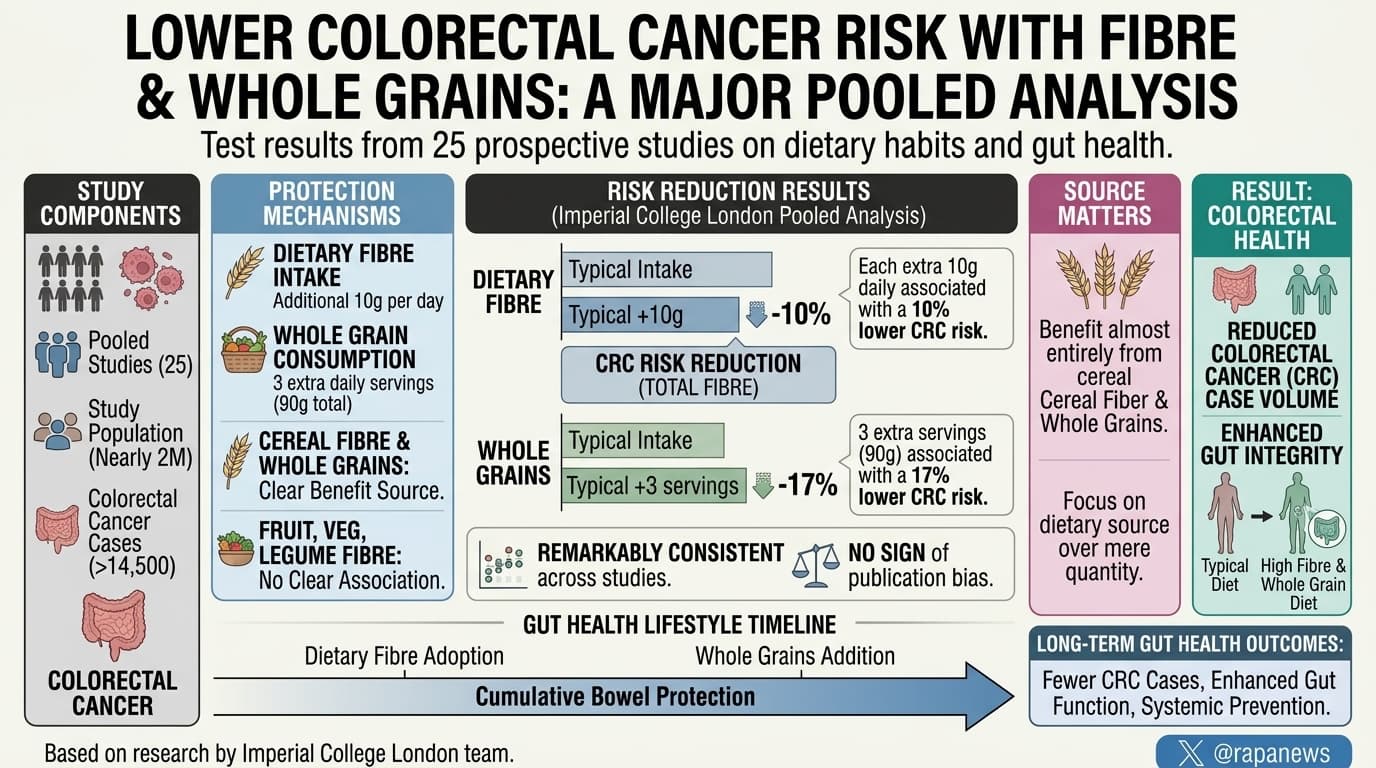
An Imperial College London team pooled 25 prospective studies, covering nearly two million people and more than 14,500 colorectal cancer cases, to test whether dietary fibre and whole grains protect the bowel. Each additional 10 grams of total fibre per day was associated with a 10% lower risk of colorectal cancer, and three extra daily servings of whole grains (90 grams) with a 17% lower risk. The benefit came almost entirely from cereal fibre and whole grains. Fibre from fruit, vegetables and legumes showed no clear association. The results were remarkably consistent across studies and showed no sign of publication bias, though they remain observational.

The idea that fibre protects against bowel cancer is more than 50 years old. It began with the surgeon Denis Burkitt, who noticed that rural Africans eating very high fibre diets rarely developed colorectal cancer. The hypothesis was elegant, but the evidence has been frustratingly mixed. Case-control studies usually supported it. Large prospective cohorts often did not.

This 2011 BMJ meta-analysis set out to settle the question with sheer volume. Working as part of the World Cancer Research Fund’s Continuous Update Project, the authors gathered every prospective study they could find: 25 in total, from the US, Europe and Asia. For the main dose-response analysis they had over 14,500 cases among close to two million participants, enough statistical power to detect modest effects and to map their shape.

The result is a clean, straight line. For every 10 grams of daily fibre, colorectal cancer risk fell by about 10%. There was no threshold and no plateau within the range studied. Strikingly, the 16 contributing studies agreed almost perfectly, with no measurable disagreement between them, and there was no sign that negative results had gone unpublished.

The more revealing finding is where the benefit came from. Cereal fibre carried the signal, with the same 10% reduction per 10 grams. Whole grains did even better: three extra servings a day, roughly a bowl of oatmeal, a slice of whole grain bread and a portion of brown rice, was linked to 17% lower risk. Fibre from fruit and vegetables showed essentially nothing. Legume fibre produced a large but wildly uncertain estimate based on only four studies.

That split matters. It suggests the protective effect is not a generic property of “fibre” but something specific to grains, perhaps their bran, their fermentable carbohydrates, or companion nutrients such as magnesium, folate, lignans and phenolic acids. The authors note that fruit and vegetables do appear protective in other analyses, so whatever helps there may not be fibre itself.

There is also reason to think these figures understate the truth. Food questionnaires are notoriously imprecise, and imprecision usually weakens associations. In the EPIC study, correcting for measurement error strengthened the fibre effect considerably. In a UK analysis using food diaries, the association was noticeably stronger than with questionnaires.

The obvious counterargument is the healthy-person effect. People who eat whole grains also tend to exercise, avoid smoking, drink less and eat less processed meat. The associations held up in studies that adjusted for these factors, but no observational analysis can fully escape this problem. A large randomised dietary trial in women found no colorectal cancer benefit, although fibre intake in that trial rose by only 2.5 grams a day, too little to expect much.

The picture that emerges is consistent and biologically plausible: whole grains and cereal fibre are among the more credible dietary levers for bowel cancer prevention. The effect per serving is modest. Across decades and a whole population, it is not trivial.

Actionable Insights

The practical message is specific: get your fibre largely from whole grains. Swap refined bread, pasta and rice for whole grain versions, and aim for about three servings a day (for example, oatmeal, whole grain bread and brown rice).

How big is the benefit? Each extra 10 grams of fibre was linked to 10% lower relative risk, and three daily servings of whole grains to 17% lower risk. In real terms, the average lifetime risk of colorectal cancer is roughly 4%. A 17% reduction brings that to about 3.3%, or about 7 fewer cases per 1,000 people over a lifetime. Adding 20 grams of total fibre (roughly doubling a typical Western intake) implies about 19% lower risk, or about 8 fewer cases per 1,000.

For one person, that is a small shift. It is comparable to many single lifestyle factors and larger than most supplements can claim.

Do not count on fruit or vegetable fibre specifically for bowel cancer protection; this analysis found no clear effect, though those foods have other benefits.

None of this replaces screening. Colonoscopy and stool testing reduce colorectal cancer far more than any diet change.

Context and Source

  • Open Access Paper: Dietary fibre, whole grains, and risk of colorectal cancer: systematic review and dose-response meta-analysis of prospective studies, Study from 2011.
  • Institutions: Department of Epidemiology and Biostatistics, School of Public Health, Imperial College London; University of Leeds; Wageningen University and Research Centre
  • Countries: United Kingdom and the Netherlands
  • Journal: The BMJ (BMJ 2011;343:d6617), published 10 November 2011
  • Impact evaluation: The impact score of this journal is 42.7 (2024 Journal Impact Factor, released 2025; CiteScore 20.4), evaluated against a typical high-end range of 0 to 90+ for top general medical journals, therefore this is an Elite impact journal.
3 Likes

Thanks, RapAdmin - important studies. Food for thought for many of us who fiber maxx. First, it’s dietary - so not clear if this applies to supplemental fiber as many of us top off with. Second, it seems very, very insistent that it’s insoluble fiber from fruits, veggies, whole grains and cereal. Furthermore, for CRC lowering it’s just whole grains and cereals. Meanwhile we have whole threads devoted to supplemental fiber, and overwhelmingly soluble - which at least according to these studies are pretty much non-actors. There’s the issue of healthy user bias, but I would note that it might actually work in the opposite way and confirm the findings, because if you are talking healthy users, then it is precisely the biggest health fanatics who (1) supplement with extra fiber, and (2) it’s overwhelmingly soluble fiber… yet it is that which shows up the joker - so healthy user bias is likely not as much of a factor. The other question for me is the displacement/substitution effect - if it’s the insoluble and dietary, cereal and whole grain showing up, then, as they say “daily bowl of oatmeal and slices of whole grain bread” is a hefty chunk of food that is displacing something in the diet, and that something seems less healthy. YMMV.

In any case, interesting findings!

1 Like