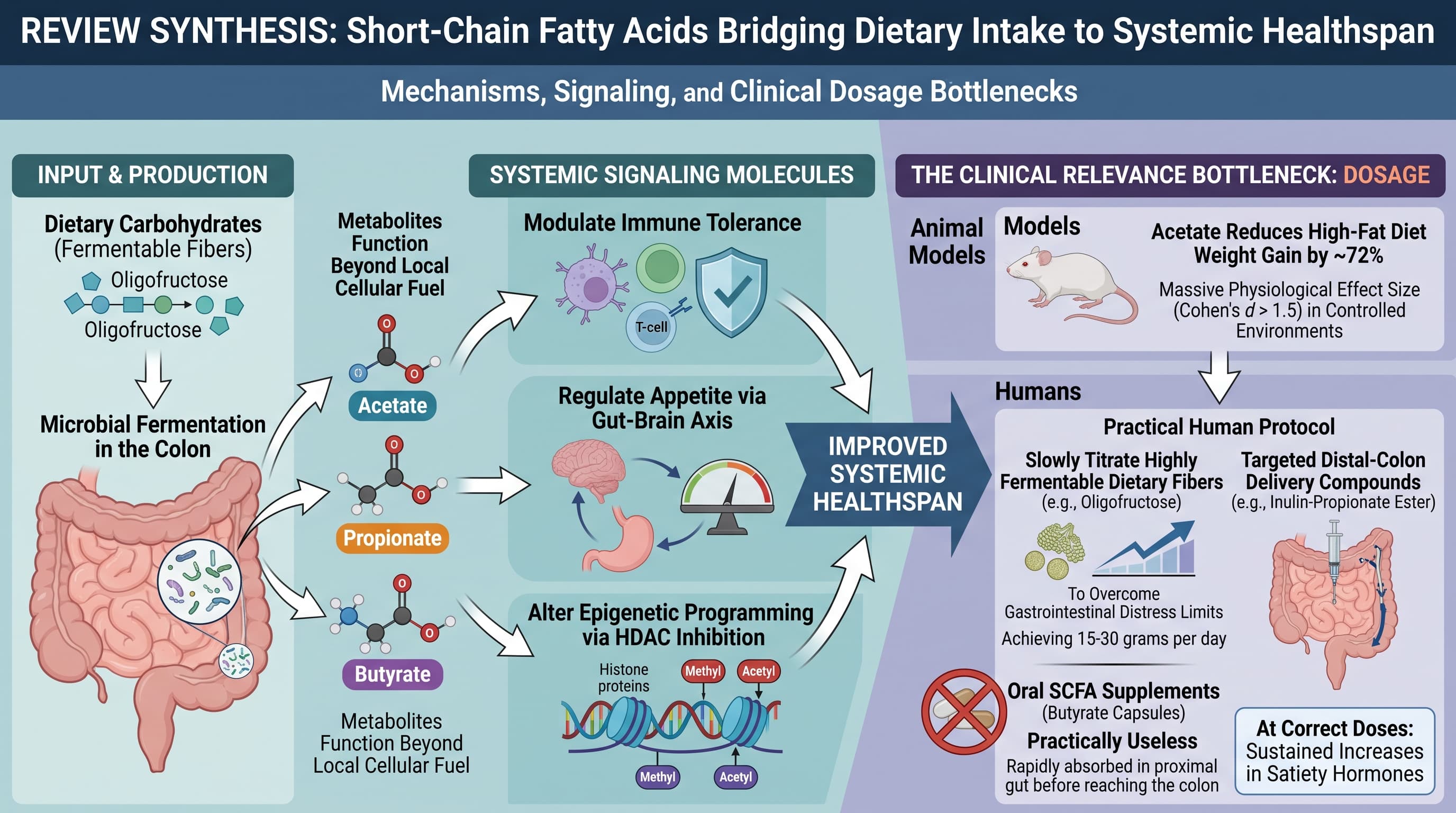
This review synthesizes mechanisms by which short-chain fatty acids, primarily acetate, propionate, and butyrate, bridge the gap between dietary carbohydrate intake and systemic healthspan. Produced via microbial fermentation in the colon, these metabolites function beyond local cellular fuel. They act as systemic signaling molecules that modulate immune tolerance, regulate appetite via the gut-brain axis, and alter epigenetic programming through histone deacetylase inhibition.
The scientific community has long recognized that high-fiber diets correlate with extended healthspan, but the exact molecular transmitters of this benefit have remained obscured by the complexity of the microbiome. This paper clarifies that short-chain fatty acids are the primary currency of this biological exchange. Produced by obligate anaerobes in the cecum and colon, these molecules establish a profound concentration gradient: butyrate is almost entirely consumed by colonic epithelial cells, propionate is heavily metabolized by the liver, and acetate achieves systemic circulation to interact with peripheral tissues.
The systemic impact of these metabolites is mediated by a widespread network of G-protein-coupled receptors, specifically FFAR2, FFAR3, and GPR109A. Activation of these receptors in the gut stimulates the release of glucagon-like peptide 1 and peptide YY, which travel via vagal afferents and systemic circulation to suppress hypothalamic appetite centers. Simultaneously, short-chain fatty acids actively suppress low-grade systemic inflammation. Butyrate operates as a potent histone deacetylase inhibitor. By preventing the removal of acetyl groups from histones, butyrate maintains open chromatin structures that favor the differentiation of regulatory T cells and suppress the activation of nuclear factor-kappa B in immune cells.
Metabolically, acetate entering the peripheral circulation suppresses lipolysis in adipose tissue and promotes the browning of white fat through increased uncoupling protein 1 expression. Propionate directly alters hepatic function by supplying a substrate for gluconeogenesis while simultaneously suppressing genes responsible for de novo lipogenesis and cholesterol synthesis. The data strongly suggests that metabolic dysfunction, including insulin resistance and steatotic liver disease, is intimately tied to a collapse in colonic short-chain fatty acid production. Restoring this production may be a required vector for maximizing human healthspan.
Actionable Insights
For individuals optimizing longevity protocols, generic fiber consumption is an inefficient strategy. Gut microbial production of short-chain fatty acids is highly substrate-dependent. Galacto-oligosaccharides effectively maximize butyrate and total production, while rhamnose shifts production toward propionate. Common supplements like polydextrose or basic cellulose show minimal metabolic utility.
To achieve clinical relevance, dosage is the primary bottleneck. Animal models demonstrate that acetate can reduce high-fat diet-induced weight gain by up to 72%, a massive physiological effect size indicating a Cohen’s d > 1.5 in controlled environments. However, achieving this magnitude of intervention in humans requires 15 to 30 grams of specific fermentable fibers per day (e.g., oligofructose). At these doses, users will see sustained increases in satiety hormones. Oral short-chain fatty acid supplements (like butyrate capsules) are practically useless because they are rapidly absorbed in the proximal gut before reaching the colon. The practical protocol requires either slowly titrating up highly fermentable dietary fibers to overcome gastrointestinal distress limits, or sourcing targeted distal-colon delivery compounds like inulin-propionate ester.
Context/Source
- Paywalled Title: Short-chain fatty acids, Published: 29 July 2026.
- Institution: Imperial College London
- Country: United Kingdom
- Journal Name: Nature Metabolism
- Impact Evaluation: The impact score of this journal is 20.8, evaluated against a typical high-end range of 0–60+ for top general science, therefore this is a High impact journal.
Related Reading
- Butyrate: The Microbiome's Anti-Aging "Kill Switch" for Senescent Cells
- What do short-chain fatty acids actually do? Gut barrier, immunity, microbiome | The Proof
- Short chain fatty acids prime colorectal cancer cells to activate antitumor immunity
- Inulin, and fructooligosaccharides (FOS), Seem to Boost Brain Function in Older Adults
- High-Fiber Foods May Fight T Cell Senescence