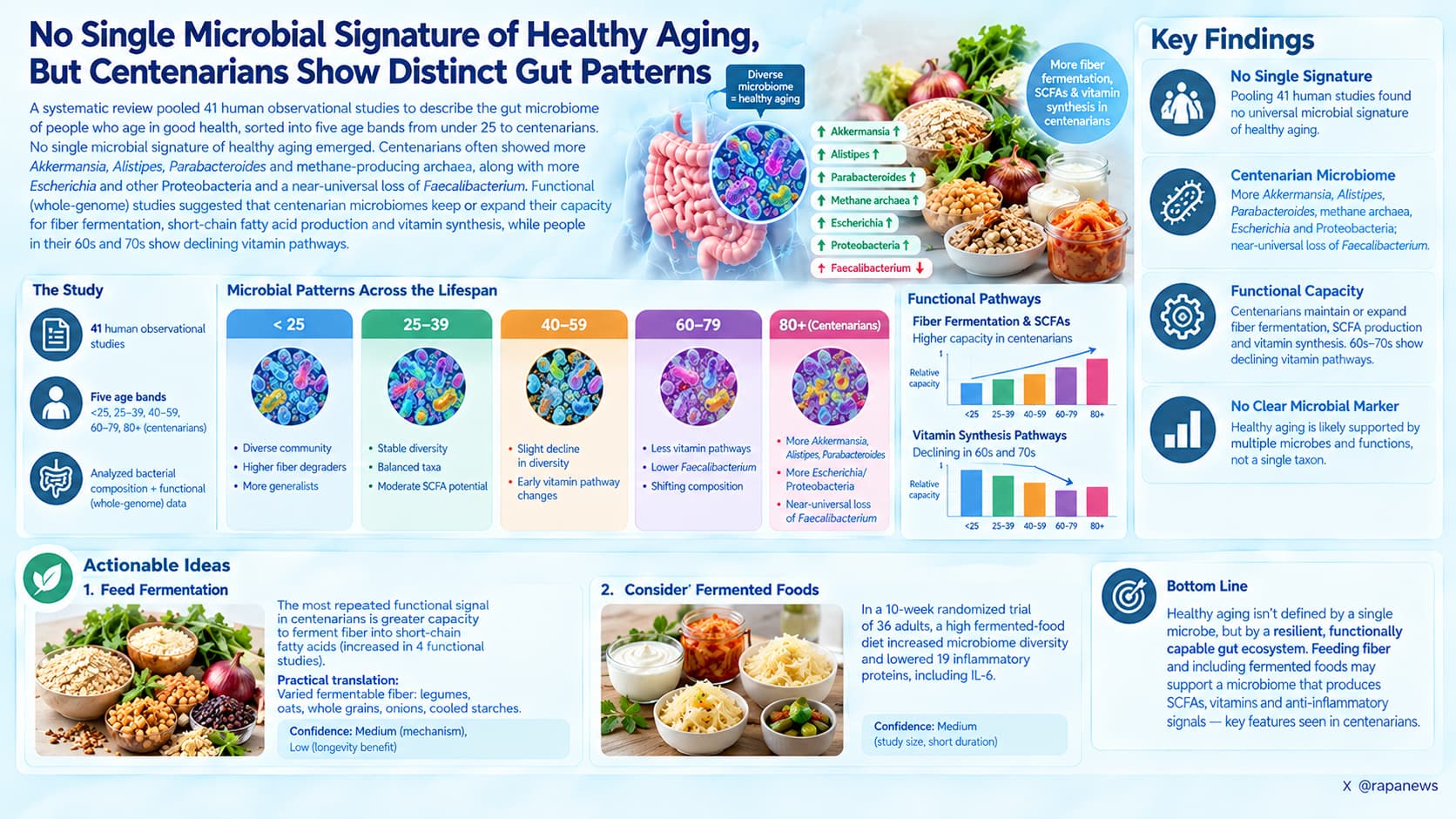
This systematic review pooled 41 human observational studies to describe the gut microbiome of people who age in good health, sorted into five age bands from under 25 to centenarians. No single microbial signature of healthy aging emerged. Centenarians often showed more Akkermansia, Alistipes, Parabacteroides and methane-producing archaea, along with more Escherichia and other Proteobacteria and a near-universal loss of Faecalibacterium. Functional (whole-genome) studies suggested that centenarian microbiomes keep or expand their capacity for fiber fermentation, short-chain fatty acid production and vitamin synthesis, while people in their 60s and 70s show declining vitamin pathways.
Reach 100 in good health and your gut will probably look odd by the standards of a 40-year-old. That is one of the clearer messages from a new systematic review of 41 human studies on the gut microbiome and healthy aging, published in the journal Microbiology by a team based in Riyadh, Saudi Arabia.
The researchers asked what the gut microbiome of someone who ages well actually looks like. Plenty of research links gut microbes to the diseases of old age. Far less has tried to describe the microbes of people who stay functional, independent and free of major illness. The team sorted the evidence into five age bands, from under-25s to centenarians, and counted how often particular microbes and metabolic functions turned up in each.
There is no single centenarian bacterium. Instead, people at the far end of the lifespan share a loose pattern. Akkermansia muciniphila, a microbe that lives in the gut’s mucus layer, was reported as enriched in centenarians in at least five studies. Alistipes and Parabacteroides recurred, as did methane-producing archaea. Less flatteringly, so did Escherichia and other Proteobacteria, a group more often linked to inflammation than to health. Meanwhile Faecalibacterium, one of the best-known producers of the anti-inflammatory fatty acid butyrate, fell in the oldest groups in every study that reported on it.
That sets up the review’s most interesting idea. Even as classic butyrate producers fade, studies that sequenced the full genetic toolkit of centenarian microbiomes found more capacity for fiber breakdown and short-chain fatty acid production, plus more genes for making vitamins B2, B6, K2 and thiamine. Adults in their late 60s and 70s, by contrast, showed declining vitamin-making pathways. The authors propose that in healthy agers, other microbes step in to keep essential jobs done. Function may matter more than which species does the work.
It is an attractive hypothesis resting on somewhat thin ground. Nine in ten studies captured a single moment in time, so they cannot say whether these microbes help people live longer or simply reflect how very old people eat, move and take medication. Almost half the studies came from China. Fewer than one in five statistically adjusted for diet, body weight or other obvious influences. Some centenarian groups contained as few as six people. Because the studies used different sequencing methods and definitions of “healthy,” the authors chose not to combine the numbers, so the review cannot say how big any of these differences are.
What it does offer is a map of the field and a plan: shared definitions of healthy aging, wider geographic coverage, and studies that measure what microbes actually produce rather than what their genes suggest they could produce.
For now, the practical reading is modest. The microbial traits that keep turning up in healthy agers center on fermenting fiber and making vitamins. That points toward diet rather than any particular probiotic product. Whether steering a 50-year-old’s microbiome in that direction changes how they age has never been tested.
Actionable Insights
This paper tests no intervention, so nothing here is proven to add healthy years. It points to traits worth protecting, ranked by how often studies agree.
- Feed fermentation. The most repeated functional signal in centenarians is greater capacity to ferment fiber into short-chain fatty acids (increased in 4 functional studies). The practical translation is varied fermentable fiber: legumes, oats, whole grains, onions, cooled starches.
- Consider fermented foods. Not from this paper, but in a 10-week randomized trial of 36 adults, a high fermented-food diet increased microbiome diversity and lowered 19 inflammatory proteins, including IL-6.
Effect size: none can be calculated from this paper, because the authors deliberately did not pool data. The best available proxy is how often studies agree. Akkermansia rose in centenarians in about 5 of 7 studies that reported it (71%). Faecalibacterium fell in 5 of 5 (100%). Escherichia rose in about 7 of 7. Think of this as a tally of votes, not a measure of size: a finding can be consistent yet tiny, and the tally ignores whether a study had 6 people or 600.
Context and Source
- Open Access Paper: Gut microbiome and healthy ageing: a systematic review of literature
- Access: Open access (Creative Commons Attribution license)
- Institutions: King Abdullah International Medical Research Center; King Saud bin Abdulaziz University for Health Sciences; Ministry of National Guard Health Affairs (Riyadh); University of Bisha
- Country: Saudi Arabia
- Journal: Microbiology (Microbiology Society, UK), Published 5 October 2026.
-
Funding: Hevolution Foundation grant HF-KSA 005
Impact evaluation: The impact score of this journal is 3.5 (2025 Journal Impact Factor, JCR Q2), evaluated against a typical high-end range of 0-60+ for top general science, therefore this is a Low impact journal. Within microbiology it is a respectable mid-tier society journal, and journal rank says little about the rigor of an individual systematic review.
Related Reading:
- No Ceiling in Sight: More Fiber Tracks With Less Heart Disease Up to 35 Grams a Day
- Butyrate: The Microbiome's Anti-Aging "Kill Switch" for Senescent Cells
- The Fiber Fix: Isolated Soluble Fiber Drives Clinically Meaningful Weight Loss and Metabolic Repair
- Psyllium Husk Demonstrated to Significantly Modulate Glycemic Aging Markers in Meta-Analysis
- World’s oldest person had a young microbiome and 'exceptional genome'