Critical Limitations
Supraphysiological dose — the central weakness. The authors concede the 1 mM in vitro dose “may not accurately reflect physiological concentrations.” Serum levels they measured are as low as 0.1 mM. Butyrate is high (20-140 mM) in the gut lumen but low systemically, so whether circulating T cells ever see an effective concentration in vivo is unresolved. This undercuts the leap from dish to human.
The mouse arm cannot isolate butyrate. Faecal filtrate is a complex soup of metabolites; the authors explicitly state they “cannot attribute the observed reductions… solely to butyrate.” No purified-butyrate in vivo arm exists. This is a confounded intervention masquerading as validation.
Novelty:
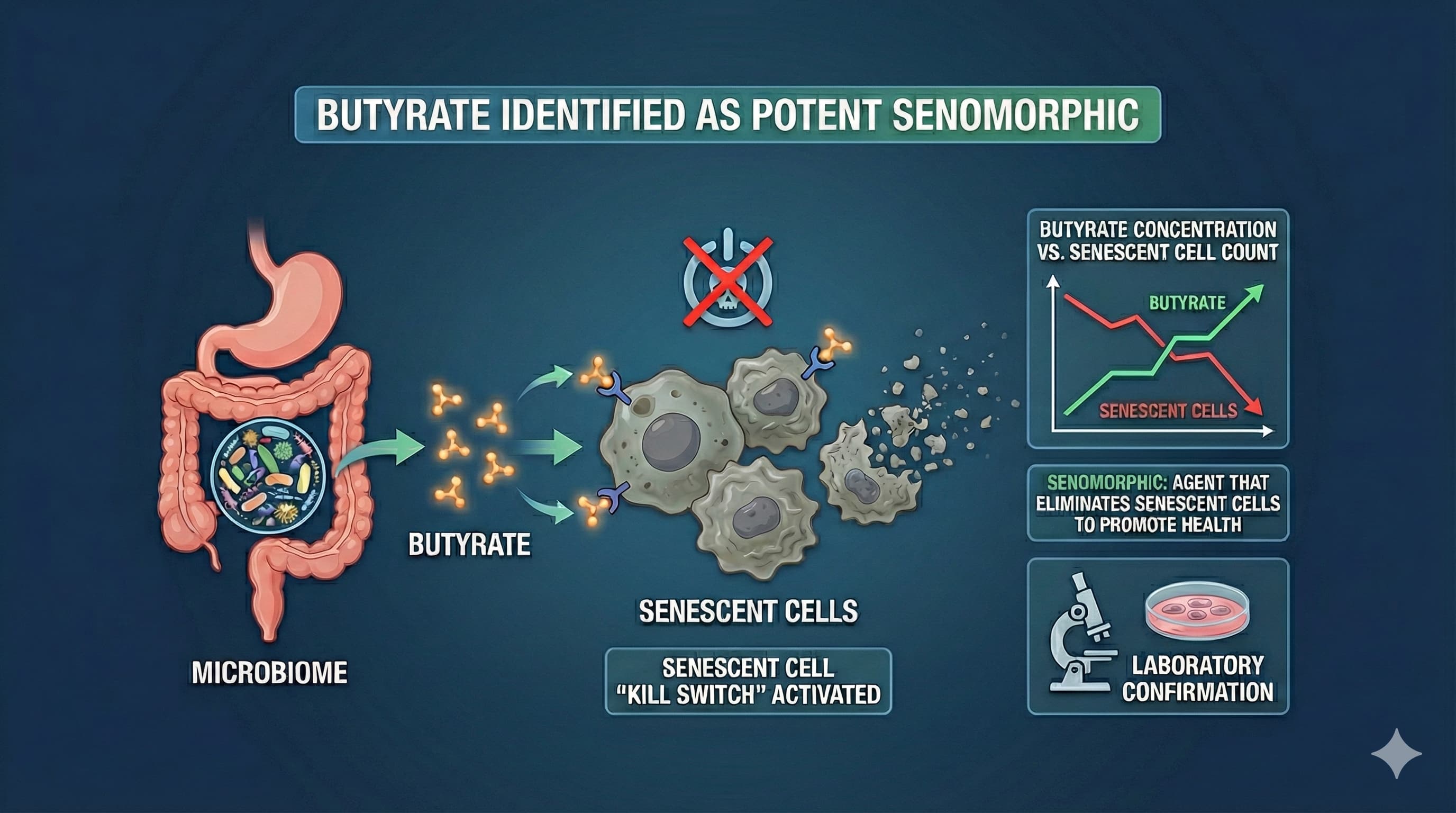
While butyrate’s anti-inflammatory role is known, classifying it specifically as a Senomorphic (a compound that suppresses the senescent phenotype without inducing apoptosis) for T-cell immunosenescence is a critical pivot. It links dietary fiber intake directly to immune system “rejuvenation” via a defined molecular pathway.
Critical Limitations:
-
Translational Uncertainty: The in vivo efficacy relied heavily on “faecal supernatants” in parts of the study, which is a complex soup of metabolites, not just pure butyrate.
-
Bioavailability Issues: Butyrate has a notoriously short plasma half-life. Getting a 1 mM concentration (used in vitro) to T-cells in the spleen or periphery via oral supplementation in humans is pharmacokinetically difficult without specialized delivery systems.
-
No Life Extension Data: We do not know if this intervention actually extends maximum lifespan, only that it cleans up immune markers.
Part 3: Actionable Intelligence
The Translational Protocol:
-
Human Equivalent Dose (HED):
-
Reference Mouse Dose: 200 mg/kg (Standard effective dose for systemic HDAC inhibition/anti-inflammation in murine models).
-
Calculation: 200 mg/kg * (3/37) = ~16.2 mg/kg.
-
For a 75 kg Human: 16.2 * 75 = 1,215 mg.
-
Target Dose: ~1.2 grams per day of Sodium Butyrate (or equivalent active butyric acid).
-
Pharmacokinetics (PK/PD):
-
Half-life: Extremely short in plasma (<10 minutes). Rapidly metabolized by the liver.
-
Optimization: Standard capsules are likely useless for systemic senescence as they are consumed by colonocytes. Look for Enteric-Coated Sodium Butyrate (targets colon) or Tributyrin (a prodrug that bypasses the stomach and releases 3 butyrate molecules, significantly improving systemic bioavailability). PubChem: Tributyrin
-
Safety & Toxicity Check:
-
NOAEL: Very high (it is a dietary metabolite).
-
LD50: >2000 mg/kg in rats.
-
Toxicity: Sodium load is the main concern. 1.2g of Sodium Butyrate contains ~250mg of Sodium.
-
Known Interactions: Potential additive effects with other HDAC inhibitors (e.g., Valproic acid) or anti-hypertensives (due to sodium load or vasodilation). DrugBank: Butyric Acid
-
Biomarker Verification Panel:
-
Efficacy: hs-CRP (High-Sensitivity C-Reactive Protein) and IL-6. Reduction in these “inflammaging” markers is the primary endpoint.
-
Target Engagement: NLR (Neutrophil-to-Lymphocyte Ratio). A reduction suggests improved immune homeostasis.
-
Safety: Serum Sodium and Blood Pressure monitoring.
-
Feasibility & ROI:
-
Sourcing: Widely available as a supplement (Sodium/Calcium/Magnesium Butyrate or Tributyrin).
-
Cost: Low. ~$30–$50/month for a high-quality Tributyrin supplement.
-
ROI: High. Low cost, high safety profile, and mechanistic plausibility for improving gut/immune health even if longevity effects are modest.
Part 4: The Strategic FAQ
1. Q: Did this study show that eating fiber is enough, or do we need supplements?
A: The study used concentrated metabolites. While fiber feeds butyrate-producing bacteria, aging guts often lose Akkermansia and Faecalibacterium species. Supplements (or Fecal Microbiota Transplant) may be required to reach the “therapeutic” 1 mM levels used in the lab.
2. Q: Is Butyrate a Senolytic (killer) or Senomorphic (suppressor)?
A: Senomorphic. It does not kill the senescent T-cells; it forces them to “shut up” (stop secreting inflammatory SASP) and behave more like normal cells.
3. Q: Why use Sodium Butyrate instead of just eating butter?
A: Butter contains butyrate, but you would need to eat sticks of it to get gram-level dosages, driving cardiovascular risk. Sodium Butyrate isolates the molecule without the saturated fat.
4. Q: Can I just take Probiotics to make my own?
A: Only if you take the right ones (e.g., Clostridium butyricum, Faecalibacterium prausnitzii) AND eat enough prebiotic fiber. Most commercial probiotics (Lactobacillus/Bifidobacterium) are lactate producers, not primary butyrate producers. PubMed: Probiotics and Butyrate
5. Q: What is the “Tributyrin” advantage mentioned in biohacker circles?
A: Tributyrin is a triglyceride containing three butyrate molecules. It is lipophilic, meaning it crosses membranes better and has a longer half-life than simple sodium butyrate salts.
6. Q: Does this cross the Blood-Brain Barrier (BBB)?
A: Yes. Butyrate is a known neuroprotective agent that can cross the BBB, functioning as an HDAC inhibitor in the brain to potentially boost plasticity (BDNF). PubMed: Butyrate Blood Brain Barrier
7. Q: Is there a risk of “over-suppressing” the immune system?
A: Unlikely at physiological doses. Butyrate regulates immune homeostasis (T-reg induction) rather than broad immunosuppression. However, extremely high doses (>10g) haven’t been safety-tested long-term.
8. Q: How does this compare to Rapamycin?
A: Both inhibit mTOR. Rapamycin is a direct, potent inhibitor with potential for significant side effects at high doses. Butyrate is a mild, physiological inhibitor with a better safety profile but likely lower potency.
9. Q: Should I cycle this like other longevity protocols?
A: Probably not. Butyrate is a daily metabolite produced in a healthy gut. Consistency is key to maintaining the “senomorphic” pressure on aging cells.
10. Q: What is the “Killer App” biomarker to track?
A: Neutrophil-to-Lymphocyte Ratio (NLR). High NLR is a proxy for systemic inflammation and immune aging. Butyrate should theoretically lower NLR over 3-6 months.
Follow-on Prompt:
Identify good or trusted brands and resellers (provide embedded links or URLs to the sites and products) of supplement: Enteric-Coated Sodium/Calcium/Magnesium Butyrate, and Tributyrin. Calculate the cost per gram for each product. Do not include any images in the response.
Gemini Response:
Here is the analysis of trusted brands and resellers for Butyrate and Tributyrin supplements, including a strict cost-per-gram analysis to determine the best Return on Investment (ROI).
Market Analysis: Tributyrin vs. Butyrate Salts
-
Tributyrin (The “Pro-Drug”): A glycerol backbone with three butyrate molecules attached. It is lipophilic, bypassing the stomach to release butyrate in the small and large intestine. Pharmacokinetic Advantage: Higher systemic bioavailability; requires lower total mass than salts.
-
Enteric-Coated Salts (Sodium/Ca/Mg): The “classic” form. These must be heavily coated or encapsulated in a lipid matrix to survive stomach acid. Pharmacokinetic Disadvantage: High mineral load (Sodium/Calcium) restricts high-dose protocols (e.g., >3g/day).
Category 1: Tributyrin (High Bioavailability)
1. Tributyrin-Max (Brand: The Perfect Stool)
-
Specs: 750 mg Tributyrin per capsule.
-
Mechanism: Uses acid-resistant vegetable capsules (DRcaps) to ensure colonic delivery.
-
Verdict: This is currently the highest concentration per capsule on the retail market.
-
Source: The Perfect Stool Shop
2. Tributyrin-X (Brand: Healthy Gut)
-
Specs: 500 mg Tributyrin per softgel.
-
Mechanism: Proprietary “PXRcap” liquid softgel designed to prevent leakage and ensure varying release points in the GI tract.
-
Verdict: The “Biohacker Favorite.” High purity (99.9%), third-party tested, minimal smell.
-
Source: Healthy Gut
3. Tri-Butyrin Supreme (Brand: Designs for Health)
-
Specs: 300 mg Tributyrin per softgel.
-
Mechanism: Uses the trademarked CoreBiome® ingredient foundation.
-
Verdict: Clinical Grade. Often prescribed by functional medicine doctors. Lower dose per cap makes it expensive for high-dose protocols.
-
Source: Designs for Health
Category 2: Enteric-Coated Salts (High Dose/Low Cost)
1. BodyBio Sodium Butyrate
-
Specs: 600 mg Butyrate Complex (active butyric acid is lower) per capsule.
-
Mechanism: Not a plastic enteric coating; they use a specific lipid matrix (MCT/Sunflower oil) that protects the salt through the stomach.
-
Verdict: The Industry Standard. Used in the majority of older clinical trials.
-
Note: Also available as Calcium/Magnesium Butyrate for those restricting sodium.
-
Source: BodyBio
2. Pro-Butyrate (Brand: Tesseract Medical Research)
-
Specs: 340 mg Butyric Acid (as hexanic acid matrix).
-
Mechanism: Uses a “CyLoc” delivery system (dexterin fiber matrix) to mask taste and enhance absorption.
-
Verdict: Highly sophisticated delivery system, but low dose per pill.
-
Source: Tesseract Medical Research
Cost-Benefit Analysis (ROI)
Note: Prices are estimated based on standard MSRP and subject to change.
| Brand |
Form |
Price (Approx) |
Total Mass (Active) |
Cost Per Gram |
| BodyBio Sodium Butyrate |
Salt (Standard) |
~$37.00 |
60g (100 caps x 0.6g) |
**$0.62 / g** |
| Tributyrin-Max |
Tributyrin (Pro-Drug) |
~$50.00 |
45g (60 caps x 0.75g) |
**$1.11 / g** |
| Healthy Gut Tributyrin-X |
Tributyrin (Pro-Drug) |
~$72.00 |
45g (90 caps x 0.5g) |
**$1.60 / g** |
| Healus Complete Biotic |
Tributyrin (Pro-Drug) |
~$50.00 |
30g (60 caps x 0.5g) |
**$1.67 / g** |
| Designs for Health |
Tributyrin (Clinical) |
~$52.00 |
18g (60 caps x 0.3g) |
**$2.89 / g** |
Strategic Recommendation
-
For Longevity Protocols (Best Value): Tributyrin-Max. At **$1.11/g**, it balances the superior pharmacokinetics of tributyrin with a price point close to the cheaper salts. To reach the Human Equivalent Dose (HED) of ~1.2g discussed in the report, you would take 2 capsules/day ($1.66/day).
-
For Budget/Maintenance: BodyBio Sodium Butyrate. At **$0.62/g**, it is the cheapest way to get the molecule. However, you must monitor Sodium intake. To reach the HED of ~1.2g, you would need 2-3 capsules/day ($0.74/day), but this entails ingesting ~400mg of extra sodium.
Next Step: Would you like me to analyze the specific contraindications of Sodium Butyrate regarding blood pressure medications, or investigate the synergistic effects of stacking this with Rapamycin?