High Dose Riboflavin Nudges the Gut Toward Making More Butyrate

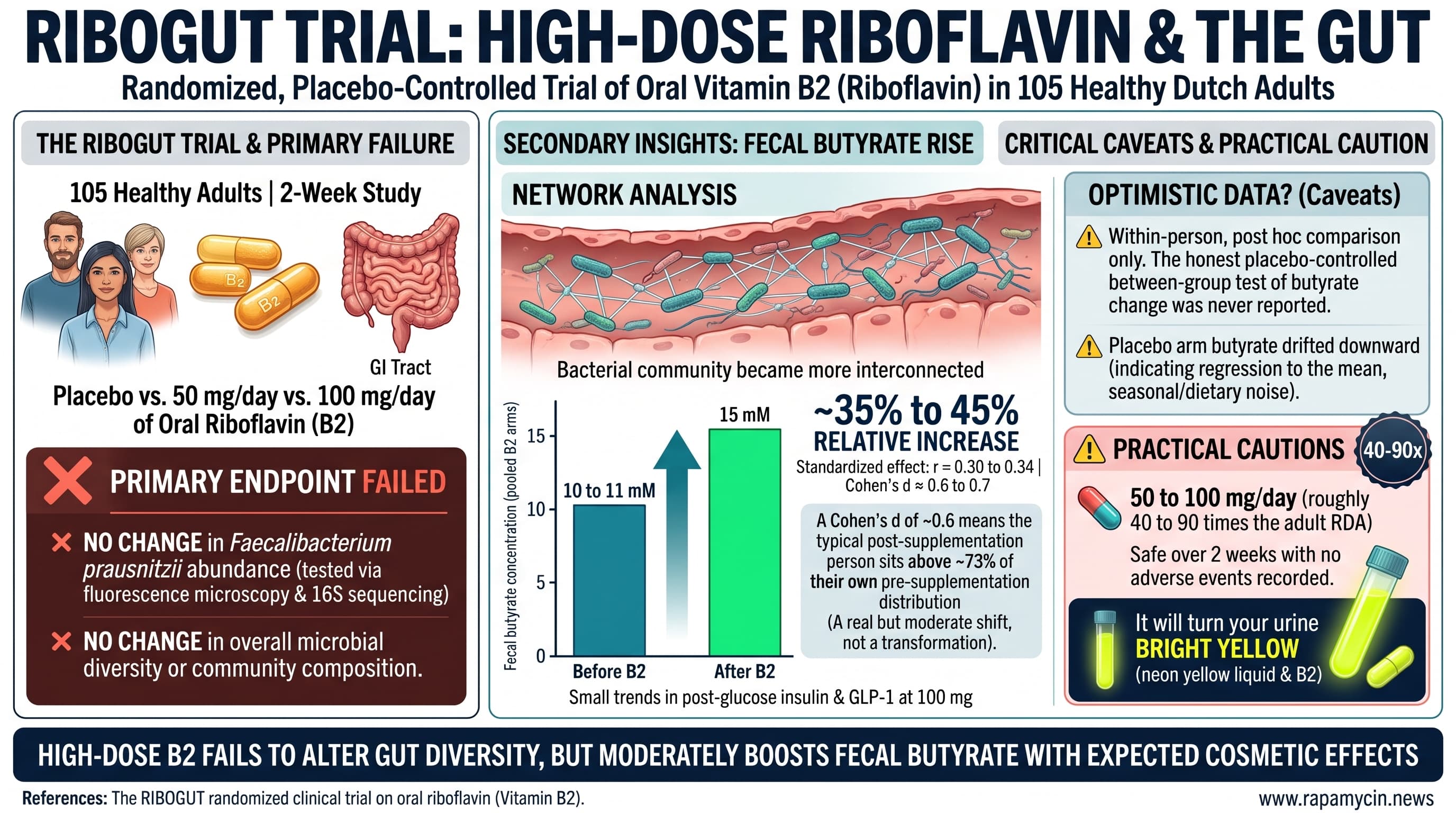
The RIBOGUT trial randomized 105 healthy Dutch adults to placebo, 50 mg/day, or 100 mg/day of oral riboflavin for two weeks, testing whether high-dose vitamin B2 could expand populations of Faecalibacterium prausnitzii, a butyrate-producing gut anaerobe repeatedly linked to gut health. The primary endpoint failed outright. F. prausnitzii abundance did not change by either fluorescence microscopy or 16S sequencing, and neither did overall microbial diversity or community composition. Secondary findings were more interesting. Fecal butyrate concentration rose in the 100 mg group, and rose more convincingly when both riboflavin arms were pooled in a post hoc analysis. Network analysis suggested the bacterial community became more interconnected. A small substudy showed non-significant upward trends in post-glucose insulin and GLP-1 at the higher dose.

The Groningen team had a specific and reasonable hypothesis. Faecalibacterium prausnitzii is one of the most abundant bacteria in the human colon and one of the most consistently depleted in inflammatory bowel disease and obesity. It makes butyrate, the short-chain fatty acid that colon cells burn for fuel and that calms local inflammation. Earlier work had shown that F. prausnitzii uses riboflavin as an electron shuttle, letting it survive in the oxygen gradient near the gut wall where it otherwise would not. Give people enough riboflavin that some escapes absorption in the small intestine and reaches the colon, the logic went, and the bacterium should flourish.

It did not. Across 105 healthy volunteers taking 50 or 100 mg daily for a fortnight, F. prausnitzii numbers held completely flat. Two independent measurement methods agreed. Overall community diversity did not budge either. Where you landed in the microbial map at the start of the trial is where you were at the end.

The riboflavin definitely arrived. Fecal and plasma riboflavin levels climbed steeply in both supplemented groups and not at all in placebo, with some of the most decisive p-values in the paper. So this was not a delivery failure. The vitamin got there and the population census refused to move.

What moved was output. Fecal butyrate rose in the 100 mg group. When the investigators combined both riboflavin arms into a single larger group, a decision made after seeing the data, the butyrate increase became clearer. Acetate rose in the 50 mg group. The bacterial interaction network, a statistical map of which organisms rise and fall together, gained connections and tightened up in the supplemented participants while the placebo network thinned out over the same period.

The interpretation the authors offer is that the same microbial community simply started working differently. More cross-feeding, more metabolic traffic, more butyrate out the far end, with the roster unchanged. Riboflavin is a precursor to FAD and FMN, cofactors that sit at the heart of bacterial electron transport, so a plausible mechanism exists for why handing a community more redox currency would raise its metabolic throughput without changing who belongs to it.

Two cautions matter. The pooling of the dose groups was decided after the fact, which is the kind of analytic choice that generates positive findings from null trials. And the study was funded by DSM Nutritional Products, which employs one author and has since brought a colon-targeted riboflavin ingredient to market built on precisely this concept.

Still, the idea that an inexpensive vitamin might shift gut metabolic function without disturbing gut ecology is worth testing properly. This study is a signal, not a verdict.

Actionable Insights

First, the headline claim is weak but not empty. Pooling both dose groups, fecal butyrate increased from a median of roughly 10 to 11 mM before supplementation to roughly 15 mM after. That is a relative increase in the neighborhood of 35 to 45 percent. Translated into a standardized effect size, the paired comparison corresponds to roughly r = 0.30 to 0.34, which converts to a Cohen’s d somewhere near 0.6 to 0.7. In plain terms, a d of 0.6 means that if you lined up people before and after, the typical person after supplementation sits above about 73 percent of their own pre-supplementation distribution. That is a real but moderate shift, not a transformation.

Second, that number is almost certainly optimistic. It comes from a within-person before-and-after comparison inside a group created after the data were seen. The honest placebo-controlled between-group test of butyrate change was never reported. In the placebo arm, butyrate actually drifted downward over the same window, which means some of the apparent gain is regression to the mean and seasonal or dietary noise rather than drug effect.

Third, be aware. 50 to 100 mg/day is roughly 40 to 90 times the adult RDA. It was safe, and generally is at higher doses like this, but there are not a lot of studies. It will turn your urine bright yellow.

Fourth, if your goal is butyrate, fermentable fiber and resistant starch have substantially stronger and better-replicated human evidence than this. Combining both approaches could be a reasonable strategy.

Context and Source

  • Open Access Paper: Riboflavin Supplementation Promotes Butyrate Production in the Absence of Gross Compositional Changes in the Gut Microbiota
  • Lead institution: Department of Medical Microbiology and Infection Prevention, University of Groningen, University Medical Center Groningen, The Netherlands.
  • Journal: Antioxidants & Redox Signaling
  • Country: The Netherlands. Co-affiliations in Australia (University of Adelaide) and Switzerland (DSM Nutritional Products AG, Kaiseraugst, and University Hospital Zurich).
  • Impact Evaluation: The impact score of this journal is 6.1, evaluated against a typical high-end range of 0 to 60+ for top general science, therefore this is a Medium impact journal.

Related Reading:

From Claude Opus 5.5:

Safety of 50 to 100 mg/day Oral Riboflavin: Evidence Review

Short answer

Across regulatory reviews, randomized trials, and decades of use in rare-disease medicine, no consistent toxicity has been shown for oral riboflavin at 50 to 100 mg/day, or at much higher doses. The evidence is strongest for short- to medium-term use, up to about three months, in non-pregnant adults. The main caveat is that this reassurance rests mostly on absence of reported harm, not on studies designed to look for it. Long-term use in healthy people, pregnancy, and deliberate colonic delivery have little data behind them. [Confidence: High for short-term safety, Medium for multi-year use]

1. Regulatory position

No major body has set a Tolerable Upper Intake Level (UL), and the reason matters.

  • US (IOM/National Academies): There was not enough data on adverse effects to set a UL. The IOM explicitly says the lack of reported harm does not rule out harm at high intakes, and that caution may be warranted. It also notes that studies using large doses were not designed to systematically evaluate adverse effects. nap
  • EU (EFSA): EFSA, like the US, decided there was not enough information to set a UL. In its food-additive re-evaluation, it found no adverse effects in two 90-day rat studies and no genotoxicity concern. However, it declined to set an Acceptable Daily Intake because carcinogenicity, chronic toxicity, and reproductive/developmental toxicity studies are missing. JECFA had previously set a group ADI of 0 to 0.5 mg/kg body weight/day. lemaeuropa
  • Nordic Nutrition Recommendations 2023: Found no qualified biomarker of adverse effects and no qualified adverse effect of high intake. norden
  • UK (Expert Group on Vitamins and Minerals): Concluded that a total intake of 43 mg is not expected to cause adverse effects. This is a guidance level based on the highest dose with available data. It is not a threshold where toxicity begins. clinicaltrials

How to read this: A 100 mg dose exceeds both the UK guidance figure and the JECFA additive ADI (about 35 mg for a 70 kg adult). Neither number marks observed harm. Each reflects the limit of the available data. “No UL” means “not enough data to find a ceiling,” not “proven harmless at any dose.” [Confidence: High]

2. Why toxicity is self-limiting: the absorption ceiling

The pharmacokinetics are the main safety argument. Little riboflavin is absorbed from single doses above 27 mg, and the body stores only small amounts in the liver, heart, and kidneys. After a single oral dose, its half-life in healthy people is about 66 to 84 minutes. nihlema

What this means in practice:

  • Single dose: 100 mg taken once produces systemic exposure only modestly higher than 30 mg. The extra passes to the colon, which is the premise of the RIBOGUT trial.
  • Split doses: Four 25 mg doses would be nearly fully absorbed, so splitting a 100 mg daily dose raises systemic exposure several-fold compared with taking it all at once. Systemic safety data at that exposure come mainly from the 400 mg/day migraine trials and rare-disease use described below. [Confidence: Medium, this is a pharmacokinetic inference rather than a measured comparison]
  • Colonic exposure: This is the less-studied variable. Human data on deliberately loading the colon with riboflavin cover only 2 to 3 weeks (RIBOGUT and RISE-UP).

3. Clinical trial evidence at or above this dose range

Migraine prophylaxis, 400 mg/day (4 to 8 times your range):

  • In the main RCT, 55 patients took 400 mg or placebo for 3 months. Three minor adverse events occurred: diarrhea and polyuria in the riboflavin group, and abdominal cramps in the placebo group. None was serious. uliege
  • A later family-medicine review noted that adverse effects were poorly reported but included diarrhea and discolored urine. It cited a number needed to harm of 4 in one trial. That trial appears to have tested a combination product containing magnesium, so magnesium may account for much of the diarrhea. [Confidence: Medium on attribution] cfpclearn
  • Pediatric trials used 50 mg and 200 mg in children with no safety signal reported. (They also found no benefit.) cfpclearn

Inflammatory bowel disease and gut microbiome trials:

  • RISE-UP: 100 mg/day for 3 weeks in Crohn’s patients.
  • RIBOGUT: 50 to 100 mg/day for 2 weeks in healthy adults.
  • Neither reported adverse events of concern.

Rare inherited disorders (the strongest long-term reassurance):

Patients with riboflavin transporter deficiency (Brown-Vialetto-Van Laere syndrome) and riboflavin-responsive MADD take very high doses for years, often from childhood.

  • Reported doses range from 7 to 60 mg/kg/day. One child was increased to 60 mg/kg/day with no adverse effects. nih
  • An adult started at 1,200 mg/day and stayed stable for 3 years on continued therapy, weaned to 200 mg daily. nih
  • Another report described a patient whose parents reduced the dose because they suspected gastrointestinal side effects from high doses. This is consistent with mild GI effects being the only real tolerability issue. springer

Caveat on the rare-disease data: These patients are functionally riboflavin-deficient at the tissue level and are monitored by specialists. They show that very high doses are tolerated for years. They do not show what years of excess riboflavin does to a fully replete healthy adult. [Confidence: Medium]

4. Known and theoretical adverse effects

Effect Evidence Practical relevance
Bright yellow urine Universal, expected Harmless. It removes urine color as a hydration cue and can interfere with urine dipsticks and older fluorometric urine assays. Tell the lab if you are giving a urine sample. [Confidence: Medium]
Diarrhea, cramps, polyuria Occasional in 400 mg trials, often confounded Mild and reversible. Uncommon at 50 to 100 mg.
Photosensitization Mechanistic: riboflavin and flavins are efficient photosensitizers that can cause oxidative damage in light-exposed tissue. In corneal studies, riboflavin alone was not cytotoxic, but combining it with UVA lowered the cytotoxic threshold tenfold. No clinical reports link oral supplements to phototoxicity. Those corneal conditions involve direct topical application plus focused UVA, which oral dosing does not reproduce. Theoretical only. [Confidence: Low concern]
Cancer Observational data on dietary intake are mostly null or inverse. One Australian cohort found weak, non-monotonic associations between riboflavin intake and prostate cancer incidence and called for corroboration. These studies cover dietary intakes of about 1 to 4 mg/day, so they say nothing direct about 50 to 100 mg. The lung cancer signal seen in smokers in the VITAL cohort involved B6 and B12, not B2. No carcinogenicity bioassays exist (per EFSA). b2b.sigmaaldrich.com +2

5. Gaps in the evidence

  • Duration: No RCT in healthy adults lasts longer than 3 months at these doses. Multi-year healthy-population safety data are limited to observational supplement use.
  • Pregnancy and lactation: Safety Data Absent. EFSA specifically cites missing reproductive and developmental toxicity studies. Riboflavin is actively transported across the placenta. Pharmacological doses have no supporting data here.
  • Sustained colonic delivery: Colon-targeted products (such as Humiome B2) and high single doses expose the colonic microbiota and epithelium to flavin levels that have only weeks of human data.
  • Drug interactions: No clinically significant pharmacokinetic interactions are well documented. Riboflavin is not meaningfully metabolized by CYP450 enzymes. Some drugs affect riboflavin status (tricyclic antidepressants, phenothiazines, some anticholinergics). No known interaction concerns exist with rapamycin, metformin, SGLT2 inhibitors, or acarbose, but none have been formally tested. [Confidence: Medium]
  • Systematic adverse event capture: Most trials report adverse events in passing rather than through structured monitoring.

Bottom line

For a non-pregnant adult, 50 to 100 mg/day taken once daily is well inside the range humans have used without demonstrated harm. It sits below the 400 mg/day migraine dose and far below rare-disease doses. The practical risks are yellow urine, occasional loose stools, and urine-test interference. The honest uncertainty is about years of use in replete people and about deliberate colonic loading. Neither has been studied, and regulators decline to set a ceiling for exactly that reason. [Confidence: High for short-term, Medium for long-term]


Sources