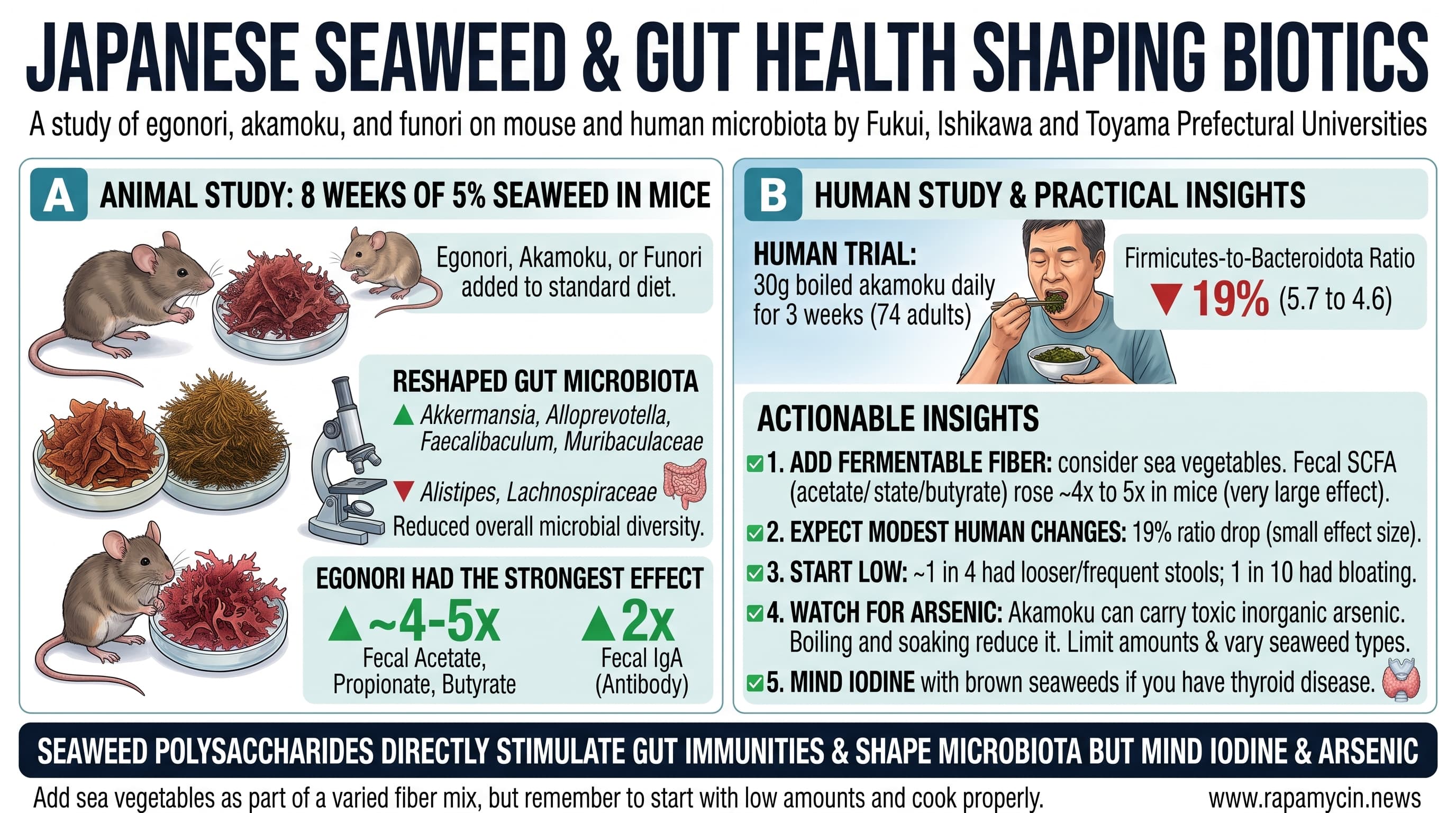
Researchers at Fukui, Ishikawa and Toyama Prefectural Universities fed young male mice a standard diet with 5% powdered Japanese seaweed for 8 weeks: egonori (Campylaephora hypnaeoides, a red alga), akamoku (Sargassum horneri, a brown alga) or funori (Gloiopeltis furcata, a red alga). All three reshaped the gut microbiota, raising Akkermansia, Alloprevotella, Faecalibaculum and Muribaculaceae while lowering Alistipes and Lachnospiraceae, but they also reduced overall microbial diversity. Egonori had the strongest effect, increasing fecal acetate, propionate and butyrate roughly four- to fivefold and doubling fecal IgA. Seaweed polysaccharides directly stimulated IgA secretion from mouse gut immune cells and modestly boosted growth of some bifidobacteria and lactobacilli in culture. In 74 adults eating about 30 g of boiled akamoku daily for three weeks, the Firmicutes-to-Bacteroidota ratio fell by about 19%.
Japan has one of the longest life expectancies in the world, and seaweed is one of the most distinctive foods in its diet. A new study from three Japanese prefectural universities asks whether the unusual fibers in seaweed help explain why, by acting on gut bacteria.
Seaweeds are packed with soluble fiber, carbohydrates our own enzymes cannot digest. These fibers travel to the colon, where bacteria ferment them into short-chain fatty acids such as acetate, propionate and butyrate. These molecules feed the cells lining the gut, help keep the gut barrier tight and send signals that influence metabolism and immunity.
The team tested three seaweeds used in Japanese regional cooking. Mice that ate chow containing 5% powdered seaweed for eight weeks developed clearly different gut communities from control mice. Several groups of microbes often linked to leaner, healthier metabolism in mouse studies became more common, most notably Akkermansia, a mucus-dwelling bacterium that has attracted interest as a potential probiotic. Others linked to obesity in mice, such as Alistipes, declined.
The red seaweed egonori produced the biggest changes. Mice eating it excreted about four times more acetate, nearly four times more propionate and five times more butyrate each day than controls. Their output of IgA, the antibody that patrols the gut lining and helps manage resident microbes, roughly doubled. When the researchers added purified seaweed fiber to immune cells taken from mouse intestines, the cells released two to almost four times more IgA, suggesting the fiber can stimulate gut immunity directly as well as through bacteria.
The team then asked 83 healthy adults in Fukui to eat about 30 g of boiled akamoku every day for three weeks. In the 74 who completed it, the ratio of two major bacterial groups, Firmicutes to Bacteroidota, fell by about a fifth. About a quarter reported looser stools or more frequent bowel movements.
The big idea is that seaweed polysaccharides behave like prebiotics, fibers that selectively feed useful gut microbes, and that this could be one way a traditional seaweed-rich diet supports metabolic health.
The evidence, though, is thinner than the conclusions suggest. The mice were young and healthy, not obese or diabetic, and the paper does not report their weight, blood sugar, cholesterol or liver tests, even though these were measured. There was no comparison with a familiar fiber such as inulin, so it is unclear whether seaweed does anything a cheaper fiber would not. Microbial diversity, usually considered a sign of gut health, actually fell. The human study had no control group, and the ratio it measured is now regarded as an unreliable marker of metabolic health. The biggest drops came from people who started with the most extreme values, a pattern that often reflects chance. Finally, akamoku belongs to the same seaweed genus as hijiki, which food agencies warn against because of inorganic arsenic, and arsenic was not measured.
Seaweed remains a reasonable part of a varied, fiber-rich diet. This study shows it can reshape the gut ecosystem; it does not yet show that this improves health.
Actionable insights
- Add fermentable fiber, and consider sea vegetables part of the mix. In mice, 5% dietary seaweed raised daily fecal short-chain fatty acids about fourfold (egonori) and butyrate up to fivefold. A standard effect size here is very large (Cohen’s d around 3 to 5), but in small mouse groups with shared cages, these numbers are likely inflated.
- Expect modest changes in people. Three weeks of about 30 g boiled akamoku daily lowered the Firmicutes/Bacteroidota ratio from about 5.7 to 4.6 (19% lower; d about 0.3, small), with no control group.
- Start low. About 1 in 4 participants had looser or more frequent stools; 1 in 10 had bloating.
- Watch the source with Sargassum species. Akamoku can carry more arsenic than hijiki, mainly the toxic inorganic form. Boiling and soaking reduce it. Limit large daily amounts and vary seaweed types.
- Mind iodine with brown seaweeds if you have thyroid disease.
- Don’t over-read microbiome tests. A lower F/B ratio or more Akkermansia is not proof of better health.
Context and source
- Open Access Paper: Japanese Edible Seaweeds Modulate the Gut Microbiota in Mice and Humans: Prebiotic Effects of Seaweed Polysaccharides, November 19, 2026.
- Institutions: Fukui Prefectural University (Departments of Bioscience and Biotechnology, and Nursing Science); Ishikawa Prefectural University (Research Institute for Bioresources and Biotechnology); Toyama Prefectural University (Department of Pharmaceutical Engineering)
- Country: Japan
- Journal: Nutrients (MDPI), 2026.
- Impact evaluation: The impact score of this journal is 5.0 (Journal Impact Factor 2024; CiteScore 9.1), evaluated against a typical high-end range of 0 to 60+ for top general science, therefore this is a Medium impact journal
Related Reading:
- SIRT6 activator fucoidan extends healthspan and lifespan in aged wild-type mice (BioRxiv)
- A Seaweed supplement may help prevent muscle loss
- Healthy Japanese Dietary Pattern Is Associated with Slower Biological Aging in Older Men: WASEDA
- Curcumin, Butyrate, and the Aging Immune System: A Microbiome-Centric Strategy for Longevity
- Butyrate: The Microbiome's Anti-Aging "Kill Switch" for Senescent Cells
- High Dose Riboflavin Nudges the Gut Toward Making More Butyrate