Daily Oat Fiber Shows Potential to Trap Ingested Forever Chemicals Before They Enter the Blood

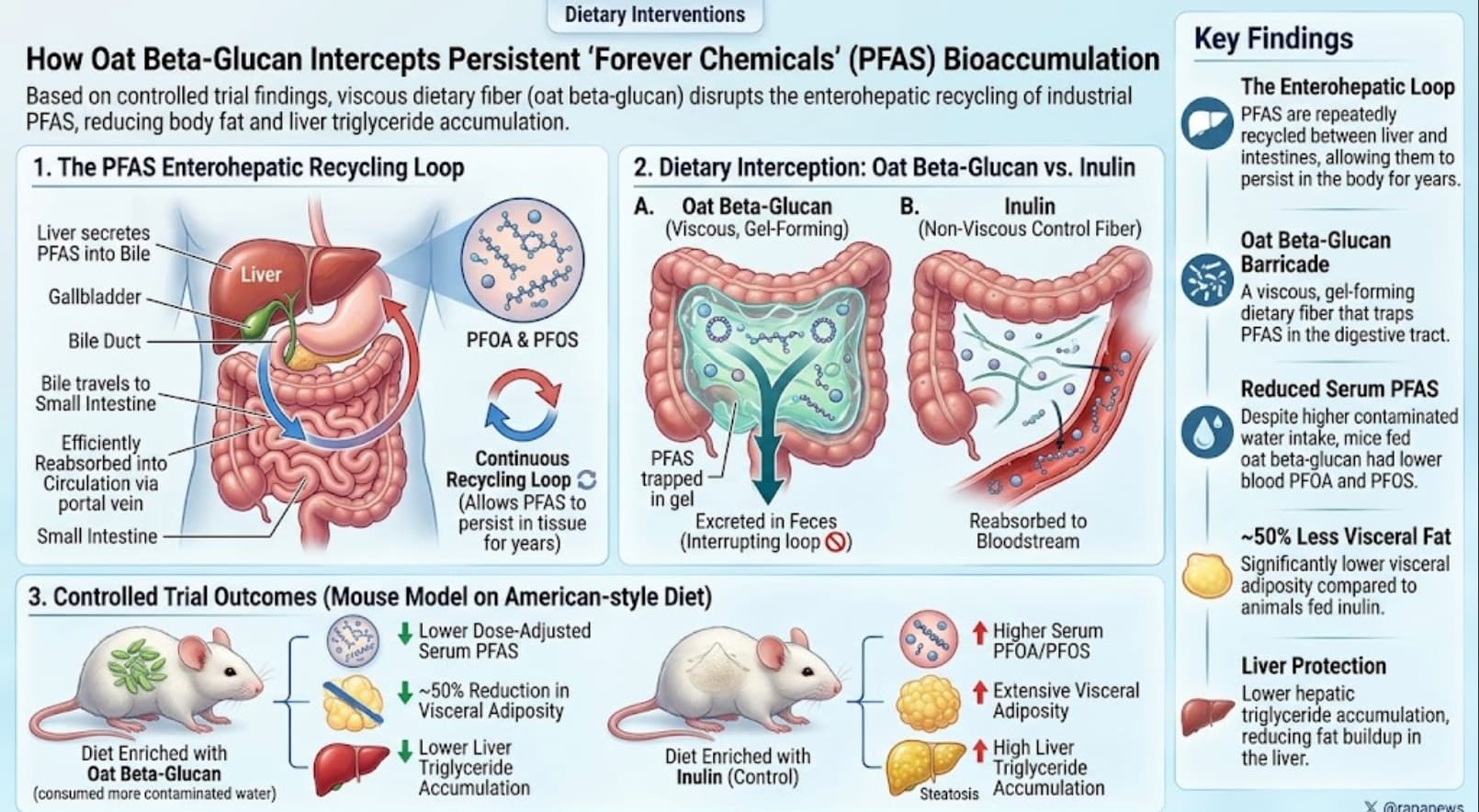
Industrial per- and polyfluoroalkyl substances (PFAS) persist in human tissues for years because the liver repeatedly secretes them into bile, only for the intestines to efficiently reabsorb them back into circulation. In a controlled mouse trial, researchers investigated whether enriching an American-style diet with oat beta-glucan could intercept this recycling loop. Despite consuming significantly more contaminated water, mice fed oat beta-glucan displayed lower dose-adjusted serum concentrations of key legacy compounds, including PFOA and PFOS, alongside a roughly 50 percent reduction in visceral adiposity and lower liver triglyceride accumulation compared to animals fed inulin. The findings suggest that viscous, gel-forming dietary fibers provide a non-pharmacological means to blunt the bioaccumulation and metabolic harms of persistent environmental pollutants.

Synthetic per- and polyfluoroalkyl substances, widely termed forever chemicals, represent an unprecedented challenge to human longevity. Engineered with carbon-fluorine backbones that resist natural degradation, these ubiquitous surfactants contaminate global water supplies and accumulate in human organs. Compounds such as perfluorooctanoic acid (PFOA) and perfluorooctane sulfonate (PFOS) linger in human tissues with half-lives spanning two to five years. The primary engine driving this prolonged retention is not an inability of the liver to excrete them, but rather an aggressive recycling process known as enterohepatic circulation. The liver filters PFAS out of the blood and deposits them into the gallbladder; upon eating, bile delivers these chemicals into the small intestine, where specialized transport proteins promptly reabsorb them, sending them directly back into the bloodstream.

Breaking this cycle requires a physical trap within the digestive tract. While pharmaceutical bile acid binders like cholestyramine can pull PFAS into the feces, they carry significant side effects and are unsuitable for population-wide prophylaxis. This led toxicologists at Boston University and the University of Massachusetts to test whether functional dietary fibers could achieve a comparable interceptive effect.

The researchers placed young male mice on an American-style diet supplemented with either inulin, a non-gel-forming soluble prebiotic fiber, or oat beta-glucan, a viscous, gel-forming soluble polysaccharide. Both cohorts were exposed to a complex mixture of seven environmental PFAS through their drinking water for six weeks, followed by a four-week washout phase. A behavioral quirk complicated the trial: mice eating the oat fiber developed a marked thirst, consuming roughly 40 percent more water and thus absorbing a significantly higher cumulative toxicant burden than their inulin-fed peers.

However, when adjusting serum concentrations for total ingested dose, the protective signature of the oat fiber became clear. Beta-glucan fed animals exhibited consistent downward trends in serum levels of legacy compounds, reducing dose-normalized PFOA by 47 percent, perfluoroheptanoic acid (PFHpA) by 31 percent, and PFOS by 20 percent compared to the inulin group. The viscous oat gel appeared to physically entangle these amphiphilic chemicals in the gut lumen, blocking their path to intestinal transporters and facilitating their fecal excretion.

Beyond xenobiotic clearance, the metabolic benefits were substantial. The oat fiber diet cut visceral fat pad accumulation in half and prevented the upward creep of hepatic triglycerides observed in the inulin group. In essence, the oat fiber shielded the animals from the lipogenic dysregulation characteristic of PFAS exposure. While murine renal clearance differs significantly from human physiology, this pilot trial establishes that strategic dietary fiber intake represents an accessible, biologically plausible countermeasure against lifetime chemical bioaccumulation.

Actionable Insights

To leverage these findings for cellular health and toxicant defense, consume between 3 and 5 grams of high-viscosity oat beta-glucan daily, ideally integrated directly into meals. Viscous, gel-forming fibers act locally in the digestive lumen during active digestion, precisely when the gallbladder contracts and empties bile containing recirculating toxins into the duodenum.

The real-world magnitude of this dietary intervention is notable. In the animal model, dietary oat beta-glucan produced a 47.4 percent reduction in dose-normalized circulating PFOA and a 31.2 percent reduction in PFHpA relative to inulin. Even more pronounced was the metabolic effect size: mice consuming beta-glucan experienced a 51.1 percent relative reduction in visceral fat pad accumulation, dropping from 5.93 percent of total body weight down to 2.88 percent. For an adult human, this effect size reflects a profound shift away from inflammatory central adiposity and liver steatosis.

Prioritize concentrated oat bran or isolated beta-glucan powders rather than standard rolled oats or non-viscous fibers like inulin. The mechanical mechanism relies strictly on viscosity: the physical creation of a thick luminal mesh that traps soap-like chemical surfactants before intestinal transporters can reclaim them.

Context and Source

  • Open Access Paper: An oat fiber intervention for reducing PFAS body burden: A pilot study in male C57BL/6J mice
  • Institutions: Department of Environmental Health, Boston University, Boston, Massachusetts, USA; Department of Biomedical and Nutritional Sciences and Department of Public Health, Zuckerberg College of Health Sciences, University of Massachusetts, Lowell, Massachusetts, USA
  • Country: United States
  • Journal: Toxicology and Applied Pharmacology
  • Impact Evaluation: The impact score of this journal is 3.8, evaluated against a typical high-end range of 0–60+ for top general science, therefore this is a Medium impact journal.

Related Reading:

1 Like

Follow-on Prompt:

Would psyllium husk work for addressing this issue as well as oat beta-glucan?

Google Gemini Flash 3.8 High, Response:

Psyllium husk is mechanistically viable and represents an equivalent, and in certain physical aspects superior, non-pharmacological agent for intercepting the enterohepatic recirculation of per- and polyfluoroalkyl substances (PFAS).

Because the primary physiological driver of prolonged PFAS retention is reabsorption in the small intestine after biliary excretion, any compound that establishes a high luminal viscosity can physically sequester these amphiphilic chemicals. Evaluating psyllium husk against oat beta-glucan requires examining their distinct polymer chemistries, colonic fermentation profiles, and metabolic trade-offs.

Biophysical Comparison: Arabinoxylan Versus Beta-Glucan

Oat beta-glucan is a linear, unbranched homopolysaccharide of D-glucopyranose units linked by beta-(1,3) and beta-(1,4) glycosidic bonds. When hydrated in the upper digestive tract, it creates a viscous matrix that hinders the diffusion of micelles and bile salts toward the apical brush border.

Psyllium, derived from the seed husks of Plantago ovata, consists of a highly branched arabinoxylan polymer with a xylose backbone substituted with arabinose and glucuronic acid residues. It exhibits a significantly higher water-holding capacity than oat fiber, swelling up to 10 to 14 times its original volume to form a rigid, mucilaginous physical barrier.

The critical physicochemical difference between the two fibers lies in their susceptibility to microbial fermentation:

  • Oat beta-glucan undergoes near-complete bacterial fermentation in the cecum and ascending colon. This breakdown generates therapeutic short-chain fatty acids (SCFAs), but it also degrades the physical gel matrix in the large intestine.

  • Psyllium is poorly fermented by human colonic microbiota, maintaining its structural viscosity and water-trapping integrity through the entire length of the large intestine to fecal evacuation.

From a purely mechanical standpoint, psyllium provides superior structural durability. If any passive PFAS reabsorption occurs in the distal bowel, psyllium keeps the toxicant bound in the stool matrix more reliably than a fermentable fiber whose structure collapses under microbial digestion.

Bile Acid Sequestration and PFAS Interception Efficacy

Neither psyllium nor oat beta-glucan possesses the high positive ionic charge of prescription bile acid sequestrants such as cholestyramine, which aggressively binds anionic fluorochemical heads through electrostatic attraction. Instead, both plant fibers operate primarily through physical entrapment within an unstirred aqueous gel layer, sterically blocking PFAS access to apical sodium-dependent bile acid transporters (ASBT / SLC10A2) and organic anion transporting polypeptides (OATPs).

Clinical trials evaluating lipid profiles show that both fibers lower low-density lipoprotein cholesterol (LDL-C) by roughly 5 to 10 percent by escorting bile acids into the stool. The United States Food and Drug Administration recognizes therapeutic equivalence at roughly 7 grams of soluble fiber from psyllium daily compared to 3 grams of soluble fiber from oat beta-glucan.

In pilot translational research and human dietary trials, soluble fibers including psyllium and oat fractions achieve a modest 6 to 10 percent reduction in circulating PFOA and PFOS over short intervention windows. This indicates that psyllium matches the clearance kinetics of beta-glucan, though neither approaches the 50 to 60 percent clearance observed with high-dose synthetic resins.

Metabolic and Longevity Signaling Differences

While psyllium matches or exceeds oat beta-glucan in physical entrapment, it does not fully replicate the secondary metabolic benefits observed in the animal trial:

  • Visceral Adiposity: The dramatic 51 percent reduction in perigonadal fat pads observed with oat beta-glucan was mediated largely by the metabolic effects of fermentation products (propionate and butyrate). These SCFAs enter the portal circulation, stimulate hepatic AMP-activated protein kinase (AMPK), and downregulate sterol regulatory element-binding protein 1c (SREBP-1c). Psyllium produces modest acetate and propionate yields, making it less potent as an upstream hepatic AMPK mimetic.

  • Hepatic Steatosis: Both fibers reduce intrahepatic triglyceride accumulation by delaying fat and carbohydrate uptake in the jejunum, reducing postprandial insulin surges.

  • Gut Mucosal Barrier: Beta-glucan fuels colonocyte turnover through butyrate synthesis, while psyllium acts predominantly as a mechanical bulking lubricant that reduces transit time. Accelerated transit decreases the mucosal dwell time of concentrated xenobiotics.

Practical Limitations and Uncertainties

Direct head-to-head clinical trials comparing psyllium against oat beta-glucan specifically for PFAS mass-balance excretion in feces do not currently exist. The assumption of comparable PFAS clearance relies on the shared mechanism of bile acid sequestration.

Psyllium also carries specific administration hurdles. Due to its rapid gelation, it can delay the absorption of co-administered prescription medications, lipophilic vitamins (A, D, E, and K), and minerals if taken simultaneously. Furthermore, inadequate water consumption alongside psyllium creates a risk of intestinal impaction.

Implementation Protocol and Verification Checklist

  1. Source and Dosage: Use pure, unflavored, non-sugar-extended psyllium husk powder. Target 7 to 10 grams of soluble fiber daily (approximately one to two rounded tablespoons of raw husk).

  2. Timing Matrix: Administer the dose 10 to 15 minutes prior to, or directly alongside, your largest fat-containing meal of the day. Gallbladder contraction and bile release into the duodenum occur in response to meal-derived lipids; the viscous mesh must be present in the duodenum simultaneously with the bile bolus to intercept recirculating PFAS.

  3. Hydration Requirement: Mix the powder in a minimum of 250 to 350 mL of water and consume immediately before viscosity peaks. Follow with an additional 250 mL of fluid to support transit.

  4. Medication Separation: Maintain a strict 2-hour window between psyllium intake and the consumption of critical medications or lipophilic longevity supplements (such as fat-soluble vitamins, CoQ10, or rapamycin).

  5. Verification Protocol: Establish a baseline serum PFAS panel via liquid chromatography-tandem mass spectrometry (LC-MS/MS) prior to starting the protocol. Maintain the daily intervention for a minimum of 16 to 24 weeks to account for tissue-to-blood equilibration dynamics, then re-test serum concentrations under identical fasting conditions to calculate your individual clearance trajectory.