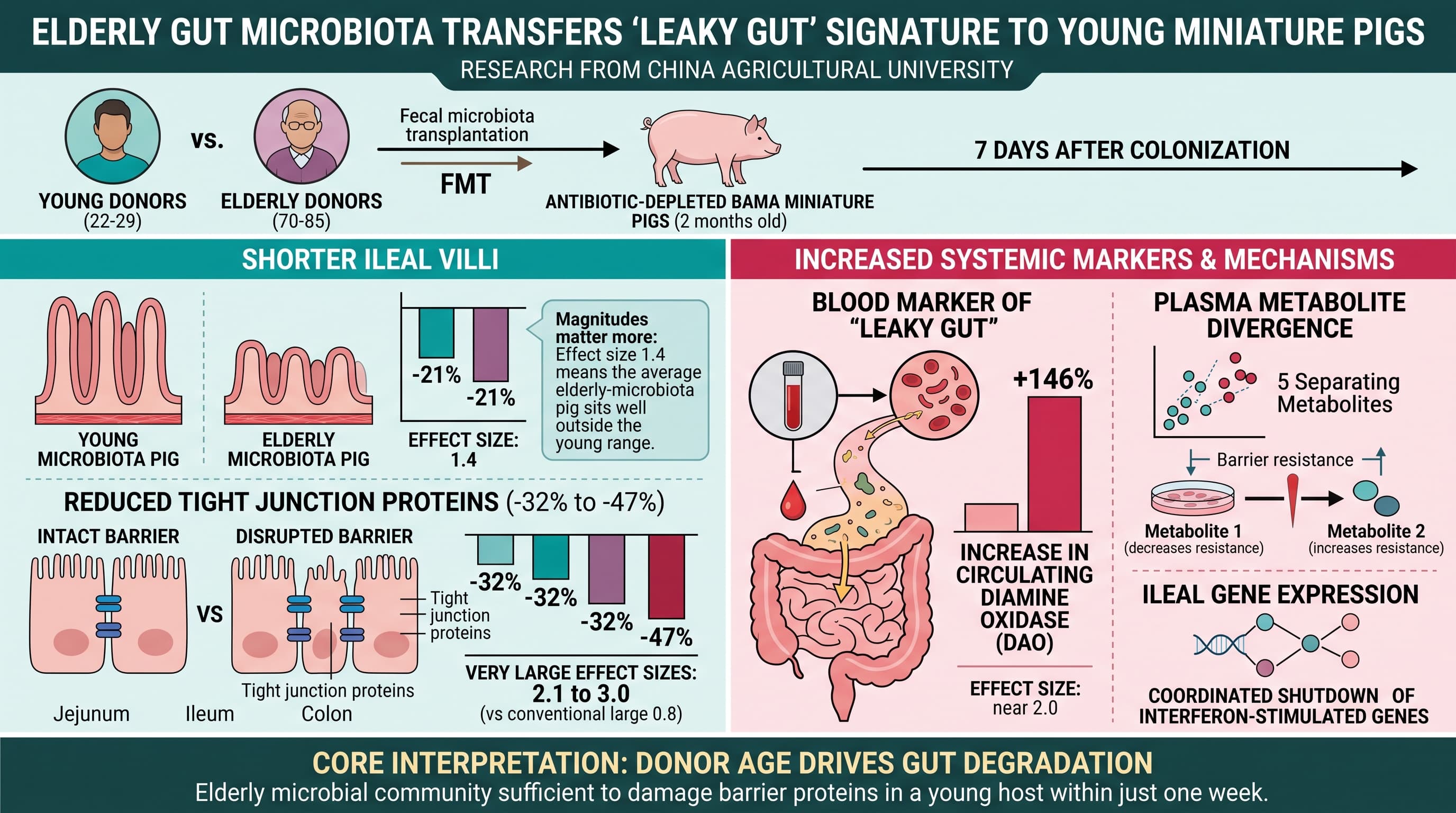
Researchers at China Agricultural University took fecal microbiota from healthy human donors aged 22 to 29 and 70 to 85, and transplanted them into antibiotic-depleted Bama miniature pigs. Seven days after colonization, pigs carrying elderly human microbiota showed shorter ileal villi, lower levels of three tight junction proteins across jejunum, ileum and colon, and roughly two and a half times higher circulating diamine oxidase, a blood marker of leaky gut. Plasma metabolite profiles diverged, with five metabolites separating the groups. Cell culture work confirmed that two of those metabolites moved barrier resistance in opposite directions. Ileal gene expression showed a coordinated shutdown of interferon-stimulated genes in the elderly group. The design is correlative at the mechanism level, the sample is six pigs per group, and the observation window is one week.
The idea that an aged gut microbiome is not just a passenger but a driver of age-related decline has been tested mostly in mice. Mice are cheap and tractable, but their gut is a poor stand-in for ours: different fermentation site, different transit, different diet. This study swapped the model. Pigs eat like us, ferment in the colon like us, and their small intestine scales to body weight roughly the way ours does. That makes the result harder to dismiss as a rodent artifact.
The setup was simple. Eighteen two-month-old male miniature pigs were divided into three groups of six. Two groups were emptied out with a three-day antibiotic cocktail, then given alternate-day gavages of human fecal slurry over eight days, drawn either from five young donors or five elderly donors. A third group received nothing. After a week of colonization the animals were euthanized and their intestines examined.
The transplants took. Microbial richness bounced back to baseline, but the community composition was reshaped and the young and elderly communities stayed distinguishable from each other. Pigs given elderly microbiota carried more Blautia obeum, a species previously linked to worsened colitis in mice and to altered glucose handling in humans. Pigs given young microbiota carried more Phocea massiliensis, a species that declines with age in mice and tracks inversely with frailty scores.
The host responded fast. Villi in the ileum, the segment doing most of the final nutrient absorption, were about a fifth shorter in the elderly group. Duodenum, jejunum and colon architecture were unchanged, which argues for a segment-specific vulnerability rather than generalized damage. Tight junction proteins ZO-1, claudin-1 and occludin dropped by roughly a third to a half depending on segment. Diamine oxidase in blood, which rises when the intestinal lining is compromised, climbed sharply.
The metabolite story was the most mechanistically satisfying part. A dipeptide, Tyr-Phe, fell in elderly recipients and correlated positively with tight junction levels. Prostaglandin E3 rose and correlated negatively. When the team applied each to cultured pig intestinal cells, Tyr-Phe raised barrier resistance and prostaglandin E3 lowered it, which is what the correlations predicted.
The transcriptomics complicate the picture. Seven hub genes, all interferon-stimulated, were downregulated in elderly recipients. The authors read this as a weakened baseline antiviral tone in the epithelium. That reading is plausible but not tested here, and it sits awkwardly with the usual inflammaging narrative of an over-activated aged immune system.
Actionable Insights
What the study does is put a number on how quickly a microbial community can degrade barrier function in a human-like gut.
The magnitudes matter more than the p-values. Ileal villus height fell about 21 percent, with a standardized effect size near 1.4. In plain terms, an effect size of 1.4 means the average elderly-microbiota pig sat well outside the range where most young-microbiota pigs clustered. Tight junction protein reductions ran 32 to 47 percent with effect sizes between roughly 2.1 and 3.0, which is very large by the usual convention that 0.8 counts as large. Blood diamine oxidase rose about 146 percent, effect size near 2.0.
The practical reading is that donor age, not the recipient’s age, drove all of this. The pigs were two months old. Whatever the elderly microbial community carried was sufficient to degrade barrier proteins in a young host within a week. That supports the general case for attending to gut community composition, and it puts specific candidates on the watch list: Blautia obeum as a possible liability marker, Phocea massiliensis as a possible favorable one. Neither is measurable on a consumer stool test with any reliability, and neither is modifiable by any validated intervention at present.
There is no lifespan data, no human endpoint, and no tested intervention. Anyone selling a probiotic on the back of this paper is ahead of the evidence.
Context and Source
- Open Access Paper: Transplantation of Elderly Human Gut Microbiota Into Pigs Reprograms Intestinal Barrier Function, Plasma Metabolome, and Gut Mucosal Transcriptomic Landscape.
- Institution: State Key Laboratory of Animal Nutrition and Feeding, China Agricultural University, Beijing, with contributions from the School of Public Health, Peking University.
- Country: China.
- Journal: Aging Cell, published by Wiley.
- Impact evaluation: The impact score of this journal is 7.7 (2025 Journal Impact Factor, 2026 JCR release; five-year JIF 8.9), evaluated against a typical high-end range of 0 to 60+ for top general science, therefore this is a Medium impact journal.
Related Reading:
- Butyrate: The Microbiome's Anti-Aging "Kill Switch" for Senescent Cells
- Microbiome-Linked Metabolic Architecture of Accelerated Biological Aging in Humans
- Curcumin, Butyrate, and the Aging Immune System: A Microbiome-Centric Strategy for Longevity
- The "Gut-Seal" Protocol: Polyphenol Synergy Remodels the Microbiome to Reverse Inflammaging
- Gut Feelings: How the Microbiome Programs Cellular Longevity
- The Mouth-Brain-Gut Axis: Why Your Oral Microbiome Is the Next Frontier in Longevity
- Gut Metabolites Control Systemic Aging: The Overlooked Power of Short-Chain Fatty Acids