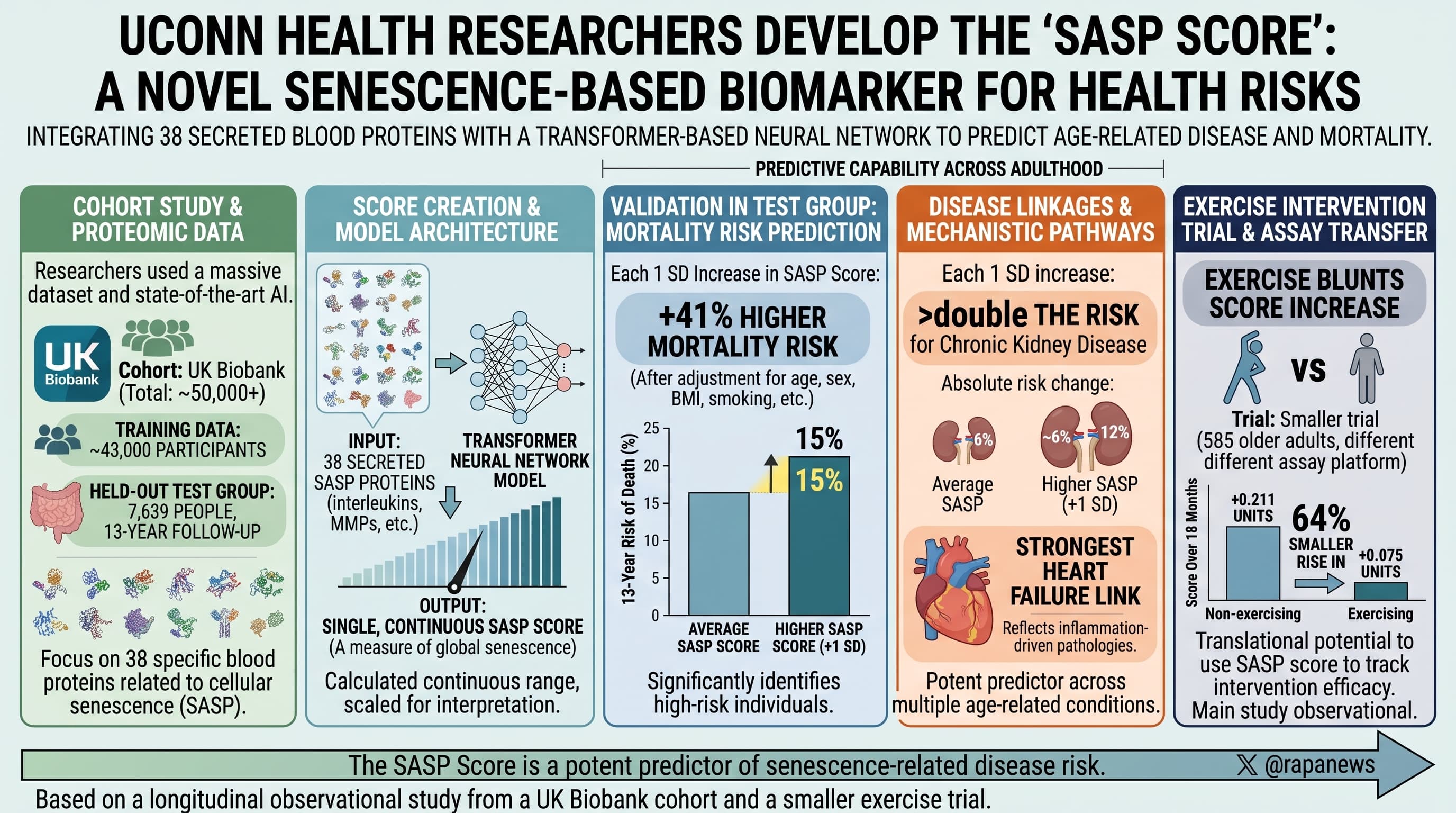
Researchers at UConn Health combined 38 blood proteins linked to cellular senescence into a single “SASP Score” using a transformer-based neural network trained on about 43,000 UK Biobank participants. In a held-out test group of 7,639 people followed for about 13 years, each 1 standard deviation increase in the score was associated with 41% higher mortality risk after adjustment for age, sex, BMI, smoking and other factors. The strongest links were to chronic kidney disease (more than double the risk per SD) and heart failure. The model was transferred to a different assay platform in a smaller exercise trial of 585 older adults. There, the score rose over 18 months in non-exercisers but not in exercisers.
Senescent cells are sometimes called zombie cells. They stop dividing but don’t die, and they keep releasing a mix of inflammatory signals, growth factors and tissue-degrading enzymes known as the senescence-associated secretory phenotype, or SASP. Many geroscientists think this secretory spillover is one of the ways aging spreads from tissue to tissue. The practical problem is measurement. Senescent cells are rare and scattered, and nobody can biopsy every organ. Blood-borne SASP proteins are the obvious workaround, but single proteins are noisy and none of them is specific to senescence.
This study tries to solve the problem by pooling signals. The team selected 38 plasma proteins that change in the same direction across multiple cell types and senescence triggers. They fed these into a guided autoencoder built on transformer architecture, the same basic machinery behind modern language models. The network compressed the 38 proteins into one number, using chronological age as a training guide so the score would capture aging-related structure rather than random variation.
In the UK Biobank test group, the score behaved like a credible aging measure. It correlated strongly with age and with established biological age measures, including PhenoAge and a proteomic aging clock. It was higher in smokers, people with central obesity, people with hypertension or high cholesterol, and frail participants. After adjusting for conventional risk factors, a higher score predicted death and a range of chronic conditions. Kidney disease, heart failure, COPD, delirium, heart attack and dementia showed the clearest signals. The composite also outperformed each of its 38 component proteins on its own.
The top contributors were GDF15, CXCL9, PGF, osteoprotegerin (TNFRSF11B) and CCL20. For readers who follow mitochondrial biology, GDF15 leading the list matters. GDF15 is a well-characterized mitochondrial stress signal and one of the most reliable aging proteins in plasma. However, it is not specific to senescent cells.
The second selling point is portability. Most proteomic clocks only work on the platform they were trained on. Here the model was fine-tuned on a different technology, a Luminex immunoassay panel, in the MEDEX trial of adults aged 65 to 84. In that cohort, the score climbed significantly over 18 months in participants who did not exercise. It stayed statistically flat in those assigned to combined aerobic and resistance training. The authors read this as exercise holding back senescence accumulation.
That conclusion runs ahead of the data. The formal test of whether the two groups’ trajectories differed did not reach significance. A pattern where one group changes “significantly” and the other does not is not the same as a significant difference between groups. The exercise finding is suggestive at best.
The larger contribution is methodological: a transferable, open-code composite that trials of senolytics and senomorphics could use as a secondary endpoint. Whether it measures senescence specifically, rather than general inflammation, kidney function and mitochondrial stress, remains an open question.
Actionable Insights
This score is a research tool, not a test you can order. The practical lessons are indirect.
First, the factors associated with a higher SASP Score are familiar and modifiable: smoking, high waist-to-hip ratio, high blood pressure and high cholesterol. These are cross-sectional associations, so they do not prove that fixing them lowers senescence burden. They are still consistent with standard cardiometabolic advice.
Second, exercise. Over 18 months, the non-exercise group’s score rose by 0.211 units. The exercise group’s score rose by 0.075 units, a rise about 64% smaller. The gap between groups was roughly 0.14 units, and if the score is scaled near standard deviation units, that is a small effect. It was also not statistically significant in the head-to-head test. Treat it as a hint that twice-weekly supervised aerobic and resistance training may slow a senescence-linked protein signature, not as proof.
Third, the risk signal. Each 1 SD higher score carried 41% higher mortality risk. In absolute terms, that roughly moves 13-year risk of death from about 11% to about 15%. For kidney disease, risk moved from about 6% to about 12%.
Finally, if you track GDF15 or other inflammatory markers privately, these data support their prognostic value, but not their use as intervention targets.
Context and Source
- Open Access Paper: A Deep-Learning Based Biomarker of Systemic Cellular Senescence Burden to Predict Mortality and Health Outcomes, published: 25 September 2026.
- Institution: UConn Center on Aging, UConn Health (Farmington, Connecticut), with Washington University School of Medicine, UC San Diego and the University of Connecticut Department of Statistics
- Country: USA (UK Biobank data)
- Journal: Aging Cell, 2026, volume 25, e70737
- Impact evaluation: Aging Cell has a 2025 Journal Impact Factor of 7.7 in the 2026 Journal Citation Reports release, with a five-year JIF of 8.9. The impact score of this journal is 7.7, evaluated against a typical high-end range of 0 to 20+ for aging and geroscience journals (Nature Aging sits near the top), therefore this is a High impact journal.
Related Reading:
- Fatty Acids can function as Senolytics: Conjugated PUFAs Target Senescent Cells via Ferroptosis
- Rubedo Life Sciences bets senescent cell clearance can make skin act younger
- Cellular Senescence as a Contributing Cause of Muscle Aging
- The Renal Pacemaker: How Kidney Senescence Drives Systemic Aging
- Irina Conboy's Generation Lab Multi-Drug Longevity Formulation / MOA