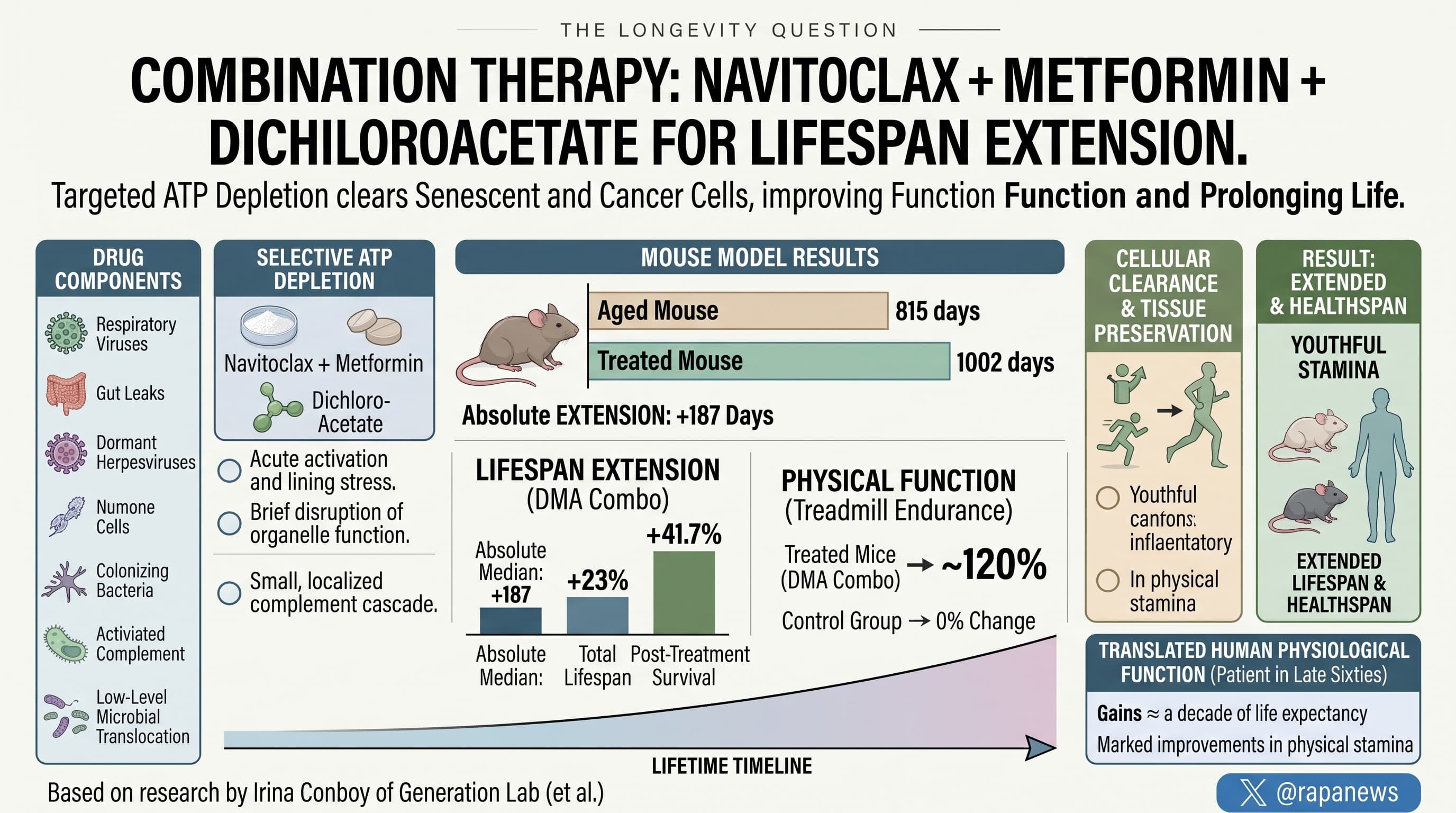
Three drugs have been identified, but her new therapeutic is operating in the same manner, but “may” be different drugs. Navitoclax is not an FDA approved drug.
3-Drug Combo Extends Lifespan by 41% (in remaining lifespan, or approx. 10% of total lifespan) | Dr. Irina Conboy
I. Executive Summary
In this interview, Dr. Irina Conboy (former Professor of Bioengineering at UC Berkeley; Co-Founder and Chief Science Officer of Generation Lab) discusses her research published in Aging (Albany NY) detailing a synergistic, three-drug pharmacological cocktail termed DMA: Dichloroacetate (DCA), Metformin (Met), and Navitoclax (ABT-263). The intervention exploits a shared metabolic vulnerability common to both neoplastic (cancerous) and senescent cells: severe mitochondrial structural/functional damage and an obligatory dependence on aerobic glycolysis (the Warburg effect) for ATP generation. Concurrently, senescent cells fuel cancer proliferation, invasion, and metastatic potential via the pro-inflammatory senescence-associated secretory phenotype (SASP).
The DMA cocktail systematically executes a tripartite energetic collapse:
-
DCA inhibits pyruvate dehydrogenase kinase (PDK), forcing pyruvate flux into damaged mitochondria and demanding oxidative phosphorylation (OXPHOS).
-
Metformin concurrently inhibits mitochondrial complex I of the electron transport chain, choking residual ATP production and triggering cytochrome c leakage into the cytoplasm.
-
A low dose (one-tenth of the standard cytotoxic regimen) of Navitoclax (ABT-263) competitively antagonizes anti-apoptotic Bcl-2 and Bcl-xL survival proteins, preventing mitochondrial pore resealing and precipitating selective programmed cell death.
Healthy human somatic cells, possessing intact mitochondrial reserves and metabolic plasticity, tolerate this metabolic stress with negligible viability loss. In vivo administration in aged mice (18–20 months old; roughly equivalent to 65–70 human years) extended remaining post-treatment lifespan by 41.7% (translating to a modest 10–12% increase across total chronological lifespan, achieving a median survival of approximately 1,000 days). The regimen improved treadmill endurance, preserved hanging agility, and did not aggravate clinical frailty indices. Crucially, reducing Navitoclax to one-tenth its standard dosage circumvented on-target dose-limiting thrombocytopenia, preserving platelet counts. Conboy explicitly cautions that DMA remains unvalidated in human clinical trials, and that off-target tissue senescence or in vivo tumor burdens were not directly quantitated in this paper. Conboy also outlines translational work at Generation Lab involving “One Generation”—a subcutaneous injectable combining two repurposed FDA-approved compounds designed to act as a pharmacological surrogate for therapeutic plasma exchange (TPE) by neutralizing age-elevated systemic circulating inhibitory proteins and promoting tissue regeneration.
II. Insight Bullets
-
Dr. Irina Conboy’s primary study investigates a three-drug combination—termed the DMA cocktail—designed to ablate both malignant and senescent cells simultaneously.
-
The paper detailing this protocol is entitled Selective targeting of cancer and senescence via shared metabolic shifts extends lifespan of old mice, published in Aging.
-
Dr. Conboy serves as Co-Founder and Chief Science Officer at Generation Lab, based at the Landing Biological Sciences campus in Burlingame, California.
-
Senescent cells and cancer cells share a fundamental physiological limitation: impaired mitochondrial ultrastructure and heavy energetic reliance on glycolysis.
-
Senescent cells cannot replicate, but they actively induce a permissive microenvironment for tumor growth, immune evasion, and metastasis by secreting pro-inflammatory SASP factors.
-
Classical antineoplastic chemotherapies frequently exacerbate non-malignant tissue senescence, increasing frailty and paradoxically accelerating disease recurrence.
-
Traditional senolytics and chemotherapeutics cause collateral cytotoxicity in healthy tissues, most notably depressing hematopoiesis and megakaryocyte/platelet survival.
-
DMA consists of Dichloroacetate (DCA), Metformin (Met), and the BH3-mimetic Bcl-2/Bcl-xL inhibitor Navitoclax (ABT-263).
-
Dichloroacetate inhibits pyruvate dehydrogenase kinase, preventing cytoplasmic conversion of pyruvate to lactate and forcing substrate flux directly into mitochondrial respiration.
-
Metformin partially blocks complex I of the mitochondrial electron transport chain, depriving metabolically compromised cells of alternative ATP synthesis pathways.
-
Forcing damaged, short-circuiting mitochondria into oxidative phosphorylation provokes excessive inner-membrane stress and triggers cytochrome c efflux into the cytosol.
-
Under severe metabolic stress, compromised cells attempt to blunt apoptosis by upregulating anti-apoptotic Bcl-2 family survival proteins.
-
Navitoclax (ABT-263) competitively binds to and neutralizes Bcl-2 and Bcl-xL, blocking the sequestration of pro-apoptotic factors and sealing cellular commitment to apoptosis.
-
Pre-stressing cells with DCA and Metformin permitted a 90% reduction (to 0.1x of standard dosing) in the requisite concentration of Navitoclax.
-
Standard clinical application of Navitoclax induces dose-dependent, on-target thrombocytopenia because circulating platelets rely on Bcl-xL for homeostatic survival, a primary clinical limitation documented in Phase II trials.
-
Lowering the Navitoclax dosage tenfold in the DMA regimen completely abrogated severe thrombocytopenia in aged mice, preserving functional circulating platelet counts.
-
In vitro screening against healthy human primary cells (including hepatocytes and neurons) revealed negligible cytotoxicity, with viability remaining above 90%.
-
In vivo testing initiated in aged C57BL/6 mice (18 to 20 months of age) resulted in a 41.7% median lifespan extension measured from the onset of intervention.
-
The 41.7% post-intervention survival gain corresponds to a 10% to 12% increase when calculated across the animal’s total chronological lifespan.
-
Treated mice reached a median chronological lifespan of approximately 1,000 days, eclipsing the conventional ~900-day upper threshold typical for C57BL/6 cohorts.
-
DMA-treated mice displayed statistically significant improvements in treadmill running endurance without loss of agility or performance on hanging grip tests.
-
Quantitative composite frailty scores showed no worsening in treated mice compared to controls, demonstrating that cytotoxic chemotherapy can be administered without inducing frailty when metabolic selectivity is leveraged.
-
C57BL/6 mice exhibit high baseline telomerase activity and long telomeres, rendering spontaneous neoplastic malignancy their primary cause of natural death.
-
The published Aging study assessed human cancer cell lines in vitro and mouse longevity in vivo, but did not measure internal tumor burdens or tissue-specific senescence markers in the mice post-mortem.
-
At least 50% of human malignancies manifest an explicit Warburg glycolytic shift, indicating broad conceptual applicability across oncologic subtypes.
-
Senescent cells in vivo remain notoriously heterogeneous, and universal molecular biomarkers across all tissue niches are still actively being categorized by international consortia.
-
Conboy argues that age-related deterioration is systemic and multi-factorial, meaning mono-molecular magic bullets targeting single proteins cannot reverse systemic tissue decline.
-
Therapeutic Plasma Exchange (TPE) and neutral blood exchange (NBE) function by non-specifically diluting elevated circulatory inhibitory proteins, returning tissue signaling toward baseline homeostatic levels.
-
Conboy views repetitive, long-term TPE as clinically unscalable, highly invasive, and prone to cumulative vascular and cellular trauma if used indefinitely for healthy longevity maintenance.
-
Blood proteins elevated in aging and chronic pathology are not intrinsically defective; they are native regulatory factors whose hyper-elevated concentrations disrupt normal downstream transcription.
-
Generation Lab is developing a subcutaneous injectable therapeutic termed “One Generation” intended to act as a pharmacological substitute for neutral blood exchange.
-
“One Generation” combines two repurposed, FDA-approved compounds designed to neutralize circulatory inhibitory proteomic noise while stimulating endogenous regenerative repair cascades.
-
Generation Lab intends to pursue an initial FDA regulatory pathway for “One Generation” targeting vascular pathologies and cardiovascular disease prevention.
-
The FDA allows clinical trial approvals focused on primary or secondary disease risk prevention based on validated clinical risk metrics, circumventing the need for “aging” to be recognized as a distinct disease.
-
High-dose single-agent Dichloroacetate exhibits severe dose-dependent clinical neurotoxicity, specifically documented as reversible peripheral neuropathy in human trials like the Kaufmann et al. RCT.
-
Conboy explicitly advises the public against self-administered biohacking with DCA, metformin, or unapproved BH3-mimetics, emphasizing that optimal human dosages cannot be linearly extrapolated from rodent data.
-
Fasting-mimicking regimens operate on general nutrient restriction, but malignant cells frequently outcompete healthy parenchyma for limited systemic glucose and amino acids.
-
High-throughput robotic multi-dimensional screening was required to identify the exact molar ratios of DCA, Metformin, and ABT-263 that optimize synergy while minimizing toxicity.
-
Formal translational steps required before DMA human clinical trials include expanded pharmacokinetic profiling, in vivo tumor-reduction models, genotoxicity assays, and immunogenicity evaluations.
-
Generation Lab projects an estimated timeline of at least twelve months before human clinical safety and Phase I dosing trials for their pharmacological platforms can begin.
============================
Full interview transcript:
Richard (Modern Healthspan): Today we are joined by Dr. Irina Conboy, a former professor at UC Berkeley and co-founder and Chief Science Officer at Generation Lab, whose pioneering research fundamentally shifted our understanding of heterochronic parabiosis and systemic rejuvenation—demonstrating that diluting old inhibitory blood factors as well as clearing senescent cells can reverse multi-tissue functional decline.
Dr. Conboy, welcome back to Modern Healthspan.
Dr. Irina Conboy: Thank you, Richard, for having me again.
Richard: Last time we spoke, which was about five years ago, we talked about your work in neutral blood exchange and the important implications that had for aging. Today, what I wanted to talk about was this recent paper that you published: “Selective targeting of cancer and senescence via shared metabolic shifts extends lifespan in old mice.”
The results were really quite good. You saw around a 41% extension in lifespan—was that median lifespan or total lifespan?
Dr. Conboy: It was much smaller than that if you consider the entire lifespan of an animal. It was maybe around 10% to 12% if you start counting from the time the mice were born. It is bigger if you start counting from the first administration.
Importantly, we are not focusing on starting with young mice; we start with mice that are already old, and then we try to extend their healthspan and lifespan from that point on.
Richard: Yes, I saw that it was 12% for total lifespan.
Dr. Conboy: It is only from the time point when you administer the treatment that it is around 40%. If you count the entire lifespan of a mouse, it is much less—around 10% to 12%.
Richard: Could you talk about the structure of the study? What did you do, and what were the key results that you observed?
Dr. Conboy: We can talk about lifespan extension, but it is worth mentioning that it is not just lifespan extension—it is an extension of lifespan when animals are treated with what is considered a chemotherapeutic capable of ablating cancer cells and senescent cells.
That makes it especially interesting. Usually, individuals undergoing chemotherapy—while it is life-saving—experience a shortened lifespan or healthspan. They become less healthy compared to ordinary healthy people without chemotherapy or cancer. That happens because we do not yet have selective chemotherapeutic drugs outside of immunotherapy, which is a major breakthrough with selective agents that target only cancer cells. Conventional chemical or biochemical chemotherapeutics also damage healthy cells in the patient; they are poorly selective for cancer cells.
The same is true about senolytics—drugs that kill senescent cells. They cause cells to undergo programmed cell death. Because some cells are more damaged than others, senescent cells perhaps do it more frequently, but conventional approaches also prevent other healthy cells from surviving, such as bone marrow cells that produce platelets. Because of that, senolytics and chemotherapeutics usually diminish the health of the rest of the tissue.
Our lifespan extension was particularly interesting because we used a chemotherapeutic and senolytic cocktail that did not diminish the health of the mouse. In fact, it allowed the mice to live longer. I would like your audience to think about it from that perspective: it is not just another longevity therapeutic. It represents a therapeutic approach that is chemotherapeutic—ablating cancer cells, preventing cancers, and ablating senescent cells—while, in contrast to other approaches, not inducing frailty or posing significant health risks.
Richard: It was targeted at both cancer and senolytics, which is really interesting. We will get into the mechanism shortly. In this mouse study, what age were the mice when you administered the therapy?
Dr. Conboy: They were about 18 to 20 months old. That would be analogous to roughly a 65- to 70-year-old person, because mice typically live until they are 24 months old. Some survive longer, but a two-year-old mouse is very old, and our mice were just before that threshold.
Richard: You measured healthspan and lifespan. From that point onwards, they lived 41.7% longer. The median lifespan was around 1,000 days for the cohort receiving the intervention.
Dr. Conboy: The complete data is detailed in the paper. The core takeaway is not simply that it is another longevity approach; typically, when treated with this class of drugs, there is damage to healthy tissues and lifespan shortens. In this case, it did not. That was an additional benefit in a study designed primarily to see whether we could selectively target cancer and senescent cells together as a pathogenic group without harming healthy cells. The lifespan extension was an additional positive finding.
Richard: Looking at the functional results: you evaluated frailty, and the overall frailty score was not significantly different, but they did have improved running performance.
Dr. Conboy: Yes, the mice on the DMA cocktail improved their performance on the treadmill and did not have diminished performance on the hanging test. The treadmill tests endurance, while the hanging test evaluates agility and coordination. Agility and coordination were preserved, and composite frailty was not significantly different between control mice and the mice receiving the cocktail.
In a standard longevity study, one might say there is no difference in frailty. However, because these mice were treated with a potent chemotherapeutic and senolytic mixture, we interpret it positively: there was no increase in frailty, whereas patients who undergo chemotherapy typically experience elevated frailty.
Richard: Laboratory mice often die from cancer—it is a leading cause of death. Did you see a reduction in the incidence of cancer?
Dr. Conboy: C57BL/6 laboratory mice were bred historically to study cancer; they exhibit high telomerase activity and long telomeres, making them cancer-prone. In this particular paper, we did not explore cancer progression models in vivo—such as p53-deficient models or other specialized strains. That will be an important next step.
The published paper focused primarily on in vitro evaluations of human cancer cells of various types alongside human senescent cells, concentrating on ablating those two pathogenic cell types together. The mouse study was conducted to confirm that we did not generate significant adverse side effects in an in vivo animal model, and during that assessment, we observed that they lived longer. Directly evaluating whether they had lower incidences of cancer and senescence in vivo is the focus of subsequent work.
Richard: Let’s discuss the cocktail itself and how it functions. What are the three components within the DMA combination?
Dr. Conboy: We call it DMA:
-
D stands for dichloroacetate (DCA), a small molecule.
-
M stands for metformin, a well-known drug widely discussed in longevity research and primarily used to treat type 2 diabetes.
-
A stands for ABT-263 (Navitoclax), a well-characterized compound in biological research that inhibits Bcl family anti-apoptotic proteins (such as Bcl-xL and Bcl-2), which normally prevent cells from dying. ABT-263 promotes programmed cell death.
Richard: What is the underlying strategy behind using these three drugs together to clear senescent and cancer cells?
Dr. Conboy: We hypothesized that it would be significantly more effective to address cancer and senescent cells by targeting them simultaneously. Senescent cells do not divide and therefore do not directly transform into tumors, but pioneering work by Judy Campisi demonstrated that senescent cells create a permissive tissue microenvironment that facilitates cancer growth and metastasis.
When a cell experiences severe damage, it can enter senescence to avoid replication, but it then secretes numerous inflammatory factors termed the senescence-associated secretory phenotype (SASP). These inflammatory molecules alter the surrounding tissue and skew immune responses, enabling cancer cells to thrive.
Our objective was to eliminate both cell types concurrently. The question became: what common weakness do cancer cells and senescent cells share?
Both cell types suffer from perturbed mitochondria and impaired capacity to generate ATP efficiently. When a cell becomes damaged and senescent, mitochondrial and endoplasmic reticulum stress responses occur, disrupting protein synthesis and normal ATP generation. Normally, this cascade triggers apoptosis. However, senescent cells evade apoptosis by under-utilizing dysfunctional mitochondria and relying heavily on glycolysis—an evolutionarily ancient mechanism of ATP generation. Similarly, cancer cells face severe internal stressors and evade cell death while relying extensively on glycolysis rather than oxidative phosphorylation.
Metformin inhibits complex I of the mitochondrial electron transport chain, further hindering ATP generation via that pathway. Healthy cells have abundant, well-functioning mitochondria and can tolerate low-dose metformin. Dichloroacetate shuffles pyruvate into the mitochondria and forces cells toward mitochondrial respiration, preventing their reliance on glycolysis. Healthy cells already depend primarily on functional mitochondria, so this shift is readily tolerated. For cancer and senescent cells, however, being forced to utilize dysfunctional, short-circuiting mitochondria while simultaneously having complex I partially inhibited creates extreme stress.
When mitochondria are stressed during respiration, cytochrome c leaks from the mitochondrial inner membrane into the cytoplasm, initiating the apoptotic cascade. Normally, cells attempt to mitigate this by using anti-apoptotic Bcl-2 family proteins to seal mitochondrial membrane pores. By adding ABT-263, we inhibit those Bcl survival proteins, preventing the cell from blocking cytochrome c release.
That completes the mechanism: DCA forces pyruvate into damaged mitochondria, metformin dampens mitochondrial electron transport efficiency, and ABT-263 disables the survival proteins that would otherwise prevent cytochrome c leakage and apoptosis.
Richard: So DCA pushes pyruvate into the mitochondria, metformin impairs the electron transport chain, and low-dose Navitoclax (ABT-263) prevents the cells from blocking the apoptotic cascade. Standard doses of ABT-263 often cause a decline in platelets, but at your dosage, that was avoided?
Dr. Conboy: ABT-263 was designed to bind anti-apoptotic survival proteins such as Bcl-2 and Bcl-xL, which prevent cytochrome c leakage into the cytoplasm. Many cell types, including platelets and neurons, rely on the Bcl family for survival. At conventional standalone doses used for chemotherapy or senolysis, Navitoclax causes significant thrombocytopenia—a severe drop in platelets.
Because DCA and metformin push cancer and senescent cells to the brink energetically, we were able to use one-tenth of the standard dose of Navitoclax. At one-tenth of the dose, it selectively ablates the stressed pathogenic cells while sparing healthy cells. In our mouse studies, platelet counts were well-preserved compared to standard regimens.
When we evaluated the cocktail across diverse healthy human primary cells—including hepatocytes and neurons—they showed minimal decline in viability (around 10% or less), whereas the cancer and senescent cells were largely eliminated. Healthy human cells tolerate the intervention because their mitochondrial reserve and function are intact.
Richard: Senescent cells and cancer cells are known to be heterogeneous. Given that both utilize glycolysis, do you expect this mechanism to apply broadly?
Dr. Conboy: In cancer, at least 50% of tumors exhibit the Warburg effect (a pronounced reliance on glycolysis). For senescent cells, universal in vivo markers are still being actively investigated by broad NIH consortia, but substantial published evidence indicates that senescent cells predominantly harbor damaged mitochondria and rely heavily on glycolytic metabolism.
Richard: In the paper, you looked at platelets in vivo. Did you measure senescent cell markers directly in the treated mice?
Dr. Conboy: We did not directly quantitate in vivo senescent cell clearance in the mice in this particular paper. We evaluated platelet preservation and overall longevity. The mice lived longer without overt detriments, indicating tolerability, but tissue-specific quantification of cancer burden and senescent markers in vivo represents our next stage of research.
Richard: Moving forward, do you view this primarily as a cancer therapeutic, a senolytic, or both?
Dr. Conboy: We view it as a dual-capacity approach. Biological aging and chronic disease rarely stem from a single defective protein or single cell type; systemic dysregulation involves widespread network imbalances across multiple cell populations. When tissues age, senescent cell accumulation and pre-cancerous transformations occur in parallel. Interventions should aim to recalibrate tissue composition as a whole rather than focusing exclusively on one isolated target.
Richard: How does this connect to your work in neutral blood exchange (NBE), where the focus is diluting age-elevated inhibitory factors? Are those circulating factors primarily produced by senescent cells, or by older healthy cells?
Dr. Conboy: I do not believe the systemic inhibitory burden originates solely from clusters of senescent cells. Senescent cells are relatively rare in vivo, as are early neoplastic cells that the immune system routinely clears.
A large component of age-related systemic decline appears to stem from cumulative molecular stress in nominally healthy somatic tissues—such as skeletal muscle, bone, and skin. These tissues begin over-secreting native proteins that, while vital at physiological levels in youth, become inhibitory when chronically elevated with age or disease.
Neutral blood exchange works by diluting these elevated factors back to youthful homeostatic ranges, unmasking the body’s intrinsic regenerative signaling. At Generation Lab, we have been working on a pharmacological alternative to therapeutic plasma exchange (TPE)—an injectable agent designed to antagonize and neutralize elevated inhibitory circulating proteins while promoting endogenous tissue repair.
Richard: TPE seems invasive and difficult to scale broadly for ongoing health maintenance.
Dr. Conboy: Repeated, long-term therapeutic plasma exchange involves filtering large percentages of blood volume and discarding plasma while returning cellular components. While valuable acutely or perioperatively—for example, reducing systemic inflammation before orthopedic surgeries—it is an invasive procedure with cumulative risks if done indefinitely every few weeks purely for longevity maintenance. Translating that concept into a targeted subcutaneous injectable offers a much more scalable approach.
Richard: Can you share more details about that injectable development?
Dr. Conboy: The therapeutic program is designated One Generation. It combines two repurposed, FDA-approved components that act cooperatively to normalize elevated inhibitory blood proteins and support tissue repair. Because the components possess established human safety profiles, translation is more streamlined, though formal regulatory validation for a new indication is still required. We are currently evaluating specific indications, with cardiovascular and vascular pathologies being prime candidates.
Richard: Regarding the DMA cocktail: metformin is FDA-approved, DCA is accessible, but ABT-263 is an investigational drug. Could individuals attempt to apply these findings independently?
Dr. Conboy: I strongly advise against personal biohacking with this combination. We utilized high-throughput multidimensional screening to identify the precise synergistic concentrations that kill pathogenic cells while sparing healthy tissue in culture. Safe, effective dosing profiles for whole humans have not yet been established. Translating this requires comprehensive animal toxicology, genotoxicity, and pharmacokinetic validation before initiating Phase I clinical trials.
Richard: This approach of energetic stress bears conceptual similarity to dietary fasting or fasting-mimicking diets, which also stress cellular metabolism.
Dr. Conboy: Fasting places systemic nutrient stress on all tissues, but malignant cells are often aggressive at scavenging residual glucose and amino acids compared to healthy tissues. Rather than systemic starvation, our strategy uses targeted pharmacology to directly force substrate through damaged mitochondrial pathways, creating an internal energetic block specific to metabolically compromised cells.
Richard: What are the next operational steps for Generation Lab regarding DMA and clinical development?
Dr. Conboy: We are completing in vivo toxicology, pharmacokinetic, and genotoxicity evaluations, alongside disease-model efficacy testing. We anticipate that formal clinical trials will take roughly a year or more to initiate, beginning with standardized safety evaluations.
Those interested in our translational research and diagnostic platforms can follow updates through the Generation Lab website.
Richard: Dr. Conboy, thank you very much for joining us and sharing these insights.
Dr. Conboy: Thank you, Richard. It was a pleasure.