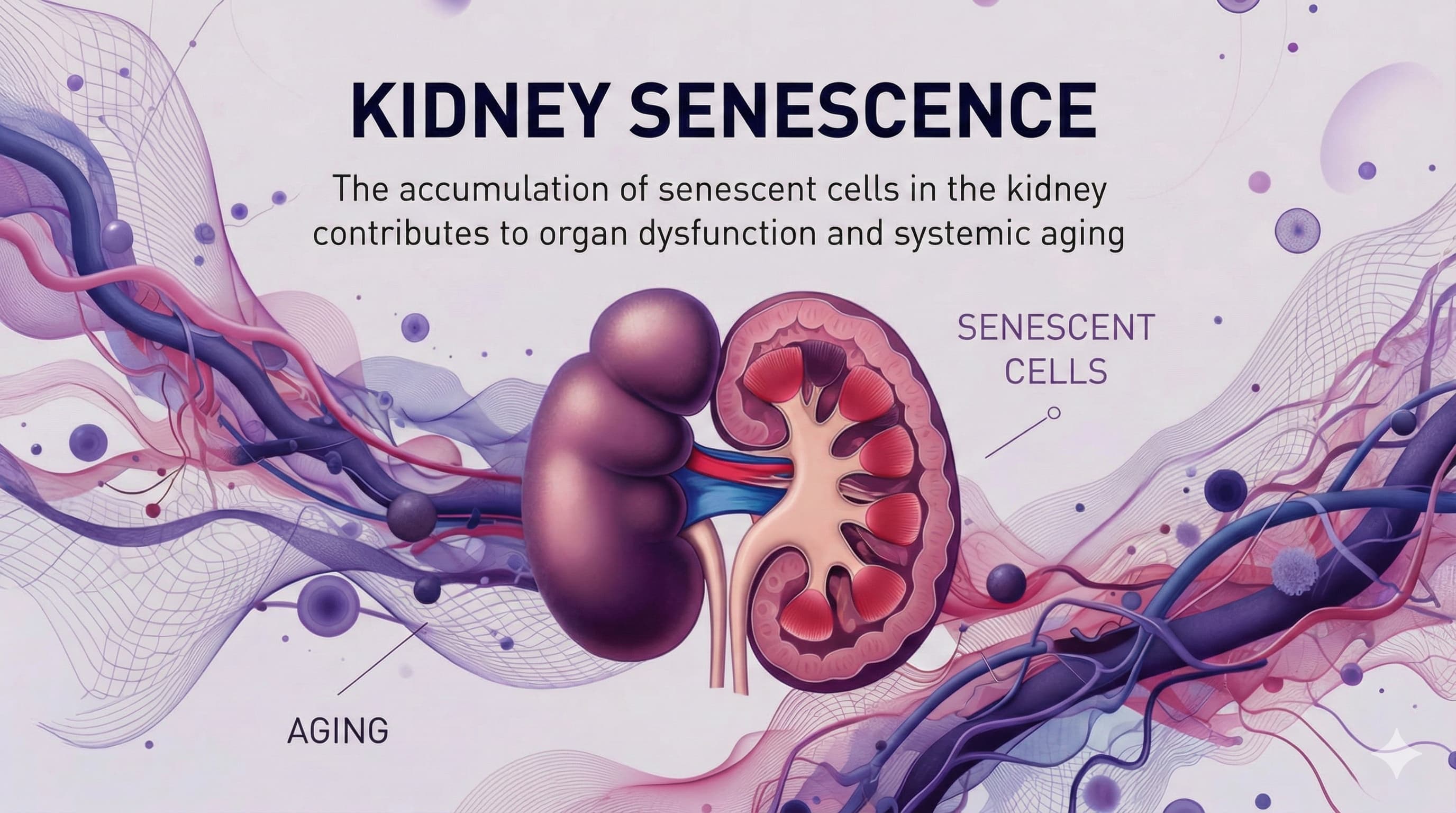
Longevity research has long treated the kidney as a passive victim of aging, merely a filter that clogs over time. A comprehensive new review challenges this view, positing that the kidney acts as a central “pacemaker” for systemic aging. The mechanism is a vicious feedback loop between cellular senescence and “inflammaging”—chronic, sterile inflammation that accelerates decline across all organ systems.
The core pathology identified is the “Senescence-Associated Secretory Phenotype” (SASP). As renal cells age, they accumulate mitochondrial dysfunction, leading to cytosolic DNA leakage that likely activates the cGAS-STING pathway and NF-κB signaling. These cells do not merely stop working; they become “zombie” cells, pumping out pro-inflammatory cytokines like IL-6 and TNF-α. This local inflammation triggers fibrosis (scarring) and, crucially, downregulates the production of α-Klotho.
Klotho is the study’s linchpin. Produced primarily in the kidney, it is a potent circulating anti-aging protein that regulates phosphate metabolism and protects vascular health. The authors argue that the senescence-induced suppression of Klotho turns a local renal problem into a systemic catastrophe, accelerating vascular calcification, cognitive decline, and sarcopenia. This suggests that interventions preserving renal Klotho output could yield disproportionate benefits for whole-body healthspan.
The review evaluates two primary pharmacological strategies: senolytics (drugs like Dasatinib and Quercetin that induce apoptosis in senescent cells) and senomorphics (compounds like Rapamycin that suppress SASP via mTOR inhibition without killing the cell). The data indicates that clearing renal senescent cells does not just restore kidney function; it breaks the systemic inflammatory loop, restoring Klotho levels and reducing biological age markers in distal tissues.
AI Analysis (from Gemini):
This paper, titled “From Senescent Cells to Systemic Inflammation: The Role of Inflammaging in Age-Related Diseases and Kidney Dysfunction”, explores the biological “vicious cycle” between cellular senescence (aging cells that refuse to die) and inflammaging (chronic, low-grade inflammation). It specifically highlights the kidneys not just as victims of aging, but as central players that can accelerate whole-body aging when they malfunction.
Detailed Breakdown
1. The Core Mechanism: The “Inflammaging” Loop
- Inflammaging: A chronic, sterile (non-bacterial) inflammation that increases with age. It is predicted by markers like IL-6, TNF-α, and CRP.
- Immunosenescence: The immune system ages too. It becomes overactive (autoimmunity/inflammation) but less effective at fighting actual threats (infections/cancer).
- The SASP Factor: Senescent cells stop dividing but remain metabolically active, churning out a “SASP” (Senescence-Associated Secretory Phenotype) cocktail of pro-inflammatory cytokines that turn neighboring healthy cells into senescent ones.
2. The Kidney as an Aging Accelerator
The paper posits the kidney is a “sentinel” of aging.
- Fibrosis: Chronic inflammation causes renal tissue to scar (fibrosis), reducing function.
- Klotho Deficiency: The kidney is the main producer of α-Klotho, a powerful anti-aging protein. Inflammation suppresses Klotho production. Lower Klotho levels are directly linked to faster aging, vascular calcification, and cognitive decline.
3. Therapeutic Strategies
The paper reviews two main classes of interventions:
- Senolytics: Drugs/compounds that selectively kill senescent cells.
- Senomorphics: Drugs/compounds that suppress the toxic SASP signals without killing the cell.
Actionable Insights for Longevity Biohackers
Based on the interventions reviewed in the paper, here is a list of actionable insights.
> Note: “Preclinical” means the strongest evidence is currently in mice/cells. “Clinical” implies human trial data exists.
1. The Senolytics (The “Clean-Up” Crew)
These compounds aim to periodically purge “zombie” cells to lower the total inflammatory burden.
-
Fisetin (The Accessible Bio-Flavonoid)
- Paper Finding: Reduces SASP gene expression and preserves kidney histology; protects mitochondria.
- Biohacker Protocol: Fisetin is widely available as a supplement. Biohackers often use “hit-and-run” pulsing protocols (e.g., high dose for 2-3 days, then off for a month) rather than daily low dosing, mimicking the intermittent “clearing” seen in studies.
- Evidence Level: Preclinical (mixed), Clinical trials ongoing.
-
Quercetin + Dasatinib (The “D+Q” Combo)
- Paper Finding: One of the most potent combinations. It targets anti-apoptotic pathways to force senescent cells to die. Shown to reduce SASP, improve renal markers, and—crucially—increase α-Klotho expression.
- Biohacker Protocol: Quercetin is a common supplement (best taken with bromelain or in phytosome form for absorption). Dasatinib is a prescription leukemia drug and carries significant risks/side effects. Advanced biohackers often focus on Quercetin alone or combine it with other natural senolytics if they cannot access or do not want to risk Dasatinib.
- Evidence Level: Preclinical + Clinical.
- Caution on Dasatinib: Dasatinib and Quercetin as Senolytic May Cause Brain Damage
2. The Senomorphics (The “Quieting” Agents)
These are typically taken more regularly to suppress the inflammatory noise (SASP) from aging cells.
-
Rapamycin (mTOR Inhibition)
- Paper Finding: Suppresses SASP and fibrosis by inhibiting the mTOR pathway.
- Biohacker Protocol: Currently the “gold standard” prescription longevity drug in the biohacking community. Usually taken once weekly (pulsed) to minimize immune suppression while maximizing mTOR inhibition.
- Evidence Level: Strong Preclinical; growing human safety data.
3. Kidney-Specific Protection (The “Klotho” Strategy)
Since the kidney produces the anti-aging protein Klotho, protecting kidney function is a longevity strategy in itself.
- Monitor Cystatin C: Don’t just rely on Creatinine/eGFR blood tests. Cystatin C is a more sensitive marker of kidney function that this paper’s context suggests would be valuable for early detection of dysfunction.
- Prioritize Mitochondrial Health: The paper links mitochondrial dysfunction directly to kidney inflammaging. Interventions like CoQ10, PQQ, and Urolithin A (mitophagy inducers) are logically consistent additions to support the high-energy demands of kidney cells.
4. Emerging/Experimental Targets
- FOXO4-DRI: A peptide that disrupts the interaction between FOXO4 and p53, causing senescent cells to commit suicide. (Mentioned as effective in enhancing renal function in preclinical models, but currently difficult to source reliably for humans).
- Glutaminase Inhibitors: Targeting the metabolism of senescent cells (which are addicted to glutamine). This suggests that cycling glutamine or fasting might mimic some of these benefits, though the paper focuses on pharmaceutical inhibitors.
Disclaimer: All these posts are generated with the help of AI systems, and there could be mistakes. Validate with good medical sources before taking any course of action.
