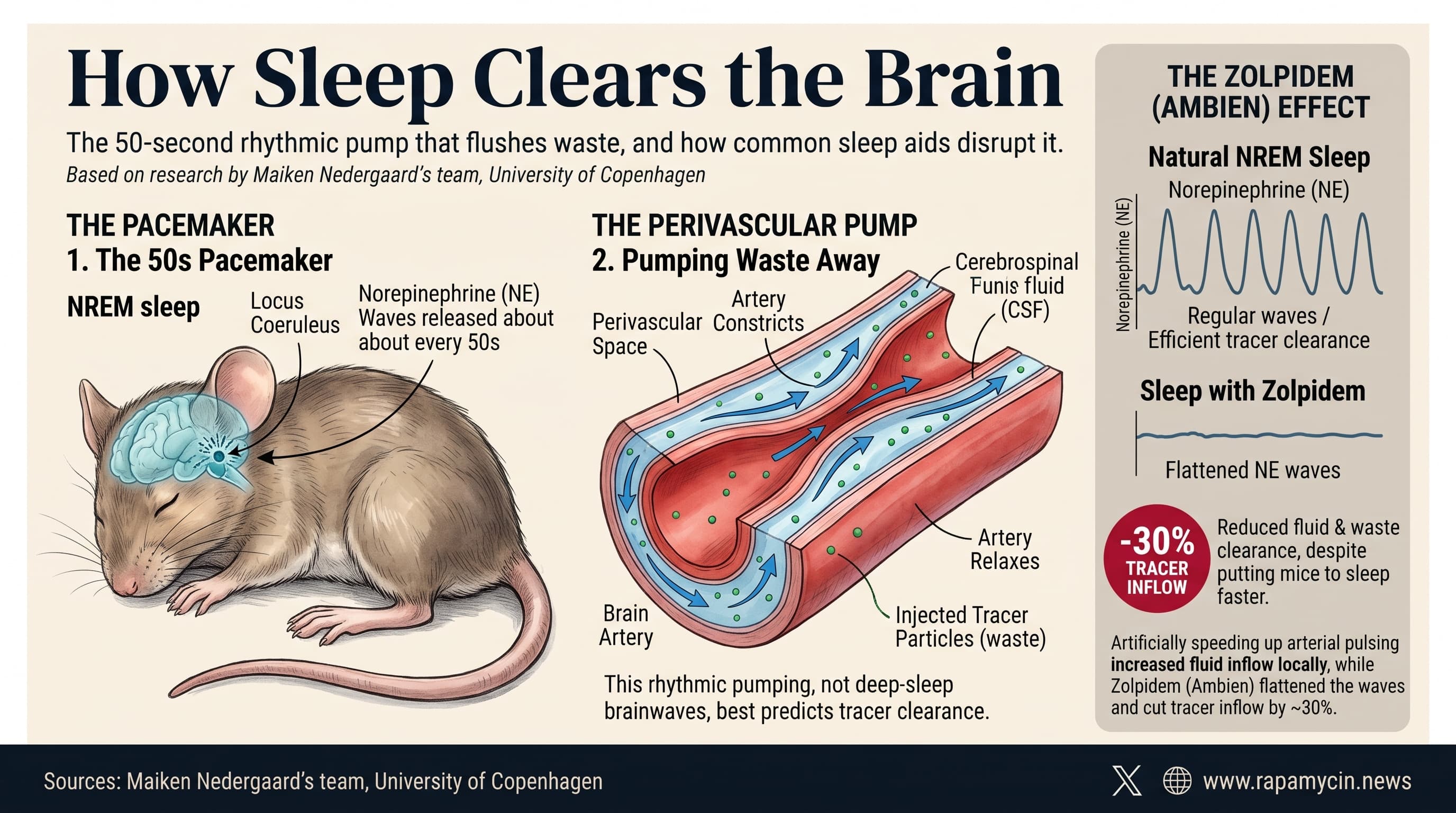
Working in freely sleeping mice, a University of Copenhagen team led by Maiken Nedergaard shows that during non-REM sleep, the locus coeruleus releases norepinephrine in slow waves about every 50 seconds. Each wave constricts brain arteries, and as the arteries shrink and relax, cerebrospinal fluid is drawn in and out of the brain along the spaces around blood vessels. That rhythmic pumping, not total sleep time or deep-sleep brainwave power, best predicted how well the brain cleared an injected tracer. Artificially speeding up arterial pulsing increased fluid inflow locally. The common sleep aid zolpidem (Ambien) flattened the norepinephrine waves and cut tracer inflow by roughly 30%, despite putting mice to sleep faster.
For a decade, the leading explanation for why sleep protects the brain has centered on the glymphatic system, a network that pushes cerebrospinal fluid through brain tissue to wash out waste proteins such as amyloid and tau. What has been missing is the engine. Something has to move that fluid, and the heartbeat alone appears too weak and too fast to do the job.
This study points to a slower and stranger driver. During deep, non-REM sleep, a small cluster of brainstem neurons called the locus coeruleus releases norepinephrine not continuously but in waves, roughly once every 50 seconds. Norepinephrine is a powerful vessel constrictor. The researchers found that each norepinephrine surge squeezes brain arteries, reducing blood volume, and as blood volume falls, cerebrospinal fluid volume rises to fill the space. When norepinephrine ebbs, the arteries relax and the cycle reverses. The result is a slow, rhythmic pump.
To see this, the team built a method they call flow fiber photometry. They genetically tagged blood albumin with a fluorescent protein made in the liver, injected a fluorescent tracer into the cerebrospinal fluid, and recorded both signals through an optical fiber in mice that were sleeping naturally in their home cages. Most earlier work used anesthesia as a stand-in for sleep, but anesthesia suppresses exactly these norepinephrine waves.
The evidence goes beyond correlation. Switching on locus coeruleus neurons with light produced norepinephrine spikes, arterial constriction and cerebrospinal fluid surges, and drugs that block norepinephrine receptors erased the vessel response. Directly forcing artery muscle to pulse faster, without touching neurons, pushed more tracer into the hippocampus and cortex on the stimulated side of the brain.
Perhaps the most counterintuitive finding concerns micro-arousals, the brief, wake-like flickers that punctuate deep sleep and usually coincide with norepinephrine peaks. In 15 mice scanned before and after five hours of natural sleep, the frequency of micro-arousals predicted brain clearance better than total sleep time, REM time or slow-wave power. The authors argue the micro-arousals themselves are not doing the work; they are a visible marker of the norepinephrine pulses underneath.
Then came the clinical twist. Zolpidem, one of the most prescribed sleeping pills in the world, got mice to sleep about four times faster. But it halved baseline brain norepinephrine, flattened its oscillations, abolished the rhythmic pulsing of arteries, and reduced tracer inflow by about a third. The sleep looked like sleep on a clock but lacked the internal rhythm that drives cleaning.
The implications reach into aging. If the pump depends on arteries that can stretch and recoil, then stiff vessels from hypertension or amyloid buildup should weaken it. And the locus coeruleus is one of the first brain regions to accumulate tau in Alzheimer’s disease. The authors suggest this could help explain the long-noted link between cardiovascular disease, poor sleep and dementia.
Caveats are substantial. These are young mice, the tracers are not real waste proteins, group sizes are small, and a rival lab has published data suggesting brain clearance actually slows during sleep. Whether human sleep runs on the same pump remains untested.
Actionable Insights
The take-home message is that the quality and internal rhythm of deep sleep may matter for brain cleaning, not just hours in bed. All of this is mouse data, so the data is preliminary rather than a proven health rule.
First, zolpidem. In mice it cut the amount of cleaning fluid entering the brain by about 30% (a large effect, roughly equivalent to the difference between sleeping and staying awake reported in earlier work, and about one third of the sleep-versus-wake gain seen here). If you use it occasionally, this is not a reason to panic or stop abruptly; it is a reason to discuss with your doctor whether non-drug approaches such as cognitive behavioral therapy for insomnia could replace it.
Second, vascular health. The pump depends on arteries that flex. Controlling blood pressure and maintaining arterial elasticity is already good advice for dementia risk; this paper gives it a plausible mechanism.
Third, medications that block norepinephrine signaling. The drugs used to block the effect here (prazosin, propranolol and atipamezole) are related to bedtime drugs some people take, such as prazosin for nightmares. Nobody has tested whether these blunt brain clearance in humans. [Confidence: Low]
Fourth, do not try to manufacture micro-arousals. Chronic sleep fragmentation harms clearance in other studies.
Context and Source
- Open Access Paper: Norepinephrine-mediated slow vasomotion drives glymphatic clearance during sleep, Published February 06, 2025.
- Institution: Center for Translational Neuromedicine, University of Copenhagen, with contributions from the University of Oxford, Rigshospitalet (Danish Center for Sleep Medicine) and the University of Rochester
- Country: Denmark (primary), with UK and USA affiliations
-
Journal: Cell
Impact Evaluation: Cell’s Journal Impact Factor is 45.1 for the 2025 JCR data year (released June 2026), with a CiteScore of 67.8. The impact score of this journal is 45.1, evaluated against a typical high-end range of 0 to 60+ for top general science, therefore this is an Elite impact journal.
Related Reading:
- Can we harness the brain’s deep-cleaning system to prevent Alzheimer’s?
- Older Brains Still Need Their Sleep. They Have Lost the Machinery to Make It
- The Hidden Architecture of Longevity: Machine Learning Decodes 95,000 Sleep Trackers Across 1,000 Diseases
- Brain Energy Boost: Noradrenaline Drives Mitochondrial Growth to Enhance Memory
- Sleep 2.0 – Understanding and Upregulating the Rejuvenating Aspects of Good Sleep
- Sodium-Restricted Diet Increases Nighttime Plasma Norepinephrine and Impairs Sleep Patterns in Man - paper behind paywall