Novelty
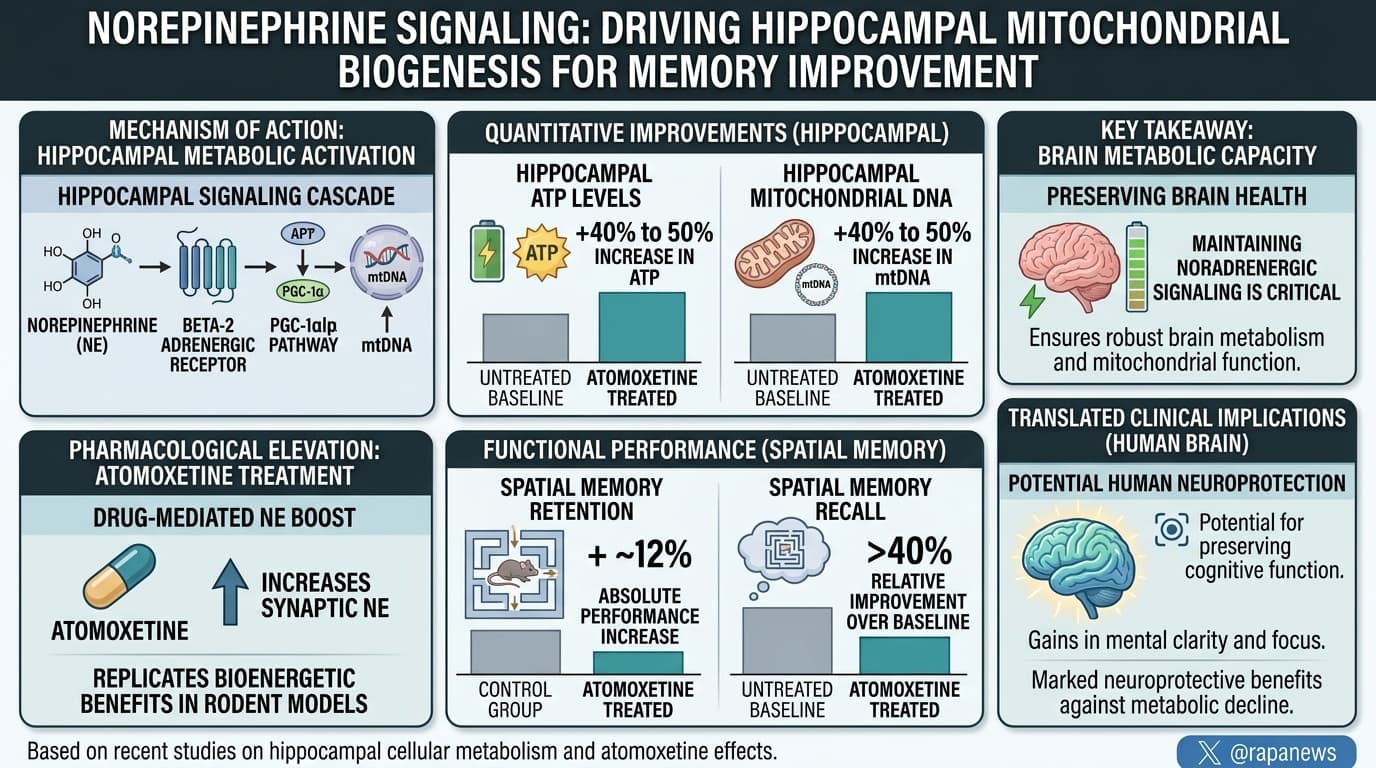
While it has been well documented that norepinephrine influences synaptic plasticity, this is the first evidence proving that noradrenergic signaling acts as a primary, upstream driver of mitochondrial biogenesis in the hippocampus. It establishes a physical mechanism linking arousal states to the expansion of cellular energy capacity in the brain.
Reasoning Framework: Probabilistic & Bayesian
The evidence strongly suggests that the beta-2 adrenergic receptor controls hippocampal mitochondrial generation in young, healthy mammalian models. [Confidence: High]. However, extrapolating these findings to formulate a chronic anti-aging protocol using atomoxetine carries significant translational risk. The probability that continuous pharmacological noradrenergic stimulation will yield sustained mitochondrial gains without triggering receptor downregulation in aged phenotypes remains uncertain.
Claims & Verification
-
Claim 1: Norepinephrine directly upregulates mitochondrial biogenesis in hippocampal neurons via beta-2 adrenergic receptors and PGC-1alpha.
-
Evidence Level: Level D (Pre-clinical). Flagged.
-
Verification: External research confirms PGC-1alpha acts as a master regulator of mitochondrial biogenesis and defense against reactive oxygen species. However, live searches yield no human data confirming this specific noradrenergic signaling cascade operates identically within live human hippocampal neurons.
-
Translational Gap: High. Molecular pathways verified in isolated rodent neurons frequently fail to translate to the complex cellular architecture of the human brain.
-
Claim 2: Norepinephrine-induced mitochondrial biogenesis in the hippocampus occurs independently of the SIRT1 pathway.
-
Evidence Level: Level D (Pre-clinical). Flagged.
-
Verification: The source study relies entirely on mouse genetic knockouts and in vitro pharmacological inhibition to prove SIRT1 independence. External searches yield no clinical trials or human observational cohort studies validating a SIRT1-independent mechanism for beta-2 receptor activation in humans.
-
Translational Gap: High. Extrapolating SIRT1 independence from rodent models to human metabolic networks is highly speculative, as human neuronal metabolism may utilize SIRT1 differently under physiological stress.
-
Claim 3: Systemic atomoxetine administration physically increases hippocampal mitochondrial DNA and cellular ATP production.
-
Evidence Level: Level D (Pre-clinical). Flagged.
-
Verification: This biological outcome has solely been observed in rodent brains post-mortem. Current medical technology does not allow for safe biopsies of the hippocampus in living humans to measure mitochondrial DNA or ATP levels following atomoxetine administration.
-
Translational Gap: High. The physical cellular changes observed in mice cannot be practically verified in living human brains, making definitive clinical proof impossible at this time.
-
Claim 4: Atomoxetine improves spatial memory, executive function, and cognition.
-
Evidence Level: Level A (Human Meta-analyses) and Level B (Human RCTs).
-
Verification: A 2024 meta-analysis demonstrates that long-term atomoxetine use improves executive functions in human patients with ADHD. However, data regarding its efficacy in neurodegenerative populations is poor. A 2021 Phase II randomized controlled trial repurposing atomoxetine for Mild Cognitive Impairment found that while the drug successfully increased cerebrospinal fluid norepinephrine, it failed to significantly alter general measures of cognition on the Mini-Mental State Examination or Montreal Cognitive Assessment.
-
Translational Gap: Moderate. Human efficacy is proven for specific psychiatric conditions, but the cognitive benefits shown in young healthy rodents do not reliably translate to aging humans or populations with neurodegenerative disease.
-
Claim 5: Beta-2 adrenergic agonists like formoterol stimulate mitochondrial biogenesis and improve tissue recovery outcomes.
-
Evidence Level: Level D (Pre-clinical). Flagged.
-
Verification: Animal models demonstrate that formoterol promotes mitochondrial biogenesis in contexts such as liver regeneration and stroke recovery. Researchers continuously note the potential for repurposing formoterol for metabolic therapies, but clinical trials confirming these specific mitochondrial benefits in the human central nervous system remain pending or unpublished.
-
Translational Gap: High. Relying on a beta-2 asthma medication to safely trigger brain mitochondrial biogenesis in humans is unsupported by current human clinical trial data.
Actionable Intelligence
The Translational Protocol (Rigorous Extrapolation)
Biomarker Verification
To verify target engagement and bioenergetic outcomes in a living human without resorting to invasive brain biopsies, a specialist must use proxy markers and advanced imaging:
-
Target Engagement: Lumbar puncture to measure Cerebrospinal Fluid (CSF) Norepinephrine and its primary metabolite MHPG (3-methoxy-4-hydroxyphenylglycol).
-
Mitochondrial Bioenergetics: Phosphorus Magnetic Resonance Spectroscopy (31P-MRS) can non-invasively measure ATP and phosphocreatine ratios in the human hippocampus in vivo.
Feasibility & ROI
-
Sourcing: Atomoxetine is available as a widely accessible, cheap, generic prescription drug (Strattera). Formoterol is a generic prescription medication, but it is formulated for inhalation; sourcing oral formoterol is unsafe and impractical.
-
Cost vs. Effect: Generic atomoxetine costs approximately $15 to $30 per month. The financial ROI is excellent, but the biological ROI is questionable. Trading cardiovascular stress (elevated heart rate and blood pressure) for speculative hippocampal mitochondrial gains makes this an unfavorable intervention for general longevity, though it may hold niche value for neuroprotection in early cognitive decline.
The Strategic FAQ
1. The animal cohorts used were young adults. Does the aging human brain possess the beta-2 receptor elasticity to upregulate PGC-1alpha? The study utilized rodents aged 4 to 8 months, roughly equivalent to human young adults. Aging biology is defined by profound receptor desensitization and blunted intracellular signaling. It remains entirely unknown if an aged brain can mount the same mitochondrial response to noradrenergic stimulation.
2. You administered 0.3 mg/kg of formoterol systemically to rodents. Isn’t the human equivalent of this dose highly cardiotoxic? Yes. The calculated human equivalent dose exceeds 3,400 micrograms. Administering this dosage systemically to a human would almost certainly trigger severe tachycardia, arrhythmias, and potentially fatal hypokalemia. Formoterol cannot be safely repurposed as a systemic oral longevity drug.
3. In vivo treatments lasted only 3 to 14 days. Since adrenergic receptors rapidly downregulate under chronic stimulation, wouldn’t this effect vanish over time? The researchers acknowledged evaluating short term and two-week durations. Chronic, unyielding pharmacological stimulation of beta-2 receptors typically results in receptor internalization and tachyphylaxis. Pulsatile or intermittent dosing might be required to maintain mitochondrial biogenesis without triggering tolerance.
4. Could the spatial memory improvements on the Barnes maze be attributed purely to the acute stimulant arousal of atomoxetine, rather than mitochondrial biogenesis? While the researchers demonstrated a statistical correlation between hippocampal ATP levels and maze performance, correlation is not causation. Acute norepinephrine elevation increases wakefulness and attention, which could independently drive better performance even without mitochondrial changes.
5. The data proves SIRT1 is not required for this pathway. Does this mean NAD+ boosting supplements will fail to synergize with this mechanism? Yes. The researchers definitively showed that inhibiting or genetically deleting SIRT1 in hippocampal neurons did not prevent norepinephrine from increasing mitochondrial DNA. Therefore, longevity protocols relying on NAD+ precursors (NMN or NR) to activate SIRT1 operate via a parallel, distinct pathway and are not strictly required to fuel this specific noradrenergic mechanism.
6. Your in vitro model utilized pure neuronal cultures. Since astrocytes provide the bulk of neuronal lactate for energy, doesn’t excluding them heavily skew the bioenergetic data? The authors admit this is a limitation. Norepinephrine is known to trigger lactate release from astrocytes. By utilizing a pure neuronal culture, the study fails to capture the complex astrocyte-neuron metabolic coupling that dictates actual brain bioenergetics in a living organism.
7. Atomoxetine increases resting heart rate and blood pressure. How do you reconcile this cardiovascular damage with a longevity protocol? This is the primary translational barrier. While atomoxetine may physically increase brain ATP, chronically elevating sympathetic tone damages the vascular endothelium and increases all-cause cardiovascular mortality risk. It is a trade-off that general longevity protocols actively seek to avoid.
8. Did the study identify any sex differences in how males and females respond to the treatment? The authors stated that atomoxetine treatment significantly increased mitochondrial DNA content in both male and female rats. Statistical modeling revealed a main effect of the drug without a significant sex interaction.
9. Why use an SNRI like atomoxetine instead of a classic stimulant like amphetamine? Amphetamines trigger massive dopamine release alongside norepinephrine, carrying high addiction liability and neurotoxic potential. Atomoxetine selectively blocks the norepinephrine transporter, largely sparing the dopamine-driven reward centers, making it a safer pharmacological tool for isolated noradrenergic targeting.
10. Can deliberate cold exposure or high-intensity interval training safely mimic this mechanism without a prescription drug? Yes. Both intense exercise and extreme cold exposure naturally and transiently spike systemic and central norepinephrine. Because these natural spikes are pulsatile rather than chronic, they are far less likely to cause beta-receptor downregulation, making them the superior physiological strategy for activating this pathway.