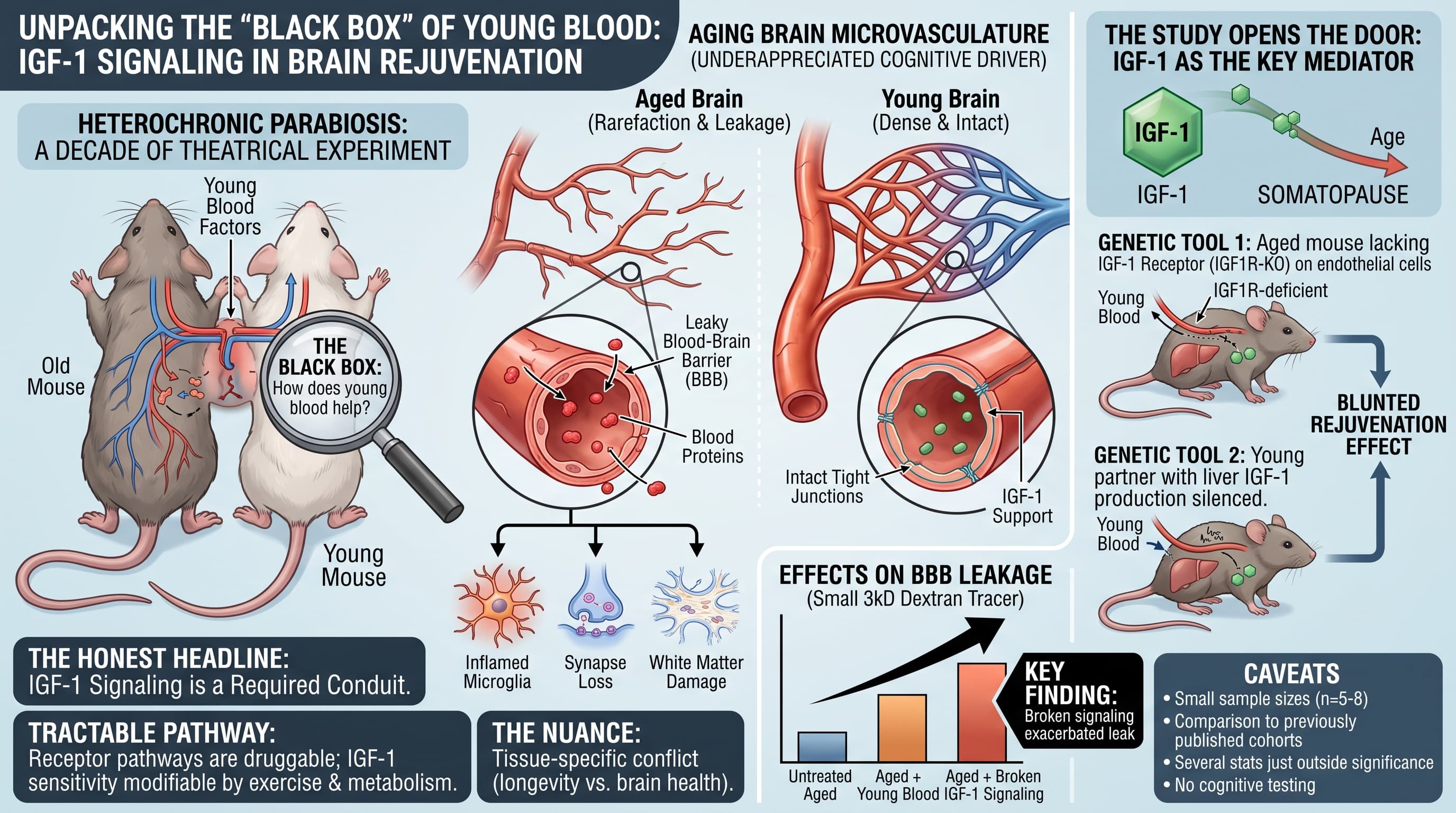
Researchers at the University of Oklahoma Health Sciences Center and Semmelweis University surgically joined the circulations of old and young mice (heterochronic parabiosis) and used live two-photon imaging through cranial windows to watch the aged brain’s blood vessels repair themselves. Old mice sharing blood with young partners showed markedly less leakage across the blood-brain barrier and roughly double the density of brain capillaries. The team then broke the insulin-like growth factor 1 (IGF-1) axis in two independent ways: deleting the IGF-1 receptor specifically from the aged mouse’s own blood vessel lining, or knocking down IGF-1 production in the young partner’s liver. Either manipulation largely abolished the benefit. The conclusion is that young blood does not rejuvenate brain vasculature by some generic mechanism; it requires a working IGF-1 ligand on one side and a working IGF-1 receptor on the endothelium on the other. The effect was attenuated but not fully erased, so other circulating factors are also in play.
For a decade, heterochronic parabiosis has been longevity biology’s most theatrical experiment: stitch an old mouse to a young one, share a bloodstream, and watch old tissues behave younger. The recurring criticism has been that it is a black box. Something in young blood helps. Nobody could say what, or through which door it enters the cell.
This study opens one of those doors. The team focused on the brain’s microvasculature, which is an underappreciated driver of cognitive aging. As we age, the capillary network thins out (rarefaction) and the blood-brain barrier becomes leaky, letting blood proteins into brain tissue where they inflame microglia, strip synapses, and damage white matter. This is a plausible engine of vascular cognitive impairment and a contributor to Alzheimer’s pathology.
The candidate mediator was IGF-1, the growth hormone-driven factor that falls steeply with age in a decline called somatopause. IGF-1 supports the endothelium: nitric oxide production, mitochondrial function, tight-junction maintenance, and new vessel growth.
Rather than infusing IGF-1, the researchers subtracted it, using two genetic tools that attack the axis from opposite ends. In one group, aged mice lacked the IGF-1 receptor on their endothelial cells, so young blood arrived but the vessel wall could not respond. In another, young partners had IGF-1 production silenced in the liver, so the blood arriving was IGF-1-poor. Both manipulations blunted the rejuvenation.
The pattern in the leakage data is telling. The effect was clearest for the smallest tracer molecule, a 3 kilodalton dextran, the most sensitive probe of subtle barrier defects. There the loss of benefit was dramatic: aged mice with broken IGF-1 signaling leaked more than aged mice that had never seen young blood at all.
The honest headline is not only that IGF-1 is the rejuvenation factor. It is that IGF-1 receptor signaling is a required conduit through which much of the benefit passes. That matters because it is tractable in a way “young plasma” never was: receptor pathways have downstream nodes that can be drugged, and IGF-1 sensitivity is modifiable by exercise and metabolic health. It also sits awkwardly beside decades of work showing that reduced IGF-1 signaling extends lifespan in worms, flies, and mice, which sets up a genuine tissue-specific conflict the field will have to resolve. Something that lengthens life in aggregate may still starve the brain’s capillary bed of the growth signal it needs to maintain itself.
The caveats are significant. Sample sizes were five to eight animals per group, the comparison groups came from a previously published cohort rather than being run alongside, and several of the supporting statistics sit just outside conventional significance. No cognition was tested.
Actionable Insights
This is mouse surgery with genetic knockouts, and no human intervention is embedded in it. What it changes is which way to lean on a contested question.
The take-home is that IGF-1 is not uniformly bad when it comes to aging. Longevity culture absorbed the idea that low IGF-1 equals long life, largely from worm and dwarf-mouse genetics. This study is evidence that the brain’s blood vessels want the opposite. When IGF-1 signaling was removed, the capillary density benefit was almost entirely lost, and barrier leak to the smallest tracer got worse than in untreated old animals.
The magnitudes are large, in mice. Using conservative estimates back-calculated from the paper’s own statistics, young blood raised capillary density with a standardized effect size near d = 1.7. For scale, 0.2 is small, 0.5 moderate, 0.8 large, and 1.7 means the average treated mouse sits above roughly 95 percent of untreated ones. Blocking IGF-1 signaling erased 70 to 82 percent of that gain. Barrier leak effects ran d = 1.0 to 2.7.
The practical translation is indirect: do not chase IGF-1 suppression as a blanket longevity strategy, and favor what preserves IGF-1 responsiveness in tissue, meaning resistance and aerobic training, adequate protein and sleep, and insulin sensitivity. The authors explicitly warn against ongoing exogenous IGF-1 (or GH) supplementation due to possible cancer risks. People are exploring pulsatile strategies to balance risks and potential rewards.
Context and Source
- Open Access Paper: Endothelial IGF-1/IGF-1R signaling supports young-blood-induced restoration of blood-brain barrier integrity and microvascular architecture in aged mice: evidence from the heterochronic parabiosis model
- Institutions: Vascular Cognitive Impairment, Healthy Brain Aging Program and Oklahoma Center for Geroscience, University of Oklahoma Health Sciences Center, Oklahoma City, USA; International Training Program in Geroscience, Semmelweis University, Budapest, Hungary; Stephenson Cancer Center, Oklahoma.
- Journal: GeroScience (Springer, journal of the American Aging Association). published online 20 August 2026.
- Impact evaluation: The impact score of this journal is approximately 6.0 (JIF; CiteScore 8.3), evaluated against a typical high-end range of 0 to 60+ for top general science, therefore this is a Medium impact journal. It is a Q1 specialty journal within geriatrics and gerontology.
Related Reading:
- Brain-Targeted IGF-1: The Perils of Over-Saturating the Longevity Switch
- IGF-1 inhibitors and lifespan extension?
- IGF1R, longevity, and brain health (Christin Glorioso)
- High IGF1 level
- IGF-1 is Lower for Centenarians
- Growth hormone supplementation can restore the thymus, but what is its effect on lifespan?
- Growth Hormone and longevity