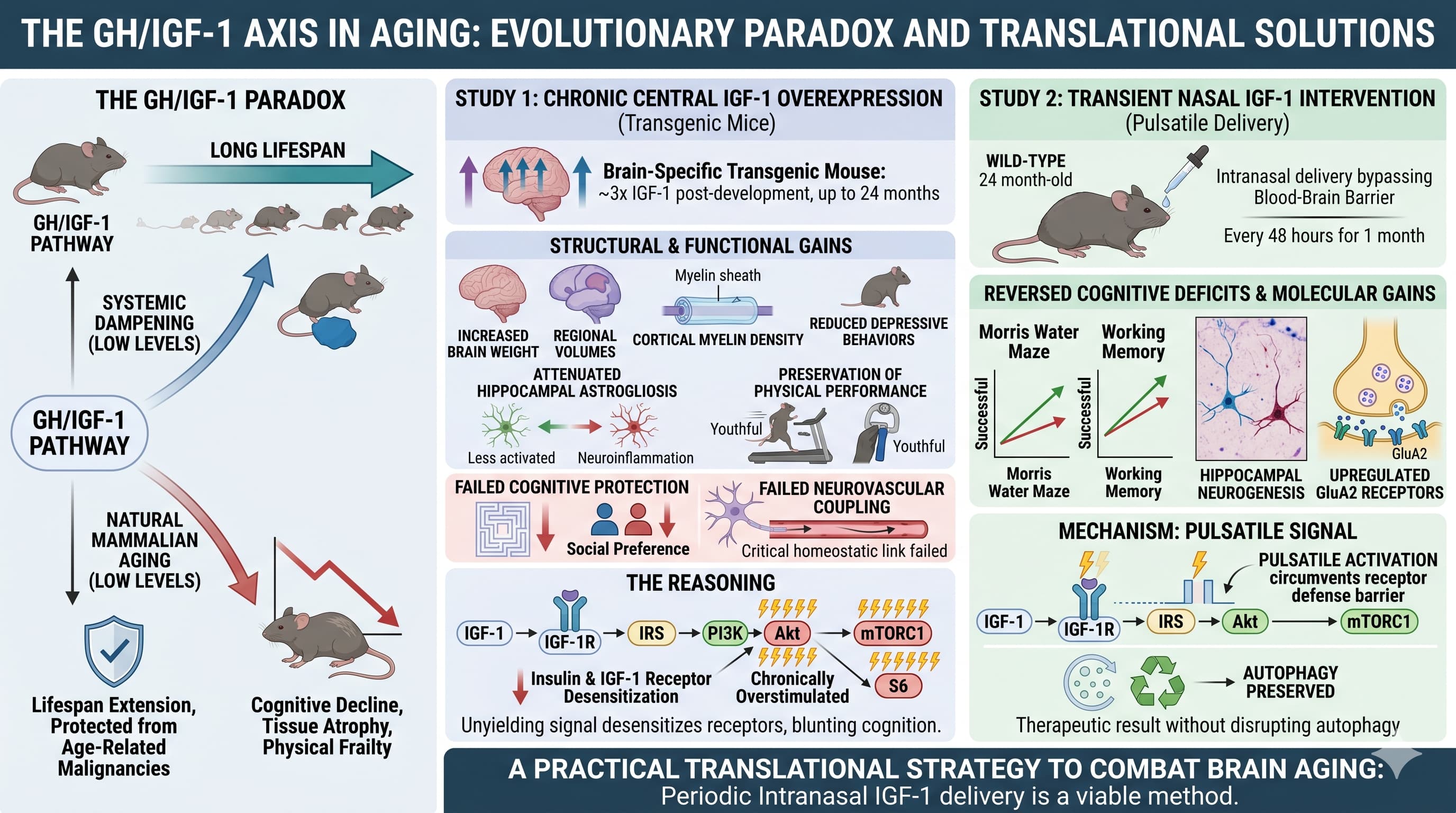
The Growth Hormone/Insulin-like Growth Factor-1 (GH/IGF-1) axis presents an exceptional evolutionary paradox in longevity science: while systemic dampening of this pathway consistently extends lifespan across multiple species and protects against age-related malignancies, a severe drop in circulating levels during natural mammalian aging is closely linked with cognitive decline, tissue atrophy, and physical frailty. To resolve this physiological tension, researchers investigated whether selectively increasing IGF-1 expression directly inside the central nervous system could deliver robust neuroprotective rewards without incurring hazardous peripheral costs like increased cancer risk.
Scientists engineered an inducible, brain-specific transgenic mouse model that achieved an approximate threefold cumulative increase in central IGF-1 protein levels post-development. These awards were meticulously monitored up to 24 months of age to analyze the downstream impacts on overall neurological and physical healthspan parameters. Chronically raising central IGF-1 levels triggered massive structural adaptations, including significant gains in total brain weight, regional volumes, and cortical myelin density. On a functional level, the treated male mice exhibited notably reduced depressive-like behaviors, attenuated hippocampal neuroinflammation (evidenced by decreased astrogliosis), and a striking preservation of physical performance, maintaining youthful treadmill running endurance and grip strength compared to aging controls.
Crucially, however, this persistent genetic overexposure flatly failed to protect the mice from age-related drops in spatial learning, social preference, or neurovascular coupling—the critical homeostatic process linking regional neuronal activity to localized cerebral blood flow. The investigators reasoned that unyielding, long-term activation of this pathway chronically overstimulated downstream signaling nodes like Akt and ribosomal protein S6 (a primary readout of mTORC1 activity). This continuous stimulation likely desensitized the insulin and IGF-1 receptors among key cell populations, paradoxically blunting cognitive processing.
To determine if a pulsatile rather than constant signal could circumvent this cellular defense barrier, the research team administered short-term intranasal recombinant human IGF-1 to 24-month-old wild-type mice every 48 hours for a month. This transient delivery method bypassed the blood-brain barrier and successfully reversed advanced age-related cognitive deficits. The nasal intervention significantly enhanced visuospatial memory, working memory, and motor learning capacity, while simultaneously triggering hippocampal neurogenesis and upregulating GluA2 receptor subunits crucial for synaptic plasticity. Remarkably, this periodic intervention achieved clear therapeutic results without disrupting autophagy, validating a highly practical, translational strategy to combat brain aging.
Actionable Insights
The paper provides a stark, practical warning against chronic, unmodulated upregulation of growth factors to achieve longevity benefits. Artificially forcing a continuous spike in central growth pathways like IGF-1 can trigger cellular adaptation, receptor desensitization, and overactivation of mTORC1, which completely obliterates any potential cognitive advantages. For biohackers and clinicians looking to protect the aging brain, the practical take-home message is that timing and delivery mechanisms are everything.
Instead of systemic growth hormone secretagogues or continuous therapies that present systemic cancer risks and cause central desensitization, interventions targeting the brain must utilize a short-term, periodic, or pulsatile delivery model. Short-term intranasal delivery of IGF-1 effectively circumvents the blood-brain barrier and successfully rejuvenates the aging brain by stimulating neurogenesis in the dentate gyrus and upregulating key synaptic plasticity markers like the GluA2 subunit. This localized, episodic activation achieves therapeutic benefits in working memory and motor coordination without disrupting critical baseline metabolic functions or downregulating macroautophagy. Biohackers should prioritize therapies that match this periodic rhythm rather than pursuing constant baseline elevation of anabolic cascades.
Context
- Paywalled Paper: Central IGF-1 protects against features of cognitive and sensorimotor decline with aging in male mice
- Institution: Department of Molecular Pharmacology and Institute for Aging Research, Albert Einstein College of Medicine, Bronx, NY, USA.
- Country: United States.
- Journal Name: GeroScience, Published in 2019.
- Impact Evaluation The impact score of this journal is 5.4, evaluated against a typical high-end range of 0–60+ for top general science, therefore this is a Medium impact journal.