Why Hair Goes Gray, and Why It Occasionally Comes Back

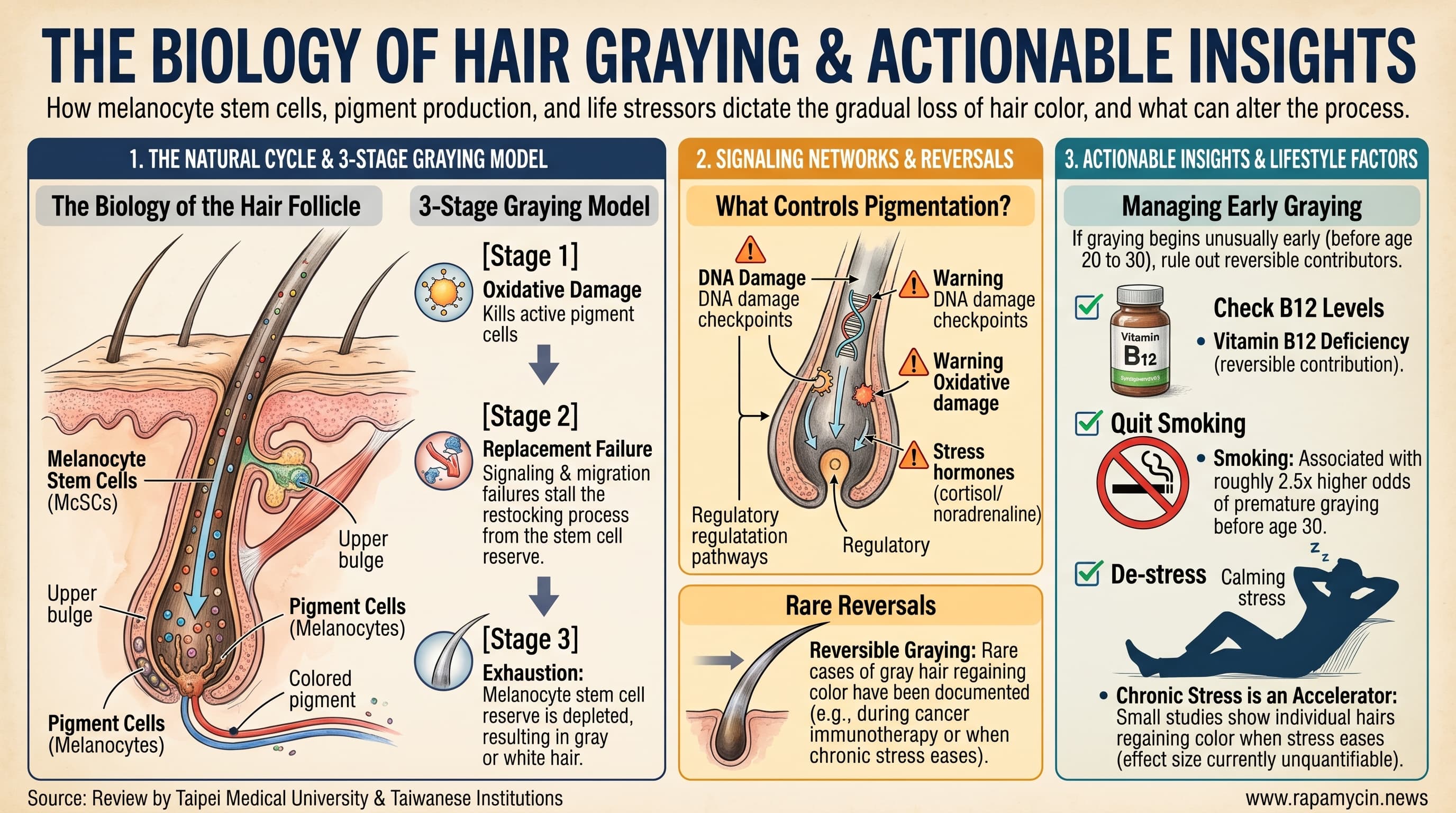
This review from Taipei Medical University and collaborating Taiwanese institutions brings together what is known about why human hair turns gray. Hair color comes from pigment cells in the hair bulb, which are restocked at the start of every growth cycle from a reserve of melanocyte stem cells higher up in the follicle. The authors describe how these cells develop, the chemistry of the two main pigments, and the signaling networks that control them, including stress hormones, oxidative damage and DNA-damage checkpoints. They then propose a three-stage model. First, oxidative damage kills active pigment cells. Next, signaling and migration failures stall their replacement. Finally, the stem cell reserve is exhausted. They also catalog rare cases in which gray hair regained color, such as during cancer immunotherapy.

Gray hair is the most visible sign of aging, yet the biology behind it is surprisingly unsettled. A new review in Frontiers in Cell and Developmental Biology tries to organize a scattered literature into a single story, and its central idea is that graying is not one event but a slow failure that moves through different parts of the hair follicle over decades.

Each hair follicle contains its own pigment supply chain. Melanocyte stem cells sit dormant in a region called the bulge. At the start of each growth cycle, some of them wake, migrate down the follicle, and mature into pigment-producing cells in the hair bulb. There they make eumelanin (brown-black) and pheomelanin (red-yellow) and hand the pigment to the cells that build the hair shaft. When the growth phase ends, those mature pigment cells die, and the cycle restarts from the stem cell reserve. A human scalp follicle can run this loop only about ten times before the system falters.

The authors propose three stages of decline. Early on, the pigment-making process itself, which generates hydrogen peroxide as a byproduct, outpaces the bulb’s antioxidant enzymes, especially catalase, and active pigment cells die. In the middle stage, signals that coordinate stem cell activation and migration weaken, so replacements fail to arrive. In the late stage, the stem cell reserve itself is used up or pushed into a terminal, senescence-like differentiation.

Two recent discoveries anchor the model. In mice, intense stress activates sympathetic nerves that flood the bulge with noradrenaline, forcing dormant stem cells to fire all at once until none are left. Separately, a 2025 study showed that stem cells with heavy DNA damage switch on the p53 pathway and quietly differentiate rather than risk turning into melanoma. In that view, gray hair is partly the visible cost of a cancer safeguard.

Human data complicate the mouse story. A single-cell study comparing gray and dark hairs from the same people found that gray follicles still contain stem cells. What they lack is the fast-dividing cells that should carry the lineage forward, along with signs of DNA damage and immune infiltration. That points to a stalled pipeline rather than an empty tank, at least in some follicles.

That distinction matters because graying can occasionally reverse. In one series of lung cancer patients on immune checkpoint drugs, about a quarter saw their hair darken. Isolated reports link repigmentation to an anti-inflammatory biologic, to melanoma in the scalp, and to reduced life stress. A topical antioxidant blend has also been claimed to restore color, though the evidence is thin and industry-generated.

For readers, the practical message is modest. Graying reflects stem cell aging, stress biology and oxidative balance. New treatments are being researched and developed by startup companies, and we’re seeing hints of potential therapeutics like Luteolin.

Insights

  1. If graying starts unusually early (before about 20 to 30, depending on ancestry), rule out reversible contributors. The review names vitamin B12 deficiency. The broader literature also points to smoking, which has been associated with roughly 2.5 times higher odds of graying before 30 in a small case-control study.
  2. Chronic stress is a plausible accelerator. The mouse evidence is strong but involves extreme stress. In humans, small studies show individual hairs regaining color when stress eases, but the effect size cannot be quantified from the data available.
  3. Treat topical “anti-gray” antioxidant products skeptically. The only cited human study reports repigmentation after four months, without a magnitude or control comparison in the review.
  4. Repigmentation on cancer immunotherapy (14 of 52 patients, or 27%, with a plausible range of about 17% to 40%) is a side effect of powerful drugs, not a strategy. It is interesting mainly because it shows that gray follicles can retain dormant pigment capacity.
  5. If someone wants to experiment, topical luteolin is the lowest-risk preclinical bet. Also worth looking at are the Rivertown formulation discussed in this thread, and rapamycin, discussed in this thread.

Context and Source

  • Open Access Paper: Unraveling hair graying: insights into melanocyte biology and the aging process, published 9 October 2026
  • Institutions: Taipei Medical University, with National Defense Medical University and affiliated hospitals
  • Country: Taiwan
  • Journal: Frontiers in Cell and Developmental Biology.
  • Impact evaluation: The impact score of this journal is approximately 4.3, evaluated against a typical high-end range of 0 to 60+ for top general science, therefore this is a Medium impact journal.

Related Reading:

1 Like

Luteolin Preserves the Stem Cells That Color Hair, at Least in Mice

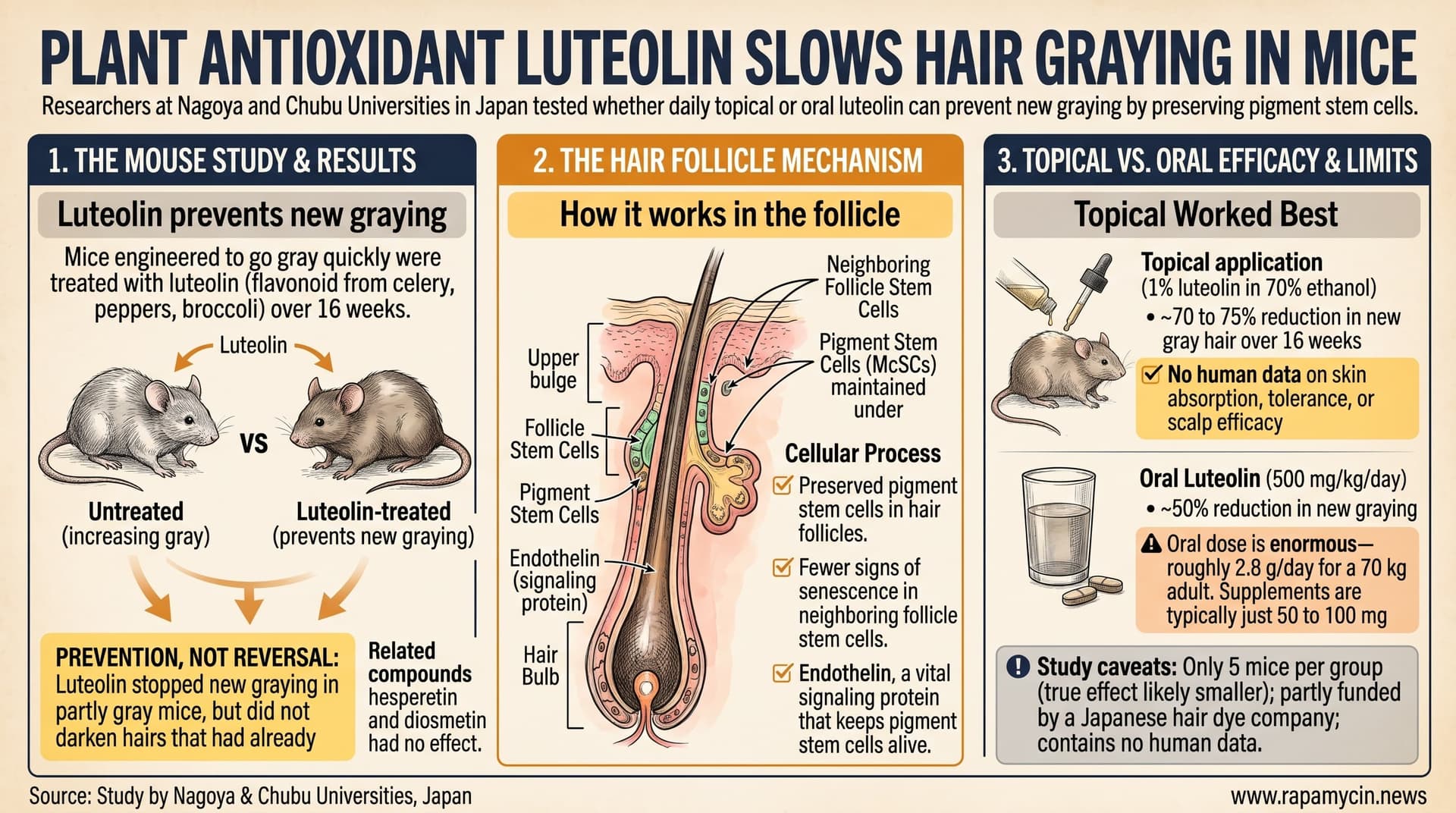
Researchers at Nagoya and Chubu Universities in Japan tested whether three plant antioxidants could slow hair graying in a strain of mice engineered to go gray quickly as they age. Daily topical luteolin, a flavonoid found in celery, peppers and broccoli, largely prevented new graying over 16 weeks. Oral luteolin also slowed graying, though less strongly. Two closely related compounds, hesperetin and diosmetin, had no effect. Luteolin-treated mice kept more pigment stem cells in their hair follicles. Their neighboring follicle stem cells showed fewer signs of senescence and maintained endothelin, a signaling protein that keeps pigment stem cells alive. The study used only five mice per group, was partly funded by a Japanese hair dye company, and contains no human data.

Antioxidants have long been floated as a way to slow gray hair, on the theory that oxidative damage wears out the pigment system in hair follicles. Almost no one had tested a specific compound in a living animal that grays with age. This brief report from Japan does exactly that, and its most interesting result is not that an antioxidant worked, but that only one of three did.

The team used a mouse they had previously developed. It carries an activated RET gene and has only one working copy of the receptor for endothelin, a signaling molecule that pigment stem cells need to survive. These mice go gray over months rather than years. The researchers had earlier mapped the sequence in this model. Keratinocyte stem cells in the follicle become senescent as hair cycles accumulate and stop making endothelin. The neighboring pigment stem cells lose their endothelin receptor and die off, and the hair turns gray.

Starting at 20 weeks of age, mice received either a 1% luteolin solution brushed on their shaved backs every day, an oral dose of luteolin, or a plain solvent. Other groups received hesperetin, a citrus flavonoid, or diosmetin, a near chemical twin of luteolin. After 16 weeks, solvent-treated mice had grayed substantially. Mice given topical luteolin looked almost unchanged. Oral luteolin slowed graying by roughly half, while hesperetin and diosmetin did nothing measurable.

Under the microscope, the luteolin mice told a consistent story. Fewer follicle stem cells carried p16, a classic marker of cellular senescence. Endothelin levels in the follicle held up. Pigment stem cells kept their endothelin receptors, and many more of them survived. Luteolin did not change how fast hair grew or cycled, which suggests it acts on pigment maintenance rather than on hair growth itself.

The finding that diosmetin failed is telling. Diosmetin differs from luteolin by a single methyl group on one ring, and both are antioxidants. If general antioxidant activity were the whole story, both should have worked. That points to something more specific about luteolin, possibly its effects on senescence or on cell signaling, rather than simple free-radical mopping.

Several cautions apply. Each group had only five mice, and the statistics appear to treat individual hairs and follicles as independent data points, which can make results look more certain than they are. The written results describe several effects in the wrong direction compared with the figures. The mouse model carries a cancer-related gene and grays through an engineered shortcut, so human relevance is assumed rather than shown. One author works for Hoyu, a Japanese hair color company that helped fund the work and licensed the mouse model.

Dose is another hurdle. The oral amount given to mice translates to nearly 3 grams a day for an adult human, far beyond any diet or typical supplement. The authors acknowledge that human safety at relevant doses has not been established.

The result is a credible early signal that protecting the stem cell neighborhood in the follicle could keep hair pigmented longer. Whether a luteolin cream can do that on a human scalp is still an open question.

Actionable Insights

  1. This is a prevention result, not a reversal result. Luteolin stopped new graying in mice that were already partly gray. It did not darken hairs that had already turned.
  2. Topical application worked best. By reading the graphs, topical luteolin cut the rise in gray hair by roughly 70 to 75% compared with solvent over 16 weeks. Oral luteolin cut it by roughly 50%. These are very large effects, but they come from five mice per group, so the true effect is uncertain and probably smaller.
  3. The oral dose is enormous. Mice received 500 mg/kg/day. Converting by body surface area (500 x 3 / 37) gives about 40 mg/kg, or roughly 2.8 g/day for a 70 kg adult. Luteolin supplements are commonly sold in capsules of roughly 50 to 100 mg, and dietary intake is far lower still.
  4. The topical arm used 1% luteolin in 70% ethanol. That is simple to formulate, but there are no human data on efficacy, skin tolerance or absorption into scalp follicles. Safety Data Absent.
  5. The most realistic near-term use is low-stakes self-experimentation with topical luteolin, tracked with standardized photos over 6 months or more. Expect uncertainty, not results.

Context and Source

  • Open Access Paper: Anti-Graying Effects of External and Internal Treatments with Luteolin on Hair in Model Mice
  • Institutions: Nagoya University Graduate School of Medicine; Chubu University; General Research and Development Institute, Hoyu Co., Ltd.
  • Country: Japan
  • Journal: Antioxidants (MDPI), published 17 December 2024
  • Impact evaluation: The impact score of this journal is 8.2, evaluated against a typical high-end range of 0 to 60+ for top general science, therefore this is a Medium impact journal.

Related Reading:

1 Like

Follow-on Prompt to Claude Opus 5.5:

What are the most promising approaches and treatments with some scientific backing that may prevent, or treat, gray hair?

Claude Response:

The short version: nothing reliably reverses age-related graying in humans yet. A few things have reasonable support for slowing it or for correcting the premature, reversible kind. Several preclinical leads look promising but are years from proof. Here is how the evidence stacks up, ranked by strength rather than by hype.

Tier 1: Modest human evidence, low risk

These won’t reverse decades of gray, but they address the factors most likely to be modifiable.

Rule out deficiencies if graying starts early. Nutritional deficiencies, including low intake of protein, vitamin B12, iron, and copper, can contribute to premature graying. Thyroid dysfunction is also worth checking. This is the one scenario where real repigmentation is plausible, but only if a deficiency is actually present. Supplementing someone who is replete does nothing. [Confidence: Medium] foundmyfitness

Don’t smoke. A 2013 observational study found that smokers were about two and a half times more likely than non-smokers to have grey hair before 30, and later pooled analyses have pointed the same way. These data are observational, so confounding is likely, but there is no downside to acting on them. [Confidence: Medium] acibademinternational

Reduce chronic stress, with realistic expectations. The best human data come from the Picard lab at Columbia. They analyzed individual hairs from 14 volunteers and compared them with each volunteer’s stress diary. Ten of the volunteers, all between ages 9 and 39, had some graying hairs regain color, and one 35-year-old man had five strands undergo graying reversal during a two-week vacation. The key caveat is that their model suggested a threshold for temporary greying: if hairs are about to go grey anyway, a stressful event might trigger that change earlier. Picard himself said he doesn’t think reducing stress in a seventy-year-old who’s been gray for years will darken their hair. So stress management may protect hairs near the tipping point. It is not a reversal therapy. [Confidence: Medium for borderline hairs, Low for established gray] www.sciencedaily.com +3

For your mitochondrial angle, the team found a link between white hairs and more proteins associated with mitochondria, an indicator of energy use and metabolic stress. Science Alert

Tier 2: Real human repigmentation, but not usable as treatments

The most systematic look at this is a 2019 review. It found 27 studies on medication-induced gray hair repigmentation, including 6 with repigmentation as a primary objective, notably with psoralen or vitamin supplementation, and 21 reports of incidental repigmentation. The evidence consisted of 4 prospective cohort studies, 3 retrospective cohort studies, 1 case series, and 19 case reports, totaling 133 patients. The drugs fall into two mechanistic buckets: anti-inflammatories (thalidomide, adalimumab, cyclosporine, among others) and melanogenesis stimulators (latanoprost, erlotinib, imatinib, tamoxifen, levodopa). escholarshipnih

Some specific signals:

  • Imatinib: 7% of 133 chronic myeloid leukemia patients showed repigmentation 2 to 14 months after starting treatment. typology
  • Psoralen plus UVA (PUVA): one study in young people with premature graying reported complete repigmentation in 46% of patients. PUVA raises skin cancer risk, so this is not a reasonable cosmetic trade. [Confidence: Low to Medium, single study] typology
  • Calcium pantothenate: two healthy patients with premature gray hair repigmented one month after starting 200 mg per day, and the hair returned to gray after they stopped. The review rated the overall B-vitamin evidence as low quality. typology
  • Checkpoint inhibitors: the 14-of-52 lung cancer series. Melissa Harris’s lab at the University of Alabama is now investigating immunotherapy specifically for gray hair, but so far only in cells and animal models. nbcbayarea

These drugs carry serious toxicity, so none of them is appropriate for hair color. Their value is as mechanistic pointers: inflammation suppression, KIT and receptor tyrosine kinase signaling, and immune tone all clearly matter.

Tier 3: Strong preclinical leads

Luteolin. This is probably the most interesting near-term lead. In a graying mouse model, topical luteolin alleviated graying while hesperetin and diosmetin did not, and oral luteolin also mitigated graying. Mechanistically, both treatments suppressed the decline of endothelin expression in keratinocyte stem cells and of its receptor (Ednrb) in melanocyte stem cells. That fits the EDN3/EDNRB axis described in the review you just analyzed. Luteolin is already sold as a supplement for topical and oral use. Caveats: the evidence comes from a single lab, a genetically engineered mouse, and there are no human data. Oral bioavailability is poor. Safety Data Absent for long-term use at anti-graying doses. [Confidence: Low for human efficacy] Anti-Graying Effects of External and Internal Treatments with Luteolin on Hair in Model Mice +2

Blocking stress signaling to the stem cell niche. In mice, removing sympathetic input or beta-2 adrenergic signaling prevented stress-induced stem cell depletion (Zhang 2020). Nobody has tested beta-blockers for graying in humans. [Confidence: Low]

p53 inhibition. Pifithrin-alpha reduced graying in mice. Given Mohri 2025, which framed graying as a melanoma safeguard, this is the approach I would be most cautious about.

Restoring stem cell mobility. Sun et al. 2023 suggest aged melanocyte stem cells get stuck in the bulge rather than disappearing. If that holds in humans, getting them moving again is the most rational target. It is still conceptual. [Confidence: Low]

Tier 4: Cosmetic ingredients with weak industry data

Most of the marketing noise is here. The data are typically small, uncontrolled and sponsor-run:

  • Taxifolin plus EGCG (the De Tollenaere study cited in the review)
  • An IFF Lucas Meyer ingredient: in 15 men after 3 months, they report a 5.3% drop in lightness and a 30% decrease in gray hair density, with no control group happi
  • A topical Ageratum conyzoides serum: a 12-week study that lacked a control arm and used a per-protocol primary analysis nutritionaloutlook
  • A 2026 case series on topical melatonin and repigmentation unav

The trial worth watching is from Unilever. It is a randomized, double-blind, whole-head study of two leave-on cosmetic treatments, enrolling up to 380 participants who have 15 to 35% naturally gray hair, with visual and instrumental color assessments over 6 months. Primary completion is estimated for October 2026. This will be the first adequately sized controlled test of an anti-gray cosmetic, so its results should land soon. trialxclinicaltrials

What I’d actually do

  1. If graying is premature, get a lab workup (B12, ferritin, TSH, copper and zinc, vitamin D) before buying anything.
  2. Address smoking, sleep and chronic stress. These are the only levers with human data, and they help mainly for hairs near the threshold.
  3. If someone wants to experiment, topical luteolin is the lowest-risk preclinical bet. Expect nothing proven.
  4. Wait for the Unilever RCT before spending money on cosmetic actives.
  5. Avoid systemic drugs for this purpose entirely.

One framing point for a longevity audience: interventions that protect the niche (antioxidant defense, lower sympathetic tone) are biologically safer bets than ones that force damaged stem cells back into service (p53 inhibition, PUVA, immune activation). Graying appears to be partly the price of melanoma protection.

Sources:

2 Likes

You mention Picard’s lab in this post. Here’s a link to his substack on this topic: Discovering that Hair Greying is Reversible

1 Like

AIUI it all links to mitochondrial function and citrate export. That is why intervening on the Janus Kinase has an effect (because it affects SLC25A1 expression).