Luteolin Preserves the Stem Cells That Color Hair, at Least in Mice
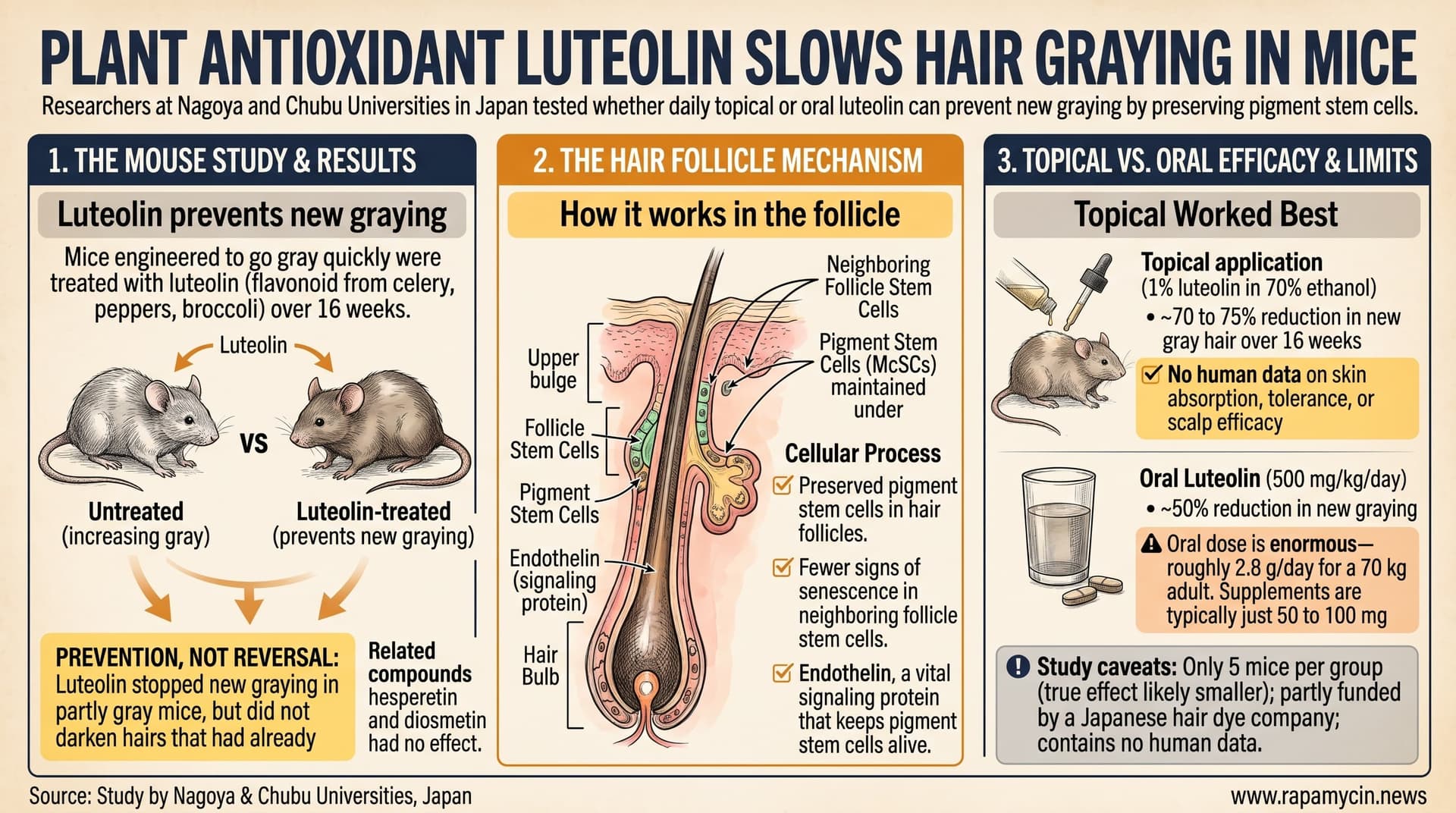
Researchers at Nagoya and Chubu Universities in Japan tested whether three plant antioxidants could slow hair graying in a strain of mice engineered to go gray quickly as they age. Daily topical luteolin, a flavonoid found in celery, peppers and broccoli, largely prevented new graying over 16 weeks. Oral luteolin also slowed graying, though less strongly. Two closely related compounds, hesperetin and diosmetin, had no effect. Luteolin-treated mice kept more pigment stem cells in their hair follicles. Their neighboring follicle stem cells showed fewer signs of senescence and maintained endothelin, a signaling protein that keeps pigment stem cells alive. The study used only five mice per group, was partly funded by a Japanese hair dye company, and contains no human data.
Antioxidants have long been floated as a way to slow gray hair, on the theory that oxidative damage wears out the pigment system in hair follicles. Almost no one had tested a specific compound in a living animal that grays with age. This brief report from Japan does exactly that, and its most interesting result is not that an antioxidant worked, but that only one of three did.
The team used a mouse they had previously developed. It carries an activated RET gene and has only one working copy of the receptor for endothelin, a signaling molecule that pigment stem cells need to survive. These mice go gray over months rather than years. The researchers had earlier mapped the sequence in this model. Keratinocyte stem cells in the follicle become senescent as hair cycles accumulate and stop making endothelin. The neighboring pigment stem cells lose their endothelin receptor and die off, and the hair turns gray.
Starting at 20 weeks of age, mice received either a 1% luteolin solution brushed on their shaved backs every day, an oral dose of luteolin, or a plain solvent. Other groups received hesperetin, a citrus flavonoid, or diosmetin, a near chemical twin of luteolin. After 16 weeks, solvent-treated mice had grayed substantially. Mice given topical luteolin looked almost unchanged. Oral luteolin slowed graying by roughly half, while hesperetin and diosmetin did nothing measurable.
Under the microscope, the luteolin mice told a consistent story. Fewer follicle stem cells carried p16, a classic marker of cellular senescence. Endothelin levels in the follicle held up. Pigment stem cells kept their endothelin receptors, and many more of them survived. Luteolin did not change how fast hair grew or cycled, which suggests it acts on pigment maintenance rather than on hair growth itself.
The finding that diosmetin failed is telling. Diosmetin differs from luteolin by a single methyl group on one ring, and both are antioxidants. If general antioxidant activity were the whole story, both should have worked. That points to something more specific about luteolin, possibly its effects on senescence or on cell signaling, rather than simple free-radical mopping.
Several cautions apply. Each group had only five mice, and the statistics appear to treat individual hairs and follicles as independent data points, which can make results look more certain than they are. The written results describe several effects in the wrong direction compared with the figures. The mouse model carries a cancer-related gene and grays through an engineered shortcut, so human relevance is assumed rather than shown. One author works for Hoyu, a Japanese hair color company that helped fund the work and licensed the mouse model.
Dose is another hurdle. The oral amount given to mice translates to nearly 3 grams a day for an adult human, far beyond any diet or typical supplement. The authors acknowledge that human safety at relevant doses has not been established.
The result is a credible early signal that protecting the stem cell neighborhood in the follicle could keep hair pigmented longer. Whether a luteolin cream can do that on a human scalp is still an open question.
Actionable Insights
- This is a prevention result, not a reversal result. Luteolin stopped new graying in mice that were already partly gray. It did not darken hairs that had already turned.
- Topical application worked best. By reading the graphs, topical luteolin cut the rise in gray hair by roughly 70 to 75% compared with solvent over 16 weeks. Oral luteolin cut it by roughly 50%. These are very large effects, but they come from five mice per group, so the true effect is uncertain and probably smaller.
- The oral dose is enormous. Mice received 500 mg/kg/day. Converting by body surface area (500 x 3 / 37) gives about 40 mg/kg, or roughly 2.8 g/day for a 70 kg adult. Luteolin supplements are commonly sold in capsules of roughly 50 to 100 mg, and dietary intake is far lower still.
- The topical arm used 1% luteolin in 70% ethanol. That is simple to formulate, but there are no human data on efficacy, skin tolerance or absorption into scalp follicles. Safety Data Absent.
- The most realistic near-term use is low-stakes self-experimentation with topical luteolin, tracked with standardized photos over 6 months or more. Expect uncertainty, not results.
Context and Source
- Open Access Paper: Anti-Graying Effects of External and Internal Treatments with Luteolin on Hair in Model Mice
- Institutions: Nagoya University Graduate School of Medicine; Chubu University; General Research and Development Institute, Hoyu Co., Ltd.
- Country: Japan
- Journal: Antioxidants (MDPI), published 17 December 2024
- Impact evaluation: The impact score of this journal is 8.2, evaluated against a typical high-end range of 0 to 60+ for top general science, therefore this is a Medium impact journal.