I’m continuing my deep dives into the genetic pathways to get actionable insights as the previous ones have been incredible precise and useful. This time I’m looking at hair loss and graying genetic pathways.
Here is the general description of the pathways and their variants. I will put the finding about my own genome below it as an example of what useful and actionable insights you can get.
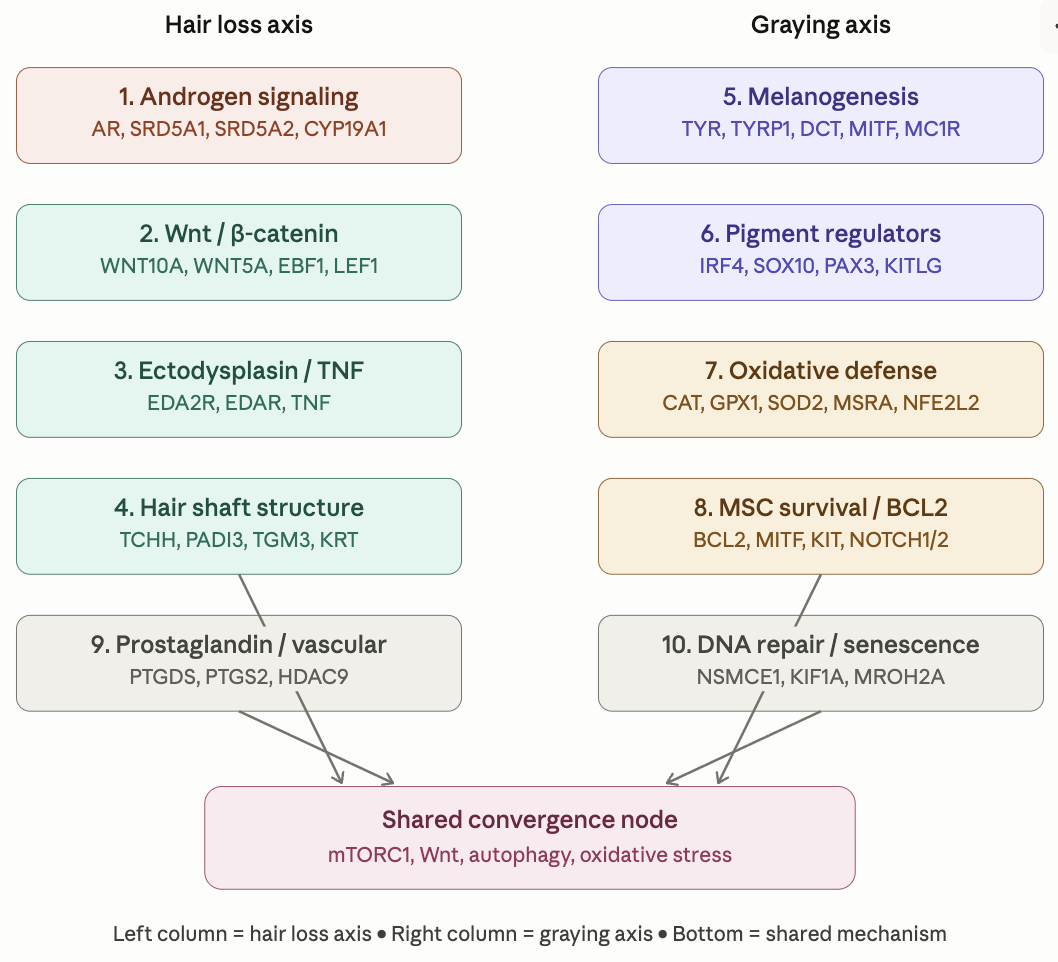
Hair_Loss_Graying_Genetic_Pathway_Reference.pdf (683.3 KB)
Hair Loss & Graying — Top 10 Actionable Findings
1. NRF2 axis is homozygous-impaired — add sulforaphane
Finding: NFE2L2 rs6721961 homozygous (−617 promoter, reduced NRF2) + rs35652124 het + KEAP1 hom + CAT hom. The master antioxidant transcription factor is set to a lower baseline induction ceiling. This is the single most important finding in the report.
Action: Add sulforaphane 10–30 mg/day (broccoli seed extract 400–800 mg) — the most potent NRF2 inducer available OTC. Directly compensates for the reduced NRF2 baseline. HIGH priority.
2. Glutathione pool convergence across four reports — increase NACET
Finding: Hair loss report (NFE2L2 hom) + Homocysteine report (CTH het) + Glycation report (GLO1 hom + AKR1B1 hom). Glutathione pool under pressure at synthesis, regeneration, utilization, AND induction.
Action: Increase NACET from 100 mg to 200–300 mg/day (or NAC 600–1200 mg). MODERATE-HIGH priority. This has been flagged in multiple prior reports and this one reinforces it.
3. Dutasteride exactly matches a quadruple-homozygous SRD5A1/2 genotype
Finding: SRD5A1 rs39848 hom + SRD5A1 rs248793 hom + SRD5A2 rs523349 hom + SRD5A2 rs632148 hom. Native androgen-disposition genotype fully shifted from reference.
Action: Continue dutasteride 0.5 mg EOD — this is textbook pharmacogenomic alignment. Consider checking serum DHT to confirm >90% suppression given every-other-day dosing and 4-SNP hom background. Continue, verify.
4. IRF4 rs12203592 ABSENT — strongly favorable for graying
Finding: The only genome-wide significant graying locus (Adhikari 2016, Praetorius 2013 Cell) is NOT in your VCF. You are likely C/C — the majority protective genotype.
Action: Note this for context. No intervention needed. Favorable finding to acknowledge.
5. WNT10A rs7349332 ABSENT + AR rs6152 ABSENT — the two largest-effect AGA SNPs are not present
Finding: The strongest non-AR AGA locus (P = 3.55×10⁻¹⁵) and the strongest X-linked AGA locus (meta-OR 2.68) are both absent. Residual AGA risk is from polygenic loci + SRD5A (which is pharmacologically blocked).
Action: No specific action. Meaningfully reduces the expected AGA trajectory beyond what dutasteride already covers. Favorable, reassuring.
6. MROH2A rs2361506 homozygous — a replicated graying SNP
Finding: Homozygous for one of only three replicated graying variants (Pospiech 2020 BMC Genomics, OR 1.4). Function poorly characterized but effect is real.
Action: No direct intervention; the NRF2 measures in items 1–2 act on the graying mechanism upstream. Monitor via clinical observation.
7. Verify Momentous Multi provides adequate selenium, B2, and copper
Finding: You are taking half-dose Momentous Multi. GPX4 rs713041 het (selenocysteine incorporation) + NQO1 P187S het (FAD/B2 cofactor) + TYR R402Q het (Cu-dependent) all need adequate micronutrient cofactor supply.
Action: Check label for per-capsule content. If at half-dose your total daily intake is Se <100 mcg, B2 <10 mg, or Cu <1 mg, add targeted supplementation. MODERATE priority; verification step.
8. TERT rs2736100 homozygous — cross-reference Cancer Predisposition report
Finding: Homozygous at the most-studied TERT telomere length variant. ALT allele generally associates with longer telomeres (favorable for aging, including graying) but increased melanoma, glioma, and lung adenocarcinoma risk.
Action: Discuss with physician alongside the Cancer Predisposition report findings, particularly regarding baseline dermatology exam for melanocytic nevi and awareness of smoking/radon exposure. Informational cross-reference.
9. Check baseline and periodic oxidative-stress biomarkers
Finding: Given the NRF2 convergence with Endothelial, Homocysteine, and Glycation reports, direct quantification of the GSH pool and oxidative damage is warranted before and after the sulforaphane/NACET dose increases in items 1–2.
Action: Order whole-blood reduced GSH + GSSG (ratio), serum selenium, urinary 8-OHdG or F2-isoprostanes, ferritin, hs-CRP. Establish baseline now; recheck in 3–6 months after intervention changes. MODERATE priority.
10. Confirm DHT suppression and obtain a phototrichogram baseline
Finding: The 4-SNP SRD5A1/2 genotype + moderate polygenic MPB load (20p11 triple het, HDAC9 hom, ~10 additional Pirastu hets) means the AGA genetic pressure is real, even with AR and WNT10A favorable. Dutasteride is the correct therapy but adequacy should be confirmed.
Action: Serum DHT, free and total testosterone, SHBG, estradiol to confirm dutasteride adequacy. Baseline phototrichogram or standardized scalp photography to track hair density objectively over time. Target DHT <10 ng/dL (>90% suppression) on dutasteride. MODERATE priority.
Gap summary (items to add to regimen)
| Priority | Addition | Dose | Targets |
|---|---|---|---|
| HIGH | Sulforaphane (broccoli seed extract) | 10–30 mg sulforaphane | NRF2 induction; NFE2L2 hom + GLO1/AKR1B1 convergence |
| MODERATE-HIGH | Increase NACET | 200–300 mg/day | Glutathione substrate; 4-way GSH convergence |
| MODERATE | Selenium (if Multi <100 mcg) | 100–200 mcg selenomethionine | GPX4 het, GPX1, MSRB1 |
| MODERATE | Topical minoxidil 5% | daily to scalp | Polygenic AGA load (if hair loss clinically observed) |
| LOW-MODERATE | Curcumin (bioavailable) | 500–1000 mg | Secondary NRF2 inducer |
| LOW-MODERATE | Urolithin A or pomegranate | 500 mg | Mitophagy; SOD2 V16A support |
| LOW | Riboflavin (if Multi <10 mg) | 25–50 mg | NQO1 het cofactor |
| LOW | Copper bisglycinate (if Multi <1 mg) | 1–2 mg | TYR het cofactor |
What the genetics DO NOT support changing
- Dutasteride dose (already optimal for the genotype)
- DHEA (neutral-to-favorable in presence of dutasteride)
- Creatine (no evidence of meaningful DHT effect, and dutasteride blocks it anyway)
- Any finasteride addition (dutasteride is already a superset)