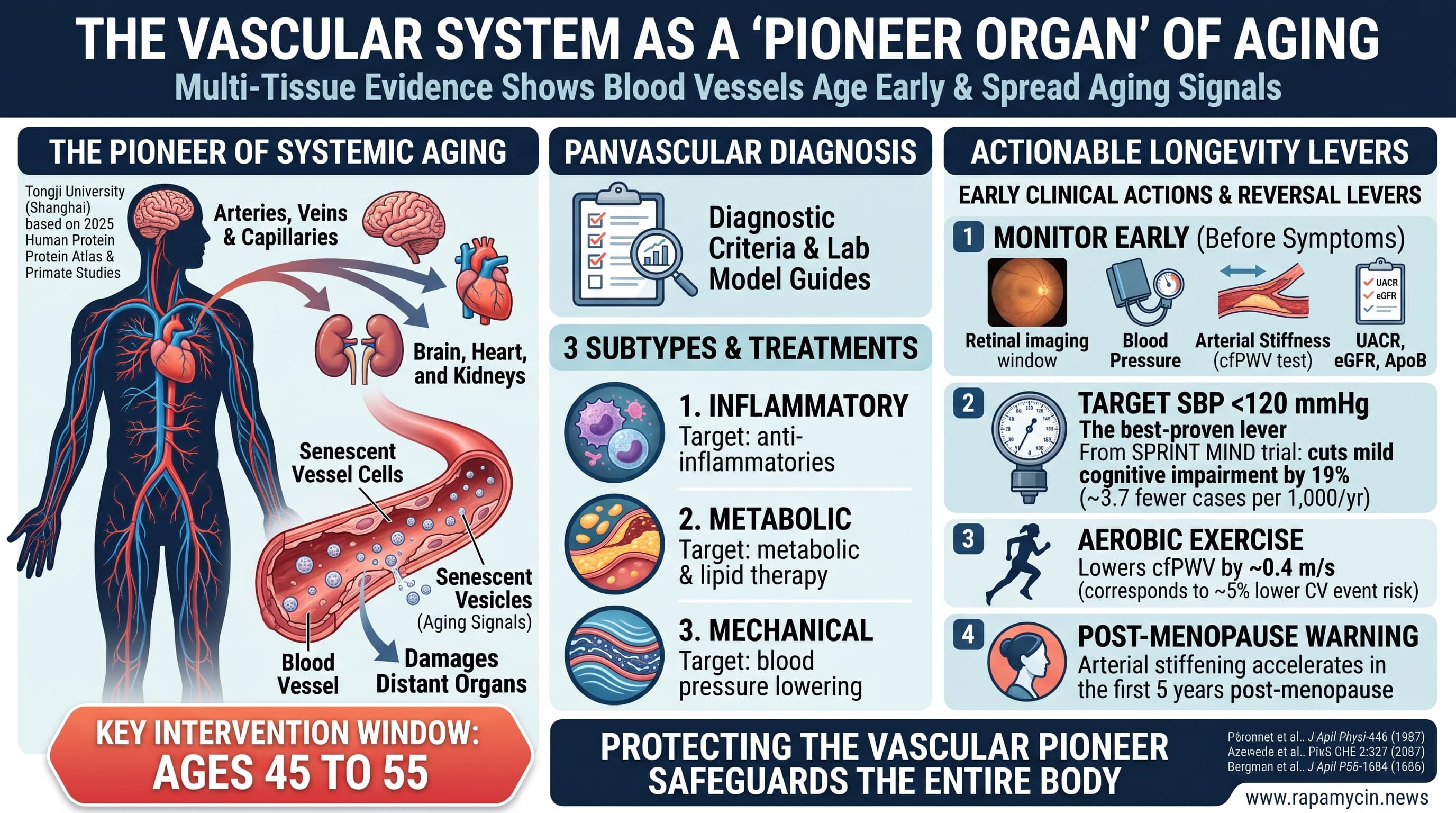
Rejuvenation Treatments in the Panvascular Aging Review: Complete Inventory and Independent Evidence Audit
The review proposes a subtype-stratified intervention roadmap. Below is every treatment it names, followed by an independent search of the actual supporting literature. Where the review’s citation is weak, misattributed or absent, I say so.
Part A: Complete Inventory of Treatments Named
Inflammatory subtype (SASP-driven)
- Senolytics (dasatinib plus quercetin named by implication through the cited trial)
- Senomorphics (SASP inhibition, named generically. Rapamycin is an example)
- Senolytic vaccination (GPNMB-targeted)
- Extracellular vesicle depletion (named as a validation criterion, not developed as a therapy)
Metabolic subtype (endothelial redox and NAD+)
- NAD+ boosting (NMN and nicotinamide riboside, via the cited preclinical work)
- CD38 inhibition (to reduce NAD+ degradation)
- Nitric oxide restoration (named generically, no specific agent)
- Time-restricted feeding (as a non-pharmacological adjuvant via AMPK and SIRT1)
Mechanical subtype (stiffness and calcification)
- Vascular calcification inhibition (named generically)
- Elastic fiber integrity restoration (named generically)
- Pulsatile hemodynamic stress reduction (named generically)
Pan-subtype
- Partial epigenetic reprogramming with Yamanaka factors (OSK/OSKM), presented as the “transformative” strategy addressing “the root cause of all three subtypes”
Named elsewhere in the paper, not in the roadmap
- Endothelium-targeted Sirt7 gene therapy (Sun 2020, cited in the feedforward-cascade section)
- Irisin-enriched extracellular vesicles acting via SIRT6 (Chi 2022, cited as an EV mechanism)
- Endothelial progenitor cell-based regenerative strategies (future directions)
- Minocycline (appears only inside a cited trial name, not proposed)
Three observations before the evidence. First, the mechanical subtype has no named agent at all; the review lists mechanisms to target, not treatments. Second, the therapies with the strongest human vascular evidence (blood pressure control, statins, SGLT2 inhibitors, exercise) appear nowhere in the roadmap. Third, mTOR inhibition and metformin are absent despite both having vascular and primate data.
Part B: Independent Evidence Audit
Evidence grading used below: A = human RCTs with clinical endpoints, B = human RCTs with surrogate vascular endpoints, C = human observational or uncontrolled, D = animal in vivo, E = in vitro or mechanism only.
1. Senolytics: dasatinib plus quercetin
Review’s claim: senescent cell clearance will attenuate senescence spread across the circulatory network.
What the independent search found:
Preclinical (Grade D). Roos et al., Aging Cell 2016, is the key vascular study and the review does cite it. In 24-month-old C57BL/6 mice given dasatinib 5 mg/kg plus quercetin 10 mg/kg by oral gavage once monthly for 3 months (months 24 to 27), treatment reduced senescent cell markers in the aortic media, improved vascular relaxation to acetylcholine without changing response to sodium nitroprusside (indicating increased NO bioavailability), and tended to reduce aortic calcification. In ApoE-knockout mice on Western diet, weekly dosing for 2 months improved vasomotor function via increased sensitivity to NO donors, and significantly reduced calcification and osteogenic signaling. Intimal plaque fibrosis was unchanged, and senescent markers were not reduced inside intimal plaques, only in the media. Also: a 2026 bioRxiv preprint reports D+Q in aged rats with carotid occlusion reduced ischemic stroke severity (n = 12 per group, not peer reviewed).
Human (Grade C, and not vascular). Hickson et al., EBioMedicine 2019, the trial the review cites, was an open-label study in 9 patients with diabetic kidney disease. It measured adipose and skin senescent cell burden. It had no vascular endpoint, no control group and no blinding. The review cites it for “senolytics decrease senescent cells in humans,” which is accurate, but it provides zero evidence for vascular rejuvenation.
Trial landscape. Phase 2 trials of quercetin or D+Q exist in Alzheimer’s disease (NCT04063124, NCT04685590), coronary artery disease (NCT04907253), chronic kidney disease (NCT02848131) and healthy participants (NCT04313634). None have reported vascular aging outcomes.
Verdict: Grade D for vascular effects. The human citation does not support a vascular claim. Safety Data Absent for vascular indications. Note that dasatinib is a cancer drug with known pleural effusion, cytopenia and bleeding risks. [Confidence: High that preclinical vascular data exist; Low that human vascular benefit is established]
2. Senolytics the review does not mention: fisetin
Not named in the review, but it is the senolytic with the best human vascular data, which is a notable gap.
Preclinical (Grade D). Mahoney et al., Aging Cell 2024: intermittent fisetin in old mice improved endothelium-dependent dilation (to 97%), lowered arterial stiffness, increased NO bioavailability, reduced mitochondrial ROS, and produced favorable arterial wall remodeling.
Human (Grade B). A randomized, placebo-controlled parallel-group pilot trial in 41 older adults (mean age 71) given fisetin 2 mg/kg/day intermittently. Brachial flow-mediated dilation improved 41% with fisetin (3.9% to 5.5%, p < 0.0001) and was unchanged with placebo (group by time interaction p < 0.01). Acute MitoQ enhanced FMD at baseline and after placebo but produced no further improvement after fisetin, implying fisetin had already removed the mitochondrial oxidative stress constraint. Serum CXCL12 fell 5%. Further trials are ongoing (NCT06133634, NCT07871162) with cfPWV as an outcome.
Verdict: Grade B for endothelial function in older adults. This is the strongest senolytic vascular evidence in humans and the review omits it entirely. No hard clinical endpoints yet. [Confidence: Medium to High for FMD effect; Low for clinical outcomes]
3. Senolytic vaccination (GPNMB)
Review’s claim: cites Suda et al., Nature Aging 2021, as a senolytic approach and as evidence for GPNMB as a biomarker.
What the search found (Grade D). Suda et al. identified GPNMB as upregulated in senescent human vascular endothelial cells, and in vessels and leukocytes of patients and mice with atherosclerosis. Genetic ablation of GPNMB-positive cells reduced adipose senescence, improved metabolic parameters in high-fat-fed mice, and reduced atherosclerotic burden in ApoE-knockout mice. A GPNMB vaccine elicited NK-cell-mediated antibody-dependent cytotoxicity and reproduced these benefits. In progeroid mice, vaccination extended median lifespan from 21 to 25 weeks, roughly 20%, in males only.
Critical caveats the review does not state: the lifespan extension was in progeroid mice with short-lived controls by design, male-specific, and the authors could not determine whether benefits came from eliminating senescent cells or from eliminating non-senescent GPNMB-high cells. GPNMB also has physiological roles including bone formation.
Verdict: Grade D, progeroid model, sex-specific, mechanism of benefit unresolved. No human data. Safety Data Absent. [Confidence: High for the mouse findings; Low for translation]
4. NAD+ boosting: NMN and nicotinamide riboside
Review’s claim: restoring endothelial NAD+ bioavailability addresses the metabolic subtype. Cites Das et al. 2018.
Preclinical (Grade D). Das et al., Cell 2018, is well-supported. Endothelial-specific SIRT1 deletion in young mice caused reduced capillary density and halved running distance. NMN given to 20-month-old mice for 2 months restored capillary number and density to young levels and increased muscle blood flow. NMN-treated mice ran 1.6 times farther than untreated. Adding sodium hydrosulfide (H2S precursor) was synergistic: 32-month-old mice on the combination ran roughly twice as far as untreated. Notably, NMN did not improve capillary density in young sedentary mice, only in young exercising mice, consistent with an age-dependent mechanism.
Human (Grade B, mixed and underpowered). Martens et al. 2018 crossover pilot, 24 healthy middle-aged and older adults, NR 500 mg twice daily for 6 weeks. Overall-group effects reported in the follow-up protocol: systolic BP down about 4 mmHg, diastolic down about 2 mmHg, cfPWV down about 42 cm/s (0.42 m/s). Post hoc subgroup analysis showed benefits concentrated in those with elevated baseline BP, where SBP fell about 8 mmHg. Critically, this was a pilot study and BP and stiffness were not the primary endpoints.
The definitive trial, NCT03821623 (94 participants, NR 500 mg twice daily for 3 months, primary endpoint casual SBP), is still listed as active, not recruiting, with estimated primary completion September 2027. The decisive result does not yet exist.
A separate CKD trial (NCT04040959, 118 participants, cfPWV primary) completed September 2024; results were not located in this search.
NMN: a 12-week RCT in 36 healthy middle-aged adults at 250 mg/day found baPWV “tended to decrease,” meaning it did not reach significance.
A pilot NR-plus-exercise trial in hypertensive older adults found a non-significant PWV trend (-0.31 m/s, d = -0.40).
Verdict: Grade D strong, Grade B weak and provisional. The 4 mmHg SBP and 0.42 m/s cfPWV figures come from an underpowered pilot with post hoc subgrouping. For context, 0.42 m/s corresponds to roughly 6% lower projected cardiovascular risk if causal. Phase II confirmation is pending. [Confidence: High for mouse capillary effects; Low to Medium for human vascular benefit]
5. CD38 inhibition
Review’s claim: reducing CD38-mediated NAD+ degradation is a metabolic-subtype strategy. Cites Tarragó et al. 2018 and Qiu et al. 2023.
What the search found (Grade D and E):
- Tarragó et al., Cell Metabolism 2018: compound 78c (Ki low nanomolar) reversed age-related NAD+ decline in old and progeroid mice, improved glucose tolerance, muscle function and exercise capacity (nearly doubled maximal running distance), reversed age-related declines in ejection fraction and fractional shortening in 2-year-old mice, and increased survival in Bub1b-H/+ progeroid mice. Effects were blocked by the NAMPT inhibitor FK866, confirming NAD+ dependence. This is cardiac and metabolic, not vascular-specific.
- Genetic CD38 deficiency alleviated angiotensin-II-induced hypertension and vascular remodeling in mice (media thickness down 28.7%, media-to-lumen ratio down 21.4%), apparently by delaying VSMC senescence through small extracellular vesicles.
- CD38 expression and activity are increased with age in stroke-prone spontaneously hypertensive rat brains, with associated reductions in NAD(P)H and NO.
- A 2025 paper reports targeting CD38 to alleviate brain endothelial dysfunction in vascular dementia models.
Verdict: Grade D. Coherent rodent evidence spanning cardiac, metabolic and vascular remodeling endpoints. No human trials of selective CD38 inhibition for vascular aging. Safety Data Absent. Note that anti-CD38 antibodies (daratumumab) exist clinically for myeloma but with substantial immunosuppression. [Confidence: Medium for mechanism; Low for translation]
6. Time-restricted feeding
Review’s claim: TRF “has been shown to restore endothelial mitochondrial redox homeostasis and improve microvascular function via activation of the AMPK-SIRT1 axis,” citing Milan et al. 2026.
What the search found: the evidence is thinner than the review’s phrasing implies.
- Animal (Grade D): TRF for 6 weeks improved endothelium-dependent relaxation and eNOS and Akt expression in high-fat-diet obese rats.
- Human observational (Grade C): a cross-sectional study of 3,487 Chinese adults aged 60+ associated TRE with lower baPWV, varying by nutritional status. Cross-sectional, so causally uninformative.
- Human interventional: mostly protocols, not results. The arterial stiffness RCT in metabolic syndrome men (IRCT20201230049889N1, n = 48) is a published protocol. The cerebromicrovascular TRE study in older adults (NCT06019195, n = 32) is single-arm and open-label with no control group. Other registered trials (NCT05488652, NCT07000708, TRES) are ongoing.
- Where PWV improvements have been reported in TRE studies, they occurred during weight loss phases, confounding the vascular effect with weight change.
Verdict: Grade D for the mechanism, Grade C for humans. No completed randomized human trial with a vascular primary endpoint was located. The review’s “has been shown to restore” overstates what exists. [Confidence: Low for independent human vascular benefit]
7. Partial reprogramming (OSK/OSKM) — the review’s “pan-subtype” flagship
Review’s claim: transient Yamanaka factor reprogramming “addresses the root cause of all three panvascular aging subtypes,” restoring youthful epigenetic patterns in all vascular cell types.
What the search found:
Foundational (Grade D, progeroid). Ocampo et al., Cell 2016: cyclic OSKM ameliorated hallmarks of aging and prolonged lifespan in a progeroid (LAKI) mouse model, and improved tissue homeostasis in older mice. Progeroid lifespan, so the Pabis caveat applies.
Normal-aging lifespan (Grade D). Rejuvenate Bio: AAV-delivered inducible OSK given to 124-week-old wild-type mice (about 77 human years) extended median remaining lifespan by 109% with improved frailty scores and restored methylation patterns. This is the first lifespan extension by reprogramming in normal mice. Published in Cellular Reprogramming, a lower-tier journal, and from a company with commercial interest.
Vascular-specific (Grade D and E) — the most relevant and the strongest:
- Single-short partial reprogramming of endothelium with OSK (lentiviral, Cdh5 promoter) in hypertensive BPH/2J mice normalized blood pressure, reduced resistance artery hypercontractility, attenuated endothelial-to-mesenchymal transition and prevented elastin breaks, evaluated 10 days post-infection. OSK-treated human endothelial cells from hypertensive patients showed increased eNOS activation and NO production with reduced ROS. This is a direct vascular rejuvenation result.
- Pharmacological (non-genetic) partial reprogramming reversed endothelial senescence in vitro, reducing p16INK4a, p14ARF, TNF-alpha, IL-1b, IL-6 and CD44, and improved blood flow and capillary density after hindlimb ischemia in 22-month-old mice. Notably, blood flow was not improved in 3-month-old mice, consistent with an age-specific effect.
- Cyclic OSKM in aged Tet-ON mice reduced ischemic brain damage after middle cerebral artery occlusion, preserving neuronal density and preventing astrocytic activation (Aging Cell 2026).
Verdict: Grade D, with genuinely vascular-specific evidence that is stronger than I credited in the prior analysis. However: all delivery is viral or transgenic, effects are short-duration (10 days to weeks), there are no human data, and the literature itself flags teratoma and dedifferentiation risk as the central unsolved safety problem. The review’s claim that it addresses “the root cause of all three subtypes” is not supported by any study testing all three phenotypes. Safety Data Absent. [Confidence: Medium that partial reprogramming improves vascular phenotypes in rodents; Low for human translation; Low for the “root cause” framing]
8. Sirt7 gene therapy (cited, not in the roadmap)
What the search found (Grade D, progeroid). Sun et al., Science Advances 2020. Progerin destabilizes the deacylase SIRT7; ectopic SIRT7 alleviated progerin-induced inflammatory response in endothelial cells. Vascular endothelium-targeted Sirt7 gene therapy via ICAM2-promoter-driven rAAV1 improved neovascularization and extended lifespan by more than 75% in the conditional progeria model.
A related line: telomerase (mTERT) therapy reversed vascular senescence and extended lifespan in progeria mice (European Heart Journal 2021).
Verdict: Grade D in progeroid models only. The “more than 75% lifespan extension” is in mice engineered to express progerin in endothelium, not normal aging. [Confidence: High for the progeria finding; Very Low for normal-aging translation]
9. Irisin-enriched extracellular vesicles (cited as mechanism)
What the search found (Grade D). Chi et al., European Heart Journal 2022: exercise-induced FNDC5/irisin-enriched EVs delay vascular aging by increasing SIRT6 stability. Supporting context: serum irisin falls with age, irisin causes partly NO-dependent vasorelaxation of aortic rings, and that relaxation is impaired in aged rats. A SIRT6 activator (MDL800) delivered in osteopontin-targeted micelles attenuated vascular aging markers in naturally aging mice via reduced MMP9.
Verdict: Grade D. Mechanistically interesting as an exercise-mimetic route. No human therapeutic application. [Confidence: Medium]
10 to 12. Mechanical subtype: what the review names generically, and what actually exists
The review names no agents here, so I searched the three mechanisms it specifies.
Inhibiting vascular calcification (Grade A-adjacent, the strongest human evidence in this entire list):
- SNF472 (hexasodium fytate), CaLIPSO phase 2b, 274 hemodialysis patients randomized to placebo, 300 mg or 600 mg IV thrice weekly for 52 weeks. Coronary artery calcium volume score progression was 11% with SNF472 versus 20% with placebo (mITT, p = 0.016); 8% versus 24% in per-protocol analysis (p < 0.001). Aortic valve calcification progression was also reduced; thoracic aorta less so. Well tolerated, with a separate analysis of bone mineral density effects. Published in Circulation 2020. This is a real human endpoint in a specific disease population, not healthy aging.
- Vitamin K2 (MK-7). Three relevant trials: 180 mcg/day for 3 years in 244 healthy postmenopausal women improved arterial stiffness, especially in those with high baseline stiffness (Thromb Haemost 2015); 360 mcg/day for 12 weeks in vitamin-K-deficient kidney transplant recipients did not change calcification propensity (T50) but prevented progression of PWV; and a 2-year trial published in JAMA Cardiology (June 2026) of 360 mcg/day MK-7 in patients with mild coronary artery disease found roughly 29% less CAC progression and 42% less calcium mass progression than placebo.
Restoring elastic fiber integrity (Grade D). Pentagalloyl glucose (PGG) binds and stabilizes elastin. It prevents and partially restores mechanical changes after elastase-induced elastic fiber fragmentation in mouse ascending aorta, prevents abdominal aortic aneurysm in rats via nanoparticle delivery, reverses vascular calcification and aneurysm with EDTA/PGG dual nanoparticle therapy in rats, and improves pulmonary artery biomechanics in a rat model of pulmonary hypertension (Nature Communications 2023). All preclinical.
Reducing pulsatile hemodynamic stress: this is blood pressure control, which has Grade A evidence (SPRINT MIND: MCI hazard ratio 0.81, 95% CI 0.69 to 0.95). The review does not name it.
Verdict: the mechanical subtype, which the review treats most vaguely, actually has the best human evidence of any of its three subtypes. [Confidence: High for calcification trials; Low for PGG translation]
13. Senomorphics and SASP inhibition more broadly
The review names senomorphics without an agent. The closest thing to human evidence for targeting the SASP cascade in vasculature is anti-cytokine therapy, which the review does not discuss:
CANTOS (Grade A). Canakinumab, an IL-1beta monoclonal antibody, in 10,061 patients with prior myocardial infarction and hs-CRP of 2 mg/L or higher. At median 3.7 years, the 150 mg dose reduced the primary endpoint (nonfatal MI, nonfatal stroke, or cardiovascular death) with hazard ratio 0.85 (95% CI 0.74 to 0.98, p = 0.021); 300 mg gave HR 0.86 (0.75 to 0.99). Absolute reduction was 4.50 to 3.86 events per 100 person-years, about 0.64 events per 100 person-years, meaning roughly 156 patients treated for a year to prevent one event. There was no mortality benefit (all-cause HR 0.94, 95% CI 0.83 to 1.06), and canakinumab caused significantly more fatal infections. Canakinumab did not change lipid levels.
Verdict: this is the proof of concept that lowering vascular inflammation reduces events in humans, and it also demonstrates the cost of doing so. It is the single most informative human trial for the review’s “inflammatory subtype” thesis, and it is absent from the paper. [Confidence: High]
Part C: Summary Table
| Treatment |
Review’s subtype |
Best evidence grade |
Best human vascular data |
Key limitation |
| D+Q senolytics |
Inflammatory |
D |
None (open-label, n=9, non-vascular) |
Review’s human citation has no vascular endpoint |
| Fisetin (omitted) |
— |
B |
FMD +41%, RCT n=41 |
Pilot; no hard endpoints |
| GPNMB vaccine |
Inflammatory |
D |
None |
Progeroid lifespan, male only, mechanism unresolved |
| EV depletion |
Inflammatory |
E/D |
None |
Named as criterion, not developed |
| NMN / NR |
Metabolic |
B (weak) |
SBP -4 mmHg, cfPWV -0.42 m/s (pilot, n=24) |
Phase II pending to 2027 |
| CD38 inhibition |
Metabolic |
D |
None |
No human trials for this indication |
| NO restoration |
Metabolic |
— |
No agent named |
Not operationalized |
| Time-restricted feeding |
Metabolic |
D / C |
Cross-sectional only |
Review overstates as “shown to restore” |
| Calcification inhibition (SNF472) |
Mechanical |
A-adjacent |
CAC progression 11% vs 20%, n=274 |
Dialysis population only; review names no agent |
| Vitamin K2 MK-7 |
Mechanical |
B/A |
CAC progression -29% over 2y |
Review names no agent |
| Elastin restoration (PGG) |
Mechanical |
D |
None |
Review names no agent |
| Hemodynamic stress reduction |
Mechanical |
A |
SPRINT MIND HR 0.81 |
Review names no agent |
| Partial reprogramming OSK |
Pan-subtype |
D |
None |
Viral delivery; oncogenic risk; “root cause” unsupported |
| Sirt7 gene therapy |
Not in roadmap |
D |
None |
Progeroid model only |
| Irisin EVs / SIRT6 |
Not in roadmap |
D |
None |
Mechanism, not therapy |
| Anti-IL-1beta (omitted) |
— |
A |
HR 0.85 CV events, n=10,061 |
Fatal infections; no mortality benefit |
Part D: What the Audit Reveals About the Review
- An inverse relationship between specificity and evidence. The review is most specific and enthusiastic about the therapies with the least human evidence (partial reprogramming, senolytic vaccination), and most vague about the subtype where human trial evidence actually exists (mechanical: SNF472, vitamin K2, blood pressure control).
- Systematic omission of the best evidence. Fisetin (the only senolytic with randomized human vascular data), canakinumab (the only trial proving anti-inflammatory therapy reduces vascular events), rapamycin, metformin, statins and SGLT2 inhibitors are all absent.
- Progeroid results presented without qualification. Both lifespan claims (Sirt7, +75%; GPNMB vaccine, +20%) come from progeroid models with controls that are short-lived by construction. Neither is evidence about normal aging.
- Overstated verbs. “Has been shown to restore” (TRF) and “addresses the root cause of all three subtypes” (reprogramming) describe hypotheses as findings.
- Zero head-to-head subtype testing. The central claim of the roadmap, that different subtypes respond differently to different interventions, has not been tested by any study cited or found.
The practical read for someone tracking this field: of the 16 interventions named, exactly zero have randomized human evidence for vascular rejuvenation as the review frames it. Two therapies the review omits (fisetin for endothelial function, vitamin K2 for calcification) have that evidence. The therapies with hard clinical endpoints in vascular aging remain the unglamorous ones.
Sources
- Roos CM, et al. Chronic senolytic treatment alleviates established vasomotor dysfunction in aged or atherosclerotic mice. Aging Cell. 2016;15(5):973-7
- Hickson LJ, et al. Senolytics decrease senescent cells in humans. EBioMedicine. 2019;47:446-456
- Intermittent fisetin treatment improves vascular endothelial function and suppresses cellular senescence in older adults. Physiology. 2026
- Mahoney SA, et al. Intermittent supplementation with fisetin improves arterial function in old mice by decreasing cellular senescence. Aging Cell. 2024
- Clinical Translation of Senolytic Therapy With Fisetin to Improve Vascular Function in Older Adults. NCT06133634
- Suda M, et al. Senolytic vaccination improves normal and pathological age-related phenotypes and increases lifespan in progeroid mice. Nature Aging. 2021
- Das A, et al. Impairment of an Endothelial NAD±H2S Signaling Network Is a Reversible Cause of Vascular Aging. Cell. 2018;173(1):74-89
- Freeberg KA, et al. Nicotinamide Riboside Supplementation for Treating Elevated Systolic Blood Pressure and Arterial Stiffness in Midlife and Older Adults. Front Cardiovasc Med. 2022
- Nicotinamide Riboside for Treating Elevated SBP and Arterial Stiffness. NCT03821623
- NMN 12-week randomized trial in healthy middle-aged adults. Sci Rep. 2023
- Tarragó MG, et al. A Potent and Specific CD38 Inhibitor Ameliorates Age-Related Metabolic Dysfunction by Reversing Tissue NAD+ Decline. Cell Metab. 2018;27:1081-1095
- CD38 deficiency alleviates Ang II-induced vascular remodeling. Signal Transduct Target Ther. 2021
- Azemi AK, et al. Time-Restricted Feeding Improved Vascular Endothelial Function in a High-Fat Diet-Induced Obesity Rat Model. Vet Sci. 2022
- The association between time-restricted eating and arterial stiffness in community-dwelling elderly. Nutr Metab Cardiovasc Dis. 2024
- Single-Short Partial Reprogramming of the Endothelial Cells Decreases Blood Pressure via Attenuation of EndMT in Hypertensive Mice
- Pharmacological Reprogramming Reverses Endothelial Cell Senescence and Restores Vascular Regenerative Function. Clin Res Cardiol. 2024
- Ocampo A, et al. In Vivo Amelioration of Age-Associated Hallmarks by Partial Reprogramming. Cell. 2016
- Rejuvenate Bio. Gene Therapy-Mediated Partial Reprogramming Extends Lifespan in Aged Mice
- In Vivo Partial Cell Reprogramming With Yamanaka Factors Reduced Ischemic Brain Damage in Aging Mice. Aging Cell. 2026
- Sun S, et al. Vascular endothelium-targeted Sirt7 gene therapy rejuvenates blood vessels and extends life span in a Hutchinson-Gilford progeria model. Sci Adv. 2020;6(8):eaay5556
- Telomerase therapy reverses vascular senescence and extends lifespan in progeria mice. Eur Heart J. 2021;42(42)
- Chi C, et al. Exerkine FNDC5/irisin-enriched extracellular vesicles delay vascular ageing by increasing SIRT6 stability. Eur Heart J. 2022
- Raggi P, et al. Slowing Progression of Cardiovascular Calcification With SNF472 in Patients on Hemodialysis: CaLIPSO. Circulation. 2020;141(9):728-739
- CaLIPSO subgroup analyses
- Knapen MH, et al. Menaquinone-7 supplementation improves arterial stiffness in healthy postmenopausal women. Thromb Haemost. 2015;113(5):1135-44
- Vossen LM, et al. Two years of menaquinone-7 supplementation and coronary artery calcification: a randomized clinical trial. JAMA Cardiol. 2026
- Effect of vitamin K supplementation on calcification propensity and arterial stiffness in kidney transplant recipients. Am J Transplant. 2023;23(4):520-530
- Crandall CL, et al. Pentagalloyl Glucose Prevents and Restores Mechanical Changes Caused by Elastic Fiber Fragmentation in the Mouse Ascending Aorta. Ann Biomed Eng. 2022
- Elastin stabilization prevents impaired biomechanics in human pulmonary arteries. Nat Commun. 2023