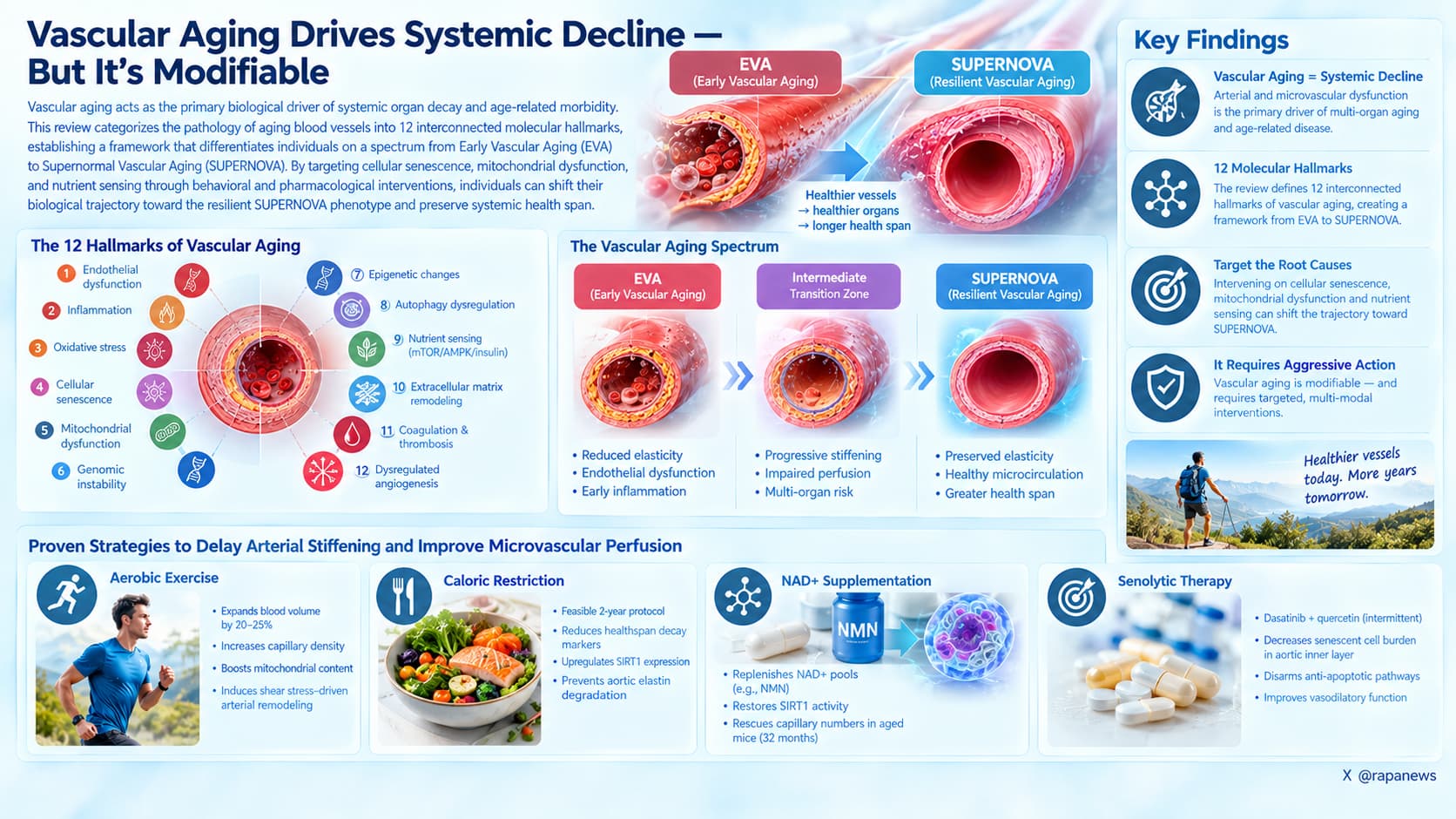
Vascular aging acts as the primary biological driver of systemic organ decay and age-related morbidity. The provided review categorizes the pathology of aging blood vessels into twelve interconnected molecular hallmarks, establishing a framework that differentiates individuals on a spectrum from Early Vascular Aging (EVA) to Supernormal Vascular Aging (SUPERNOVA). By targeting cellular senescence, mitochondrial dysfunction, and nutrient sensing through behavioral and pharmacological interventions, individuals can shift their biological trajectory toward the resilient SUPERNOVA phenotype and preserve systemic health span.
The human vascular network is the earliest organ system to exhibit signatures of cellular senescence, positioning arterial decay as the principal catalyst for widespread tissue dysfunction. Historically viewed as a passive conduit system, the vasculature is now understood to be a highly dynamic microenvironment. Chronic exposure to oxidative stress and mechanical shear forces degrades endothelial cells and vascular smooth muscle cells. This degradation triggers a cascade of systemic aging that compromises distant organs, directly propelling the pathogenesis of Alzheimer’s disease, chronic kidney disease, and cardiovascular failure.
To systematically decode this process, researchers have identified twelve distinct hallmarks of vascular aging. These hallmarks are organized into three primary dimensions. The first dimension involves genomic and homeostatic instability, encompassing telomere attrition, epigenetic shifts, and the loss of protein quality control. The second dimension centers on cellular and metabolic dysfunction, specifically highlighting dysregulated nutrient sensing through mTOR and AMPK pathways, alongside mitochondrial failure. The third dimension characterizes microenvironmental evolution, driven by the accumulation of senescent cells, the exhaustion of endogenous stem cell pools, and persistent low-grade inflammation known as the senescence-associated secretory phenotype.
This mechanistic framework provides the foundation for stratifying patients into two extreme clinical macro-phenotypes. Early Vascular Aging describes a trajectory of accelerated arterial stiffening, characterized by rapid internal remodeling, loss of arterial compliance, and a biological vascular age that far exceeds chronological age. Conversely, the Supernormal Vascular Aging phenotype describes a subpopulation that successfully decouples chronological aging from vascular decay. Individuals exhibiting the SUPERNOVA phenotype maintain pristine arterial elasticity, pristine internal elastic lamina integrity, and a pronounced resistance to stress-induced structural remodeling.
The transition from a standard or accelerated aging trajectory to a SUPERNOVA profile requires active intervention. Genetic architecture provides a baseline, but cumulative environmental exposures dictate the ultimate phenotype. Sustaining metabolic homeostasis through specific longevity pathways insulates the arterial tree from systemic decay. Targeted behavioral modifications and pharmacological agents represent the most viable strategies to clear senescent populations, restore mitochondrial redox balance, and suppress inflammatory cascades. The ultimate goal of modern geroscience is not merely the isolated treatment of downstream age-related diseases, but the systematic preservation of the vascular niche to maintain whole-organism vitality.
Actionable Insights
Modulating vascular aging requires aggressive, targeted interventions. The review highlights several practical strategies to delay arterial stiffening and improve microvascular perfusion.
-
Aerobic Exercise: Appropriate physical training expands circulating blood volume by an absolute magnitude of 20 to 25 percent. This directly enhances capillary density, improves mitochondrial content, and forces shear stress-induced arterial remodeling.
-
Caloric Restriction: A two-year continuous caloric restriction protocol is clinically feasible and effectively reduces biological predictors of healthspan decay. This intervention upregulates SIRT1 expression and prevents the degradation of aortic elastin. Note: Scientific evidence robustly supports the classification of rapamycin as a “caloric restriction mimetic” that replicates several vascular and systemic benefits of caloric restriction.
-
NAD+ Supplementation: Replenishing NAD+ pools via precursors like nicotinamide mononucleotide (NMN) restores SIRT1 activity. Short-term NMN administration robustly rescues diminished capillary numbers in mouse models even at an advanced chronological age of 32 months.
Statistical parameters like Cohen’s d or exact hazard ratios are absent in the source material due to its nature as a high-level literature review. The quantifiable real-world magnitude is best represented by the 20 to 25 percent capacity expansion in blood volume via exercise, and the preservation of capillary architecture at extreme biological age via NAD+ restoration.
Context/Source
- Open Access Paper: Decoding Vascular Senescence: Cellular Insights and Therapeutic Strategies
- Institution: Nanjing University of Chinese Medicine
- Country: China
- Journal: International Journal of Biological Sciences
- Impact Evaluation: The impact score of this journal is 9.2, evaluated against a typical high-end range of 0–60+ for top general science, therefore this is a High impact journal.