Taurine Quiets the NLRP3 Inflammation Switch That Drives Aging

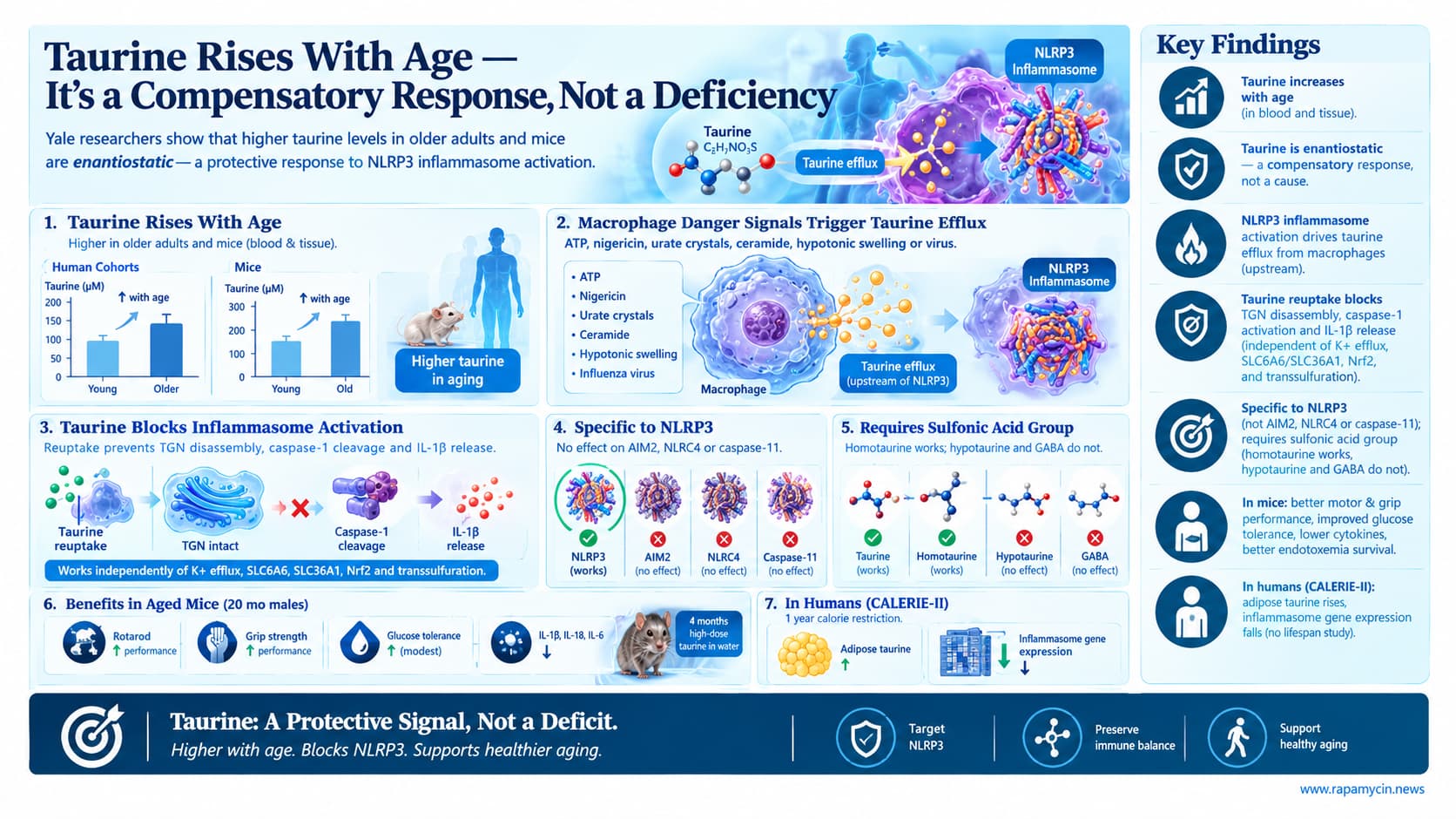
This study overturns the premise of the 2023 taurine-deficiency hypothesis while partially rescuing its practical conclusion. Measuring taurine by mass spectrometry in two human cohorts and in mice, the Yale group found that circulating and tissue taurine rises with age rather than falling. They argue this rise is enantiostatic, meaning it is a compensatory response that opposes a destabilizing process rather than a cause of it. The destabilizing process they identify is NLRP3 inflammasome activation in macrophages. When a macrophage senses a danger signal such as extracellular ATP, nigericin, urate crystals, ceramide, hypotonic swelling or influenza virus, it rapidly dumps taurine out of the cell, and that efflux sits upstream of inflammasome assembly rather than downstream of it. In 20-month-old male mice, four months of high-dose taurine in drinking water improved rotarod and grip performance, modestly improved glucose tolerance, lowered IL-1 beta, IL-18 and IL-6, and improved survival of lethal endotoxemia. Calorie restriction elevates taurine and lowers inflammation in humans.

In 2023 a paper in Science proposed that taurine levels fall as we age, and that topping them back up could slow the process. It was an attractive story, partly because taurine is cheap, abundant in the diet and already sitting on supplement shelves. Two years later a second Science paper could not find the decline. The field has been stuck on that disagreement ever since.

A team at Yale led by Vishwa Deep Dixit has now done something more useful than picking a side. They measured taurine carefully in two independent human cohorts and in mice, and found the opposite of a decline. Serum taurine went up with age in both sexes. In mice it went up in blood and in heart, spleen, lung, kidney, liver and both major fat depots. The deficiency premise, as stated, does not hold.

Then comes the twist. The researchers gave 20-month-old mice, roughly the equivalent of a human in their sixties, four months of taurine in their drinking water, pushing levels higher still. Those mice held on longer on a rotating rod, gripped harder, handled a glucose load slightly better, and carried less inflammatory signalling in blood and liver. Raising a molecule that was already elevated made the animals measurably better off.

The explanation the team offers is borrowed from marine biology. Mangum and Towle called it enantiostasis: when the internal environment cannot be held steady, the body mobilises molecules that push back against the instability. On that reading, the age-related taurine rise is not the problem. It is the body’s attempt at an answer, and it is not a large enough answer.

What taurine is pushing back against turns out to be one of the better-characterised engines of age-related inflammation, the NLRP3 inflammasome. This is a protein assembly inside immune cells that, once triggered, cuts loose the inflammatory messengers IL-1 beta and IL-18 and can blow the cell apart. The surprise in the data is the direction of travel. Macrophages do not lose taurine because the inflammasome fired. They lose it first, within five minutes, and that loss is part of what fires the inflammasome. Taurine leaving the cell is a signal, not debris.

The team traced the downstream step to the trans-Golgi network, the cell’s sorting and dispatch hub, which has to come apart before NLRP3 can assemble. Keeping taurine inside the cell keeps that hub intact. Strip taurine out, by diet or by deleting the enzymes that make it, and macrophages become noticeably more trigger-happy.

The human arm is the part worth watching. Participants in the CALERIE-II calorie restriction trial, eating about 14 per cent less for a year, showed higher taurine in their fat tissue alongside lower expression of inflammasome genes. That ties a well-validated longevity intervention to the same molecule.

What the paper does not have is a lifespan curve. Healthier mice are not necessarily longer-lived mice, and the dose used in the drinking water is far above what anyone takes from a tub of taurine.

Actionable Insights

The functional gains in old mice were large by the usual yardstick. Rotarod improved by about 1.2 standard deviations and grip strength by about 1.6. For scale, a 1.0 effect means the average treated mouse outperformed about 84 per cent of untreated ones. Inflammatory markers moved by about 1.1 to 1.5 standard deviations.

The catch is dose. Mice received 8,000 mg/kg per day. Converted by body surface area, that is 8,000 divided by 12.3, giving 650 mg/kg, or roughly 45 g per day for a 70 kg adult. Common supplementation of 1 to 6 g per day is 8 to 45 times lower. The acute injection studies used 500 to 1,000 mg/kg, which does scale to a realistic 2.8 to 5.7 g per day.

Context and Source

  • Open Access Paper: Taurine lowers inflammaging by regulating the NLRP3 inflammasome in macrophages|
  • institutions: Yale School of Medicine, Departments of Pathology, Immunobiology and Comparative Medicine, New Haven, CT. Yale Center for Research on Aging; Kyoto University; Keio University (WPI-Bio2Q); Pennington Biomedical Research Center; AdventHealth Orlando; UC San Diego; St. Jude; Mayo Clinic Kogod Center on Aging|
  • Countries: United States and Japan
  • Journal: Cell, volume 190
  • Impact evaluation. The impact score of this journal is 45.1, evaluated against a typical high-end range of 0 to 60 plus for top general science, therefore this is an Elite impact journal.

Related Reading:

Biomarker Data, Effect Size Extraction

How to read the numbers below. The paper reports p-values and nothing else. A p-value tells you how surprised to be if nothing were happening. It does not tell you how big the effect is, and with small groups a convincing p-value can sit on top of an effect that is either huge or modest. So the effect sizes below are reconstructions, not the authors’ figures. For each comparison the reported p-value and the group sizes were converted back into a t statistic, and then into Cohen’s d using d = t multiplied by the square root of (1/n1 plus 1/n2).

What Cohen’s d means in plain terms. It is the gap between two group averages measured in standard deviations, which is the natural spread of the measurement itself. A d of 0.2 is small, 0.5 is moderate, 0.8 is large. A d of 1.0 means the average treated animal scores better than about 84 percent of untreated animals. A d of 1.5 means better than about 93 percent.

The confidence intervals matter more than the point estimates here. With 15 animals per group, the interval around a large d is wide, and the lower bound is what you should plan around.

Mouse health span, 20-month-old males, 4 months of taurine

Endpoint n per group Reported p Derived t Cohen’s d 95 percent CI for d Plain reading
Grip strength 15 vs 15 0.0002 4.25 1.55 0.73 to 2.37 Average taurine mouse beats about 93 percent of controls
Rotarod latency 15 vs 15 0.0030 3.27 1.19 0.41 to 1.97 Beats about 88 percent of controls
Glucose tolerance AUC 14 vs 15 0.0006 3.88 1.44 0.64 to 2.28 Lower AUC, meaning better clearance
Serum taurine 11 vs 8 0.0002 4.65 2.16 1.00 to 3.28 Target engagement confirmed, roughly doubled
Serum IL-1 beta 9 vs 8 0.0299 2.40 1.17 0.14 to 2.20 Lower bound is near zero
Liver IL-1 beta 9 vs 8 0.0312 2.38 1.16 0.13 to 2.19 Lower bound is near zero
Liver IL-6 9 vs 8 0.0085 3.03 1.47 0.41 to 2.55 The most robust cytokine effect
Liver IL-18 9 vs 8 0.0448 2.19 1.06 0.04 to 2.08 Barely excludes zero

Absolute magnitudes, read off the figure axes rather than from reported numbers, so treat these as approximate. Rotarod moved from roughly 60 to 70 seconds in controls to roughly 90 to 95 seconds with taurine, an improvement in the region of 35 to 45 percent. Grip moved from roughly 90 to 100 gram-force to roughly 115 to 125 gram-force, in the region of 20 to 30 percent. [Confidence: Low on the exact values, Medium on the direction and rough scale]

A confound that cuts into both. Taurine slightly reduced body weight and fat mass without affecting lean mass. Rotarod performance improves when an animal carries less fat, independent of any neuromuscular benefit, and absolute grip force is also weight-sensitive. Neither endpoint is reported normalized to body weight. Some unknown fraction of the apparent health span effect may be a leanness effect. [Confidence: Medium]

No effect was found on serum IL-18, MCP-1 or eotaxin, and no serum IL-6 effect in the acute LPS model. Selective reporting of the hits is a live concern.

Human taurine versus age, cross-sectional

Comparison n Reported p Cohen’s d 95 percent CI Note
Serum taurine, women aged 65 plus vs 21 to 35 20 vs 19 0.0028 1.03 0.36 to 1.69 Higher in older
Serum taurine, men aged 65 plus vs 21 to 35 15 vs 17 0.0022 1.19 0.44 to 1.94 Higher in older
Serum taurine vs age, women, continuous 39 0.0002 r = 0.57 (R squared 0.3245) not computed Age explains about 32 percent of variance
Serum taurine vs age, men, continuous 32 0.0007 r = 0.71 (R squared 0.5101) not computed Age explains about 51 percent of variance
Plasma taurine vs age, either sex not stated not significant near zero not computed The matrix discrepancy, see Limitations

Mouse tissue taurine with age, 2 vs 28 months, n = 10 per group

Tissue Reported p Cohen’s d Note
Liver less than 0.0001 at least 2.1 Largest tissue effect
Kidney less than 0.0001 at least 2.1
Visceral adipose less than 0.0001 at least 2.1
Subcutaneous adipose 0.0013 1.69
Lung 0.0076 1.33
Heart 0.0138 1.22
Spleen 0.0155 1.19
Brown adipose, skeletal muscle not significant near zero The two tissues that did not rise

Organ-specific aging priorities

Ranked by the strength of evidence in this paper.

  1. Liver. The most consistent organ. IL-1 beta, IL-18 and IL-6 all fell, taurine doubled, and liver taurine rose most steeply with age.
  2. Visceral adipose tissue. Single-cell transcriptomics showed downregulation of TNF-alpha signalling, interferon response, IL-6 signalling and complement in adipose progenitors, macrophages and mesothelial cells, plus a reduction in the aged-VAT B cell population. Caveat on pooling below.
  3. Neuromuscular. Rotarod and grip both improved, but the mechanism is unexplored and the leanness confound is unaddressed.
  4. Systemic metabolic. Glucose tolerance improved modestly. The authors themselves call it modest.
  5. Kidney and heart. Taurine rose with age in both. Neither was functionally assessed after supplementation. Complete gap.
  6. Brain. Not examined. The B2M result, where taurine suppressed a protein previously linked to cognitive decline, is the only hook and it is transcriptional and indirect.

Novelty

What was not known before this paper.

  1. Taurine efflux is an upstream trigger of NLRP3, not a downstream consequence. This is the genuinely new finding. Prior work by Rossi-Smith et al. in Cell Reports 2025 had established that taurine transport modulates ionic fluxes during NLRP3 activation. This paper reorders the causality with knockout and kinetic evidence and promotes taurine from modulator to proximal signal. [Confidence: High]
  2. Serum taurine rises with age in humans and mice. The field has been arguing between a 2023 Science paper claiming decline and a 2025 Science paper finding no biomarker signal. Two independent human cohorts plus two mouse cohorts, all pointing up, is a substantive contribution to that dispute even if the serum versus plasma discrepancy is unresolved. [Confidence: Medium, see Limitations]
  3. The effect is potassium-independent. Taurine efflux and potassium efflux are separable pathways converging on the same inflammasome. Measured by ICP-MS rather than a colorimetric kit. [Confidence: High]
  4. Chemical specificity maps to the sulfonic acid group. Hypotaurine inactive, homotaurine active, beta-alanine and GABA inactive. This had not been systematically tested against the inflammasome. [Confidence: High]
  5. Canonical taurine transporters are dispensable in macrophages. SLC6A6 and SLC36A1 were the two candidates and both are excluded, singly and together. An unidentified transport route exists. [Confidence: High]
  6. Taurine restrains constitutive inflammasome activity in cryopyrinopathy models. FCAS and Muckle-Wells gain-of-function Nlrp3 mutants responded to taurine. This opens a rare-disease angle that is arguably more tractable than the aging angle. [Confidence: Medium]
  7. Calorie restriction raises adipose taurine in humans. From CALERIE-II tissue, with adipose specificity, since plasma taurine and hypotaurine did not change. New to this paper. [Confidence: Medium]
  8. A conceptual reframe. The enantiostasis framing, borrowed from Mangum and Towle 1977, offers a general template for interpreting age-related increases in protective metabolites as insufficient compensation rather than pathology. Whether it is a useful framework or an unfalsifiable one is an open question. If any age-related rise can be called adaptive-but-insufficient, the framework explains nothing. [Confidence: Low]

What is not new. That taurine supplementation reduces inflammation in rodents, that NLRP3 drives inflammaging, that NLRP3 reduction extends mouse lifespan, that TGN disassembly precedes NLRP3 assembly, and that calorie restriction lowers inflammation in CALERIE-II. All were established.

2 Likes

Looks like I should add taurine to my stack again.