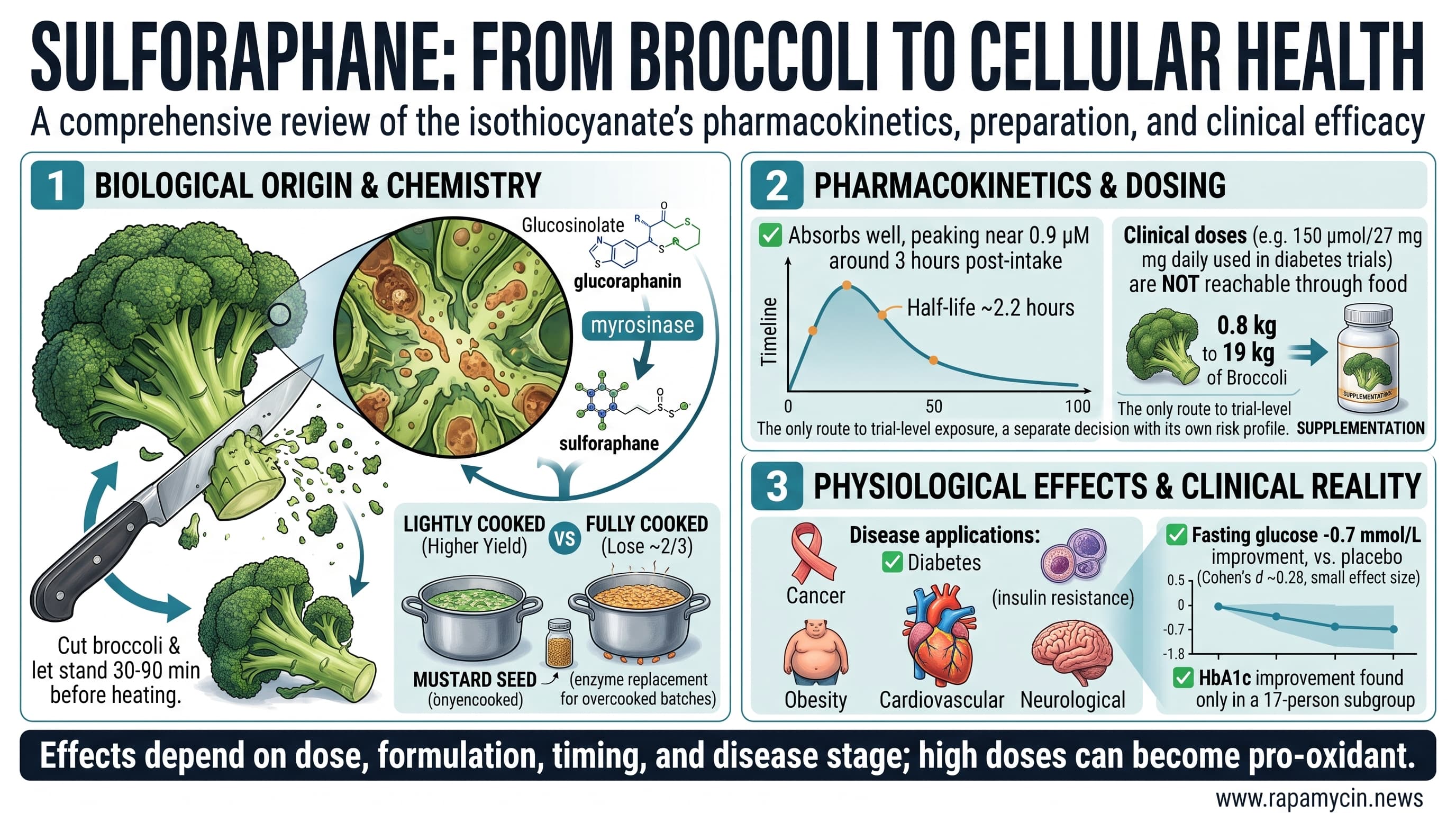
Six researchers in Naples assembled 214 references into a narrative review of sulforaphane, the isothiocyanate released when damaged broccoli tissue brings the glucosinolate glucoraphanin into contact with the enzyme myrosinase. They survey physicochemistry, pharmacokinetics, molecular mechanisms, safety and disease applications spanning cancer, diabetes, obesity, cardiovascular and neurological conditions. The pharmacokinetic section is the most useful part. Preformed sulforaphane absorbs well, peaking near 0.9 micromolar about three hours after intake with a half-life around 2.2 hours, which places many laboratory concentrations within genuine physiological reach. That is unusual among dietary compounds. The review repeatedly stresses that effects depend on dose, formulation, timing and disease stage, and that high doses can turn pro-oxidant.
Most of nutritional science’s promising molecules die in the same place. A compound performs beautifully on cultured cells, a paper appears, headlines follow, and then somebody calculates that reaching the concentration used in the dish would require drinking forty liters of tea a day. The effect was real. It was simply unreachable.
Sulforaphane is one of the few that survives this test, and a new review in Nutrients assembles the evidence for why.
The compound comes from broccoli, though not directly. Intact broccoli contains glucoraphanin, which is inert. A separate enzyme, myrosinase, sits in a different compartment of the plant cell. Damage the tissue by chopping or chewing and the two meet, and sulforaphane is produced. This has practical consequences the review spells out. Prolonged heating destroys myrosinase, so fully cooked broccoli yields roughly a third of the sulforaphane of lightly cooked broccoli. Cutting the vegetable and letting it rest for thirty to ninety minutes before cooking lets the reaction run first. Powdered mustard seed carries a heat-resistant form of the enzyme and can rescue an overcooked batch.
Once swallowed, preformed sulforaphane absorbs efficiently in the jejunum. Somewhere between seventy and ninety percent of a dose is recovered in urine as metabolites. Blood levels peak near 0.9 micromolar about three hours later, then fall with a half-life of roughly two hours.
That peak figure is the important one. Many of the cell experiments underpinning sulforaphane’s reputation used concentrations between 0.5 and 10 micromolar. The lower half of that range is achievable in a living person. One frequently cited senescence experiment used a single micromolar once a week. For a dietary compound this is a rare position to be in.
So the interesting question becomes what the molecule does once it arrives, and the answer running through the review is: real, modest, and conditional.
The strongest human trial covered, a twelve week study in type 2 diabetes, found fasting glucose about 0.7 millimoles per liter lower than placebo. The improvement in glycated hemoglobin that tends to get quoted came from an obese subgroup of seventeen people, and the main comparison on that measure found nothing.
The review’s more valuable contribution is its insistence that sulforaphane is not uniformly good for you. At low concentrations it supports antioxidant defenses. At higher ones it depletes glutathione and generates superoxide, turning pro-oxidant. In mesenchymal stem cells, low doses protected and high doses killed.
And sitting in the safety section is the finding that deserves the most attention. In mouse lung cancer models, sulforaphane given before tumors were initiated was neutral or protective. Given after tumors were already established, it was associated with increased tumor multiplicity or growth in some experimental settings.
Actionable Insights
Preparation changes the yield more than brand choice does. Cut broccoli and let it stand thirty to ninety minutes before heating. Keep cooking light, because fully cooked broccoli delivers roughly a third of the sulforaphane of lightly cooked. If a batch is already overcooked, powdered mustard seed supplies a heat-resistant form of the missing enzyme.
Clinical doses are not reachable through food. The diabetes trial used 150 micromoles daily, about 27 milligrams. Broccoli florets contain 1.4 to 32.9 milligrams per kilogram, so matching that dose means roughly 0.8 kilograms of broccoli on the most favorable assumption and 19 kilograms on the least. Supplementation is the only route to trial-level exposure, and that is a separate decision with its own risk profile rather than a continuation of eating vegetables.
The measured human benefit is small. Fasting glucose ran about 0.7 millimoles per liter below placebo. Converted to a standardized effect size by dividing that difference by the spread of the measurement, this is a Cohen’s d near 0.28, where 0.2 is conventionally called small. The widely repeated HbA1c improvement came from a subgroup of seventeen people, not the full trial.
One caution deserves weight. In mouse lung cancer models, sulforaphane given after tumors were established increased tumor growth in some settings.
Context and Source
- Open Access Paper: Sulforaphane and Human Health: From Biological and Pharmacological Properties to Therapeutic Potential in Disease Prevention and Treatment, November 25, 2026.
- Institutions: Department of Precision Medicine, University of Campania Luigi Vanvitelli, Naples; Institute of Biosciences and BioResources (IBBR), National Research Council (CNR), Portici; Department of Pharmacy, University of Naples Federico II
- Country: Italy
- Journal: Nutrients, 2026.
- Impact: The impact score of this journal is 5.0, evaluated against a typical high-end range of 0 to 60+ for top general science, therefore this is a Low to Medium impact journal.
Related Reading:
- Sulforaphane to the Rescue: Overcoming Age-Blunted Exercise Signaling via Phytochemical Stacking
- Can't Exercise? Sulforaphane from Broccoli Sprouts Reverses Frailty in Aging Mice
- Broccoli Sprout Drink Helped Chinese Villagers Clear a Polluted Air Carcinogens
- Sulforaphane: how to supplement? Forms, dose, brands, timing