High-Dose Flu Vaccine Raises Protection in Over-75s From 40 to 72 Percent, in Men and Women Alike
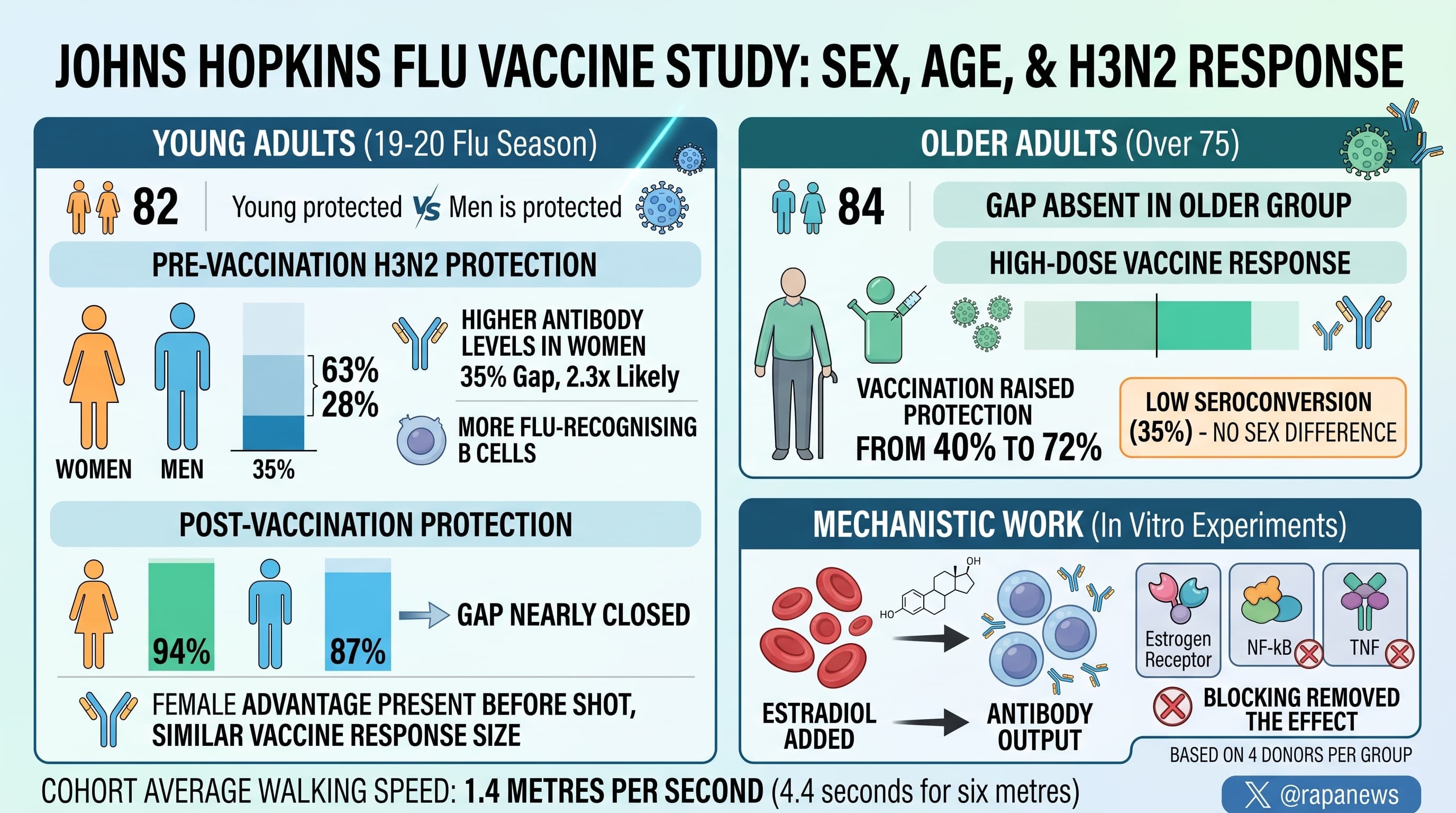
Johns Hopkins researchers followed 82 young adults and 84 adults over 75 through the 2019 to 2020 flu vaccine season. Young women had higher antibody levels against the H3N2 strain than young men, and more flu-recognising B cells. That gap was absent in the older group. In lab dishes, adding estradiol to blood cells from young women increased antibody output, and blocking the estrogen receptor, NF-kB or TNF removed the effect. The mechanistic work rests on four donors per group. The female advantage was already present before vaccination, and the size of the response to the vaccine did not differ significantly between the sexes.
Women generally produce more antibodies than men after vaccination, and that gap narrows in old age. A team at Johns Hopkins set out to explain why, and their answer centres on estrogen acting directly on the cells that make antibodies.
The study ran two groups in parallel. Eighty-two healthcare workers aged 18 to 49 received the standard flu shot. Eighty-four community-dwelling adults over 75 received the high-dose version recommended for their age. Blood was drawn before vaccination, then at 7 and 28 days.
Among the young adults, women had higher neutralising antibody levels against the H3N2 strain at both the start and the end. They also carried more B cells able to recognise the flu protein hemagglutinin. None of this held for H1N1, where almost everyone already had strong immunity. And none of it held in the over-75s, where men and women looked alike.
The team measured twelve steroid hormones by mass spectrometry. Young women had far higher estradiol and estrone than anyone else. In the older group the pattern flipped slightly, with men having more estrogen than women.
Gene activity in sorted B cells pointed the same way. A week after vaccination, B cells from young women showed higher activity in estrogen-response genes and in an inflammatory signalling route known as TNF signalling via NF-kB. Many of the genes involved carry DNA sequences that the estrogen receptor can bind.
The most direct evidence came from cell culture. When blood cells from young women were exposed to flu protein plus estradiol overnight, more cells secreted antibody and each secreted more of it. Tamoxifen, which blocks the estrogen receptor in B cells, cancelled the boost. So did drugs that block NF-kB or TNF. Cells from men did not respond to estradiol at all. Cells from older women still responded, though less strongly.
There are reasons for caution. The young women’s advantage existed before the needle went in. Measured as fold increase or as the share of people who seroconverted, the response to the vaccine was statistically the same in men and women. In fact, a slightly larger share of young men than young women seroconverted. The culture experiments used four donors per group and frozen cells. Two-thirds of the young women were on birth control of mixed types, which alters natural hormone levels. The two age groups received different vaccine doses, and nobody between 50 and 74 was enrolled, so the menopause transition is missing from the picture.
The authors raise the idea of estrogen as a vaccine adjuvant for postmenopausal women. This study did not test that. It shows that estrogen receptor signalling can increase antibody secretion from young women’s B cells in a dish, and that older women’s cells retain some of that capacity.
Actionable Insights
This study does not support changing anything about how or whether you get a flu shot.
What it shows in practical terms:
- Before vaccination, 63 percent of young women already had protective H3N2 antibody levels, against 28 percent of young men. That is a 35 percentage point gap, or about 2.3 times as likely.
- After vaccination the gap nearly closed: 94 percent of women and 87 percent of men were protected. Young men benefited at least as much from the shot.
- In adults over 75 receiving the high-dose vaccine, 72 percent reached protective levels but only about 35 percent seroconverted, with no sex difference. Vaccination still raised protection from 40 to 72 percent in that group.
- In culture, estradiol raised the number of antibody-secreting cells from young women by roughly half and nearly doubled antibody output per cell. These are approximate readings from four donors.
For postmenopausal women on hormone therapy, the finding that older B cells still respond to estrogen is of interest, but no clinical benefit was measured. For people on TNF-blocking drugs, the culture result is a hypothesis only.
Overall, young women have higher H3N2 antibody levels and more flu-specific B cells than young men. Estradiol can increase antibody secretion from young women’s blood cells in culture via the estrogen receptor. This mechanism explains sex and age differences in vaccine response in people. Estrogen may improve vaccine protection if given to older women
The practical message is that young men and older adults of both sexes have the most to gain from the vaccine.
Context and Source
- Open Access Paper: Sex and age differences in antibody responses to seasonal influenza vaccination are mediated by estrogenic upregulation of NF-kB and TNF signaling in B cells
- Institution: Johns Hopkins Bloomberg School of Public Health and Johns Hopkins School of Medicine, with co-authors at the US National Institute on Aging and Erasmus Medical Center, Rotterdam
- Country: USA
- Journal: mBio (American Society for Microbiology), published 10 September 2026.
- Impact evaluation: The impact score of this journal is 5.4 (Journal Impact Factor, 2025 JCR data year), evaluated against a typical high-end range of 0 to 60+ for top general science, therefore this is a Medium impact journal.