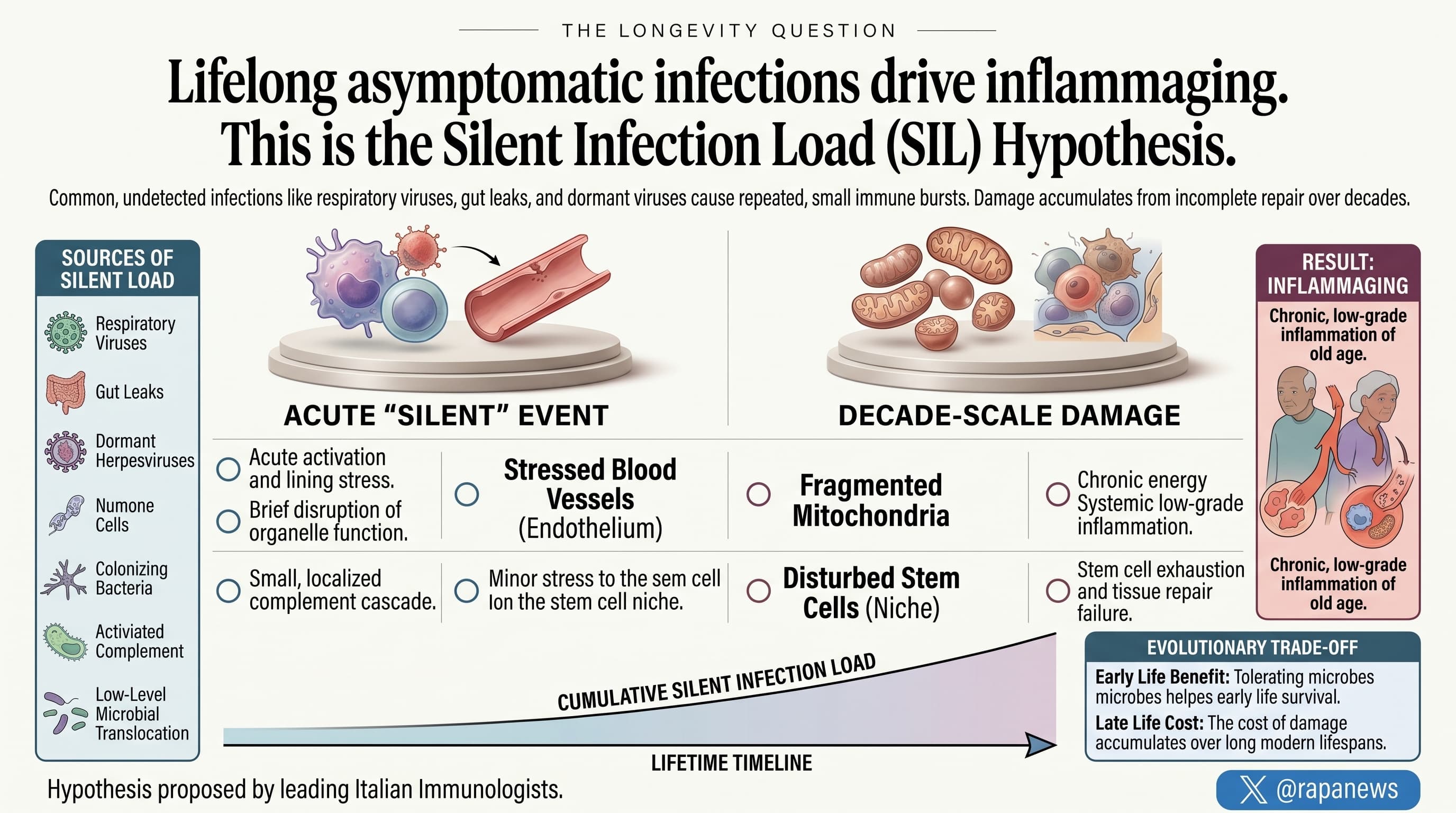
This narrative review from three Italian immunologists proposes the “Silent Infection Load” (SIL) hypothesis. It argues that the lifelong total of infections that cause no symptoms contributes to inflammaging, the chronic low-grade inflammation of old age. These include common respiratory viruses, mild gut infections, herpesviruses that wake up without symptoms, colonizing bacteria, and low-level leakage of microbes across damaged barriers. The authors say each event causes a small, contained burst of immune activity. That burst stresses blood vessel linings, fragments mitochondria, activates complement, and disturbs stem cells. Repair is incomplete each time, so the damage adds up over decades. They present this as an evolutionary trade-off. Tolerating microbes helped people survive early in life, and the cost only shows up in the long lives people live today. The authors say openly that most of the evidence is indirect, and they propose vaccination as the main way to test the idea and act on it.
Most of us think of infection as an event: a fever, a lost week, then recovery. A new review from three Italian immunologists argues that the infections that matter most for aging may be the ones we never feel.
Andrea Cossarizza of the University of Modena and Reggio Emilia and colleagues call their idea the Silent Infection Load. Over a lifetime, the body quietly fights off a near continuous stream of microbes. These include rhinoviruses and seasonal coronaviruses, stomach bugs that never get past a queasy afternoon, herpesviruses such as cytomegalovirus and Epstein-Barr virus that sleep in our cells and periodically wake, and bacteria living on skin, gums and mucosa. The authors argue that each encounter triggers a small, contained burst of immune activity, which they call a micro-storm.
A micro-storm never raises a fever. According to the review, though, it does raise signalling molecules such as IL-6 and TNF, loosen the seals between cells lining small blood vessels, fragment mitochondria, and switch on complement, a cascade of blood proteins that tags and attacks invaders. Each episode clears, but the authors contend repair is rarely complete. A slightly leakier vessel, a more damaged mitochondrion, a stem cell pushed out of its resting state one more time: over decades, these leftovers could add up to the inflammation that feeds frailty, heart disease and dementia. The process may also feed itself. An aging immune system controls latent viruses less well, which means more reactivations and more inflammation.
The evolutionary framing is the most interesting part. Wiping out every microbe would cost too much energy and cause too much collateral damage, so tolerating some persistence was the affordable strategy. Few ancestral humans lived long enough for the late-life bill to arrive. Now most of us do. On this view, inflammaging is not the immune system breaking down. It is the running cost of a design built for a shorter life.
The practical angle is vaccination. If silent infections are part of the problem, preventing them should slow inflammaging. The authors cite evidence linking shingles vaccination to lower dementia rates. They also argue that a future cytomegalovirus vaccine could matter more for aging than for infection control.
The caveats are large, and to their credit the authors state them. Almost no evidence comes from people followed over time with truly silent infections. Most of it is borrowed from severe infections, cell culture and animal work, then extrapolated downward. Their own grading rates only latent herpesviruses as strongly supported. They also present the silent load as an amplifier of other aging drivers, not a main cause.
Field data complicate the picture further. The Tsimane of Bolivia carry heavy infection burdens and high inflammatory markers, yet they have some of the lowest rates of coronary artery disease ever measured. More infection does not straightforwardly mean worse aging.
What the review offers is a testable agenda. Build an index of lifetime silent infection from antibody profiling and blood markers, track it in aging cohorts, and use vaccine rollouts as experiments. Until then, the Silent Infection Load is a well-argued hypothesis, not a finding.
Actionable Insights
This is a review with no new data, so any benefits come from the human studies it cites, not from the paper itself.
- Get the recombinant shingles vaccine if you are eligible. This is the strongest actionable signal. In a natural experiment in Wales, people who became eligible for shingles vaccination were about 20% less likely (relative) to receive a new dementia diagnosis over 7 years, roughly 3.5 fewer diagnoses per 100 people. A separate US records study found about 17% more dementia-free time over 6 years with the recombinant vaccine than with the older live vaccine. That works out to roughly five extra months without a diagnosis. [Confidence: Medium. The Welsh design is unusually strong for observational data, but the mechanism is unproven.]
- Stay current on influenza, RSV (older adults) and pneumococcal vaccines. These reduce symptomatic disease and some silent carriage or shedding. No trial has yet shown that they slow inflammaging itself. [Confidence: Low for the aging benefit.]
- Take periodontal health seriously. Gum pathogens are one of the more plausible sources of chronic low-grade systemic inflammation, but the evidence is associative. [Confidence: Low to Medium.]
- Cytomegalovirus has no vaccine yet. Its association with mortality in older adults is real but modest and confounded, so there is no clinical action for it today.
Context and Source
- Open Access Paper: The silent infection load: How lifelong asymptomatic infections may contribute to inflammaging as an evolutionary trade-off of longevity, 3 September 2026.
- Institutions: University of Modena and Reggio Emilia; IRCCS Ospedale San Raffaele and Vita-Salute San Raffaele University, Milan; IRCCS Fondazione Don Carlo Gnocchi, Milan; University of Milan
- Country: Italy
- Journal: Ageing Research Reviews
- Impact evaluation: The impact score of this journal is 15.5 (2025 Journal Impact Factor, 2026 JCR release; CiteScore 20.6), evaluated against a typical high-end range of 0 to 60+ for top general science and review journals, therefore this is a High impact journal.