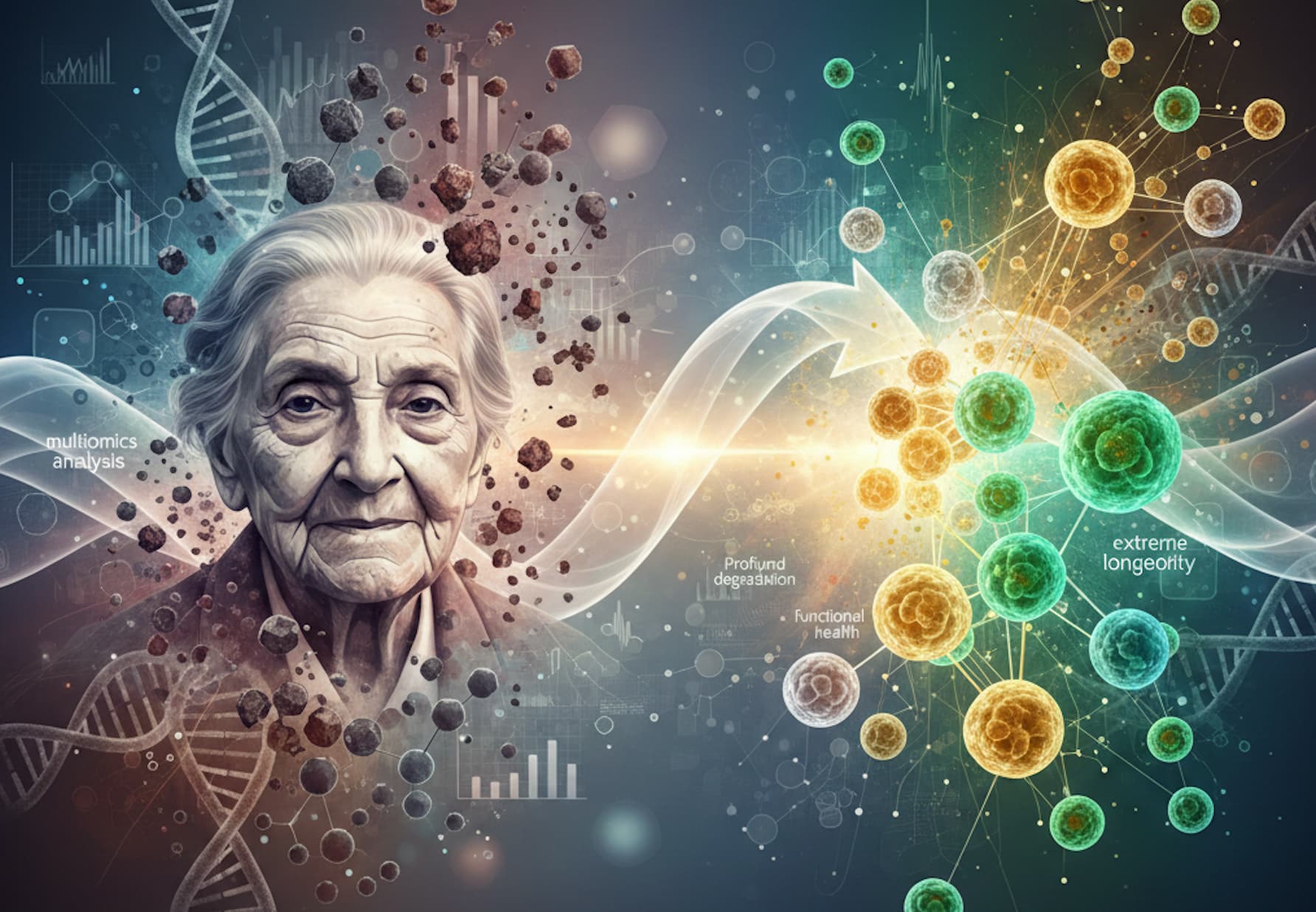
A new commentary in npj Aging synthesizes a groundbreaking multiomics analysis of Maria Branyas Morera, the world’s oldest validated living person until her death at 117 years. The core finding challenges the dogma that extreme longevity requires the near total absence of aging biomarkers. Instead, the data reveals a “profound decoupling” between biological degradation and functional health.
While Branyas exhibited canonical signs of advanced aging—such as severe telomere attrition and clonal hematopoiesis (accumulation of mutations in blood stem cells)—she simultaneously maintained a “youthful” epigenome, a highly resilient immune system, and an efficient lipid metabolism. This suggests that extending human lifespan beyond 100 does not require significantly slowing the aging process. Rather, it requires a specific “genetic and metabolic shield” that compensates for cellular damage. Key resilience factors identified include a Bifidobacterium-enriched gut microbiome, depletion of deleterious loss-of-function mutations, and specific polymorphisms in inflammatory pathways like IL-6.
Source:
-
Open Access Paper: The pursuit of understanding human longevity
-
Journal: npj Aging (Nature Partner Journals), * Published: 05 February 2026
-
Institution: Nicolaus Copernicus University (Poland), Charité Medical University (Germany), Harvard University (USA), Stanford University (USA).
-
Impact Evaluation: The 2024 Impact Factor for npj Aging is approximately 5.4, this is a High impact specialist journal, ranking Q1 in Geriatrics and Gerontology.
Related Reading:
Study Design Specifications
-
Type: Commentary & Review of a N=1 Multiomics Case Study (Santos-Pujol et al., 2025).
-
Primary Subject: 1 Human Female (Maria Branyas Morera, 117 years old).
-
Comparison: Matched against non-supercentenarian cohorts and general epidemiological data (Blue Zones).
-
Models Referenced: General references to Yeast, Rodents, and Monkeys for caloric restriction data.
Lifespan Analysis
-
Human Data: The subject reached 117 years and 168 days, exceeding regional life expectancy (Catalonia) by >30 years.
3 Likes
Mechanistic Deep Dive
The authors identify a “dichotomous biological paradigm” where senescence markers coexist with potent compensatory mechanisms.
1. The “Resilience Shield” vs. “Aging Damage”
-
The Damage (Accepted): The subject displayed severe telomere attrition and clonal hematopoiesis (mutations in SF3B1, TET2), usually predictors of mortality and myeloid malignancies.
-
The Shield (Protective):
-
Inflammation (IL-6 & NF-κB): The subject possessed specific polymorphisms in IL6 (rs2069837) and favorable expression of the RELA (NF-κB p65) network. This likely prevented “inflammaging,” the chronic low-grade inflammation that drives multi-morbidity.
-
Interferon Regulation: Unique expression of RFX5 and STAT1/STAT2 complexes suggests a hyper-vigilant antiviral state, protecting against infectious mortality.
-
Lipid Metabolism: The subject maintained a “metabolically advantageous lipidomic profile,” crucial for cardiovascular preservation despite age.
2. Microbiome & Metabolism
-
Bifidobacterium Enrichment: The study highlights an abundance of Bifidobacterium, a genus typically depleted in the elderly. This correlates with the subject’s high yogurt intake and is hypothesized to modulate systemic inflammation via the gut-brain axis.
-
Methionine & mTOR: The commentary reinforces that restricting methionine and inhibiting mTOR (via Caloric Restriction or pharmacological mimetics) remains the most robust translatable intervention for mimicking these centenarian traits.
Novelty
-
The “Decoupling” Hypothesis: This paper solidifies the concept that you do not need “perfect” biomarkers to reach 117. You can have “old” DNA (telomeres/mutations) if you have “young” function (inflammation/metabolism).
-
Genetic “Depletion”: It validates the “genomic depletion” theory—supercentenarians are defined not just by what they have (longevity genes), but by what they lack (rare loss-of-function variants that cause early death).
Critical Limitations
-
N=1 Constraints: The core multiomics data is derived from a single individual. This is anecdotal by definition and cannot distinguish between causal drivers of longevity and mere survivorship bias.
-
Reverse Causality: It is unclear if the Bifidobacterium levels drove the longevity or if the subject’s unique physiology selected for that microbiome.
-
Translational Gap: The paper identifies genetic shields (e.g., IL6 variants) which are non-modifiable. It offers limited data on how a non-centenarian can induce these specific protective states pharmacologically.
Biohacker Verdict
Actionable Insight: The survival of Maria Branyas despite heavy telomere attrition suggests that chasing telomere length is a low-yield strategy. Instead, prioritize inflammation suppression (IL-6 management) and gut barrier integrity (Bifidobacterium / Akkermansia support).
Confidence Score: [Medium-High] for the observation of the phenotype; [Low] for the universality of the specific genetic mechanisms identified.
Part 3: Claims & Verification
1. Claim: Extreme longevity is “decoupled” from biological aging markers (e.g., clonal hematopoiesis and telomere attrition).
-
Verification Status: Supported (Nuanced).
-
Evidence Level: Level C (Human Observational/Cohort).
-
Analysis: While telomere attrition and somatic mutations (Clonal Hematopoiesis of Indeterminate Potential - CHIP) are canonical markers of aging, research confirms that supercentenarians often tolerate high burdens of these mutations without the expected mortality. A 2022 study confirmed that while somatic mutations accumulate with age, their association with mortality risk vanishes in the oldest-old, suggesting a “buffering” mechanism or unique resilience.
-
External Support: Clonal Hematopoiesis Analyses in Clinical, Epidemiologic, and Genetic Aging Studies (2022)
2. Claim: Bifidobacterium enrichment in the gut microbiome drives healthy aging.
3. Claim: The IL6 polymorphism (rs2069837) is a genetic determinant of longevity.
4. Claim: Methionine restriction and mTOR inhibition extend lifespan.
-
Verification Status: Translational Gap (High Uncertainty).
-
Evidence Level: Level D (Pre-clinical/Animal) for lifespan; Level B (RCT) for metabolic markers only.
-
Analysis: The claim that these interventions extend lifespan is heavily reliant on rodent and yeast data. Human clinical trials (e.g., NCT00640757) have only demonstrated short-term weight loss and metabolic improvements (insulin sensitivity) over 16 weeks. There is no human data confirming lifespan extension, and long-term safety (e.g., bone density, sarcopenia risk) remains unverified.
-
External Support: Methionine restriction and mimetics to ameliorate human aging (2025); Methionine-Restriction Diet in Obese Adults (RCT Details)
5. Claim: Physical activity in centenarians is characterized by “natural movement” rather than strenuous exercise.
6. Claim: RELA (NF-κB) and STAT networks facilitate “immune resilience.”
-
Verification Status: Supported.
-
Evidence Level: Level C (Mechanistic / Single-Cell Analysis).
-
Analysis: Recent single-cell atlases of centenarian blood confirm a distinct immune remodeling: preservation of cytotoxic (NK/CD8+) function despite the loss of naïve cells. The RELA (NF-κB) pathway is the master regulator of this inflammatory balance. Hyper-activation leads to frailty, while the controlled regulation seen in centenarians (often via specific gene expression profiles) allows for effective pathogen defense without chronic tissue damage.
-
External Support: Centenarians: a model of immune resilience (2025); Study reveals how centenarians preserve youthful immune defenses (2025)
1 Like
Part 4: Actionable Intelligence (Deep Retrieval & Validation Mode)
1. The Translational Protocol: Methionine Restriction (MR) & Rapamycin
This section converts the murine “Gold Standard” longevity interventions referenced in the commentary into human-equivalent protocols, highlighting the dangerous gap between animal efficacy and human safety.
A. Methionine Restriction (MR)
-
Source Data: The study references 0.17% Methionine (Met) diet as the longevity threshold in mice (Source 1.1). Control diets typically contain ~0.86% Met. This represents an ~80% reduction in intake.
-
Human Equivalent Dose (HED) Calculation:
-
Baseline Human Intake: Average Western diet contains 2.5–3.0g Met/day.
-
Target Threshold: An 80% reduction targets ~500–600 mg Met/day.
-
Feasibility: Extremely Low. Achieving <800mg requires a strict vegan diet excluding soy, nuts, and grains, or the use of expensive medical foods (e.g., Hominex-2).
-
Biomarker Verification:
-
Primary: FGF21 (Fibroblast Growth Factor 21). Serum levels increase 10-fold in restricted states and are the definitive marker of MR efficacy (Source 3.1).
-
Secondary: Decreased IGF-1 and distinct reduction in Cystathionine.
-
Safety & Toxicity:
-
Bone Density Risk: MR significantly reduces Volumetric Bone Mass Density (vBMD) and bone mineral content in animal models (Source 6.1).
-
Sarcopenia: Severe protein restriction carries a high risk of muscle wasting in humans >65 years.
-
ROI: Low for general population due to difficulty; High for short-term “pulsing” (e.g., Fasting Mimicking Diet cycles) to spike FGF21.
2. The Strategic FAQ
Questions a longevity specialist should ask the authors, answered with current evidence.
Q1: The paper highlights Maria Branyas’s IL6 variant. Does this imply I should take Tocilizumab (IL-6 inhibitor) for longevity?
-
Answer: Unlikely and Dangerous. While the IL6 rs2069837 variant reduces chronic basal inflammation (“inflammaging”), pharmaceutical IL-6 blockade (Tocilizumab) is a sledgehammer that compromises acute immune defense. Long-term use in healthy adults would likely increase infection mortality (a key killer of centenarians) rather than mimic the subtle regulatory effect of the SNP.
Q2: Can I achieve the “Bifidobacterium enrichment” seen in the centenarian via probiotics, or is it a selection artifact?
-
Answer: Translational Gap. While you can take B. longum (e.g., strain BB536, 5–10 billion CFU), it is unclear if the centenarian gut allowed these bacteria to thrive or if the bacteria caused the longevity. However, given the low risk, supplementing with Bifidobacterium + prebiotics (inulin/FOS) is a high-reward/low-risk bet.
Q3: How do I reconcile the “Methionine Restriction” advice with the need for protein to prevent sarcopenia in my 70-year-old patients?
-
Answer: You cannot do both simultaneously. This is the “Geriatric Protein Paradox.” The solution is likely pulsed restriction (e.g., 5 days of low-protein/MR per month) or pharmacological mimetics (e.g., SGLT2 inhibitors) rather than chronic dietary restriction, which is dangerous for skeletal muscle in the elderly.
Q4: Is there a “Goldilocks” dose for Bifidobacterium?
-
Answer: 10^9 to 10^10 CFU. Clinical data (Source 5.1) suggests a therapeutic window of 1–10 billion CFU. Higher doses do not necessarily yield better colonization (“engraftment” depends on the ecological niche/fiber availability, not just seed count).
Q5: Does the paper’s emphasis on “Lipid Metabolism” suggest statins are longevity drugs?
-
Answer: No. The centenarian profile highlighted “efficient” lipid metabolism, not just low LDL. Statins reduce LDL but increase the risk of Type 2 Diabetes and muscle issues. The profile points more toward functional HDL and mitochondrial fatty acid oxidation (FAO), better targeted by exercise or PPAR-delta agonists (e.g., Cardarine - experimental/unsafe) than statins.
Q6: If I am “Checkmate” on the IL6 and FOXO3 genes (i.e., I have the “bad” variants), how much lifespan is lost?
-
Answer: <20-30%. Twin studies estimate heritability of lifespan is only ~25%. The “Decoupling” finding in this paper reinforces that you can have “bad” hardware (mutations) but “good” software (epigenetics/lifestyle). Your “bad” genes just mean you have a smaller margin for error in lifestyle choices.
Q7: Is there a commercially available test for the “Clonal Hematopoiesis” (CHIP) mentioned?
-
Answer: Yes. Tests like the “TruSight Myeloid Sequencing Panel” or specific CHIP assays from companies like Grail (Galleri - indirectly) or specialized longevity clinics can sequence TET2, DNMT3A, and ASXL1.
Q8: Can I use Glycine to mimic Methionine Restriction?
-
Answer: Yes (Theoretically). The ITP is currently testing Glycine supplementation. The mechanism is “Methionine Clearance”—excess Glycine helps the liver process Methionine, potentially mimicking the ratio balance of restriction. This is a much safer/easier intervention (3–5g Glycine/day) than restricting dietary protein.
1 Like