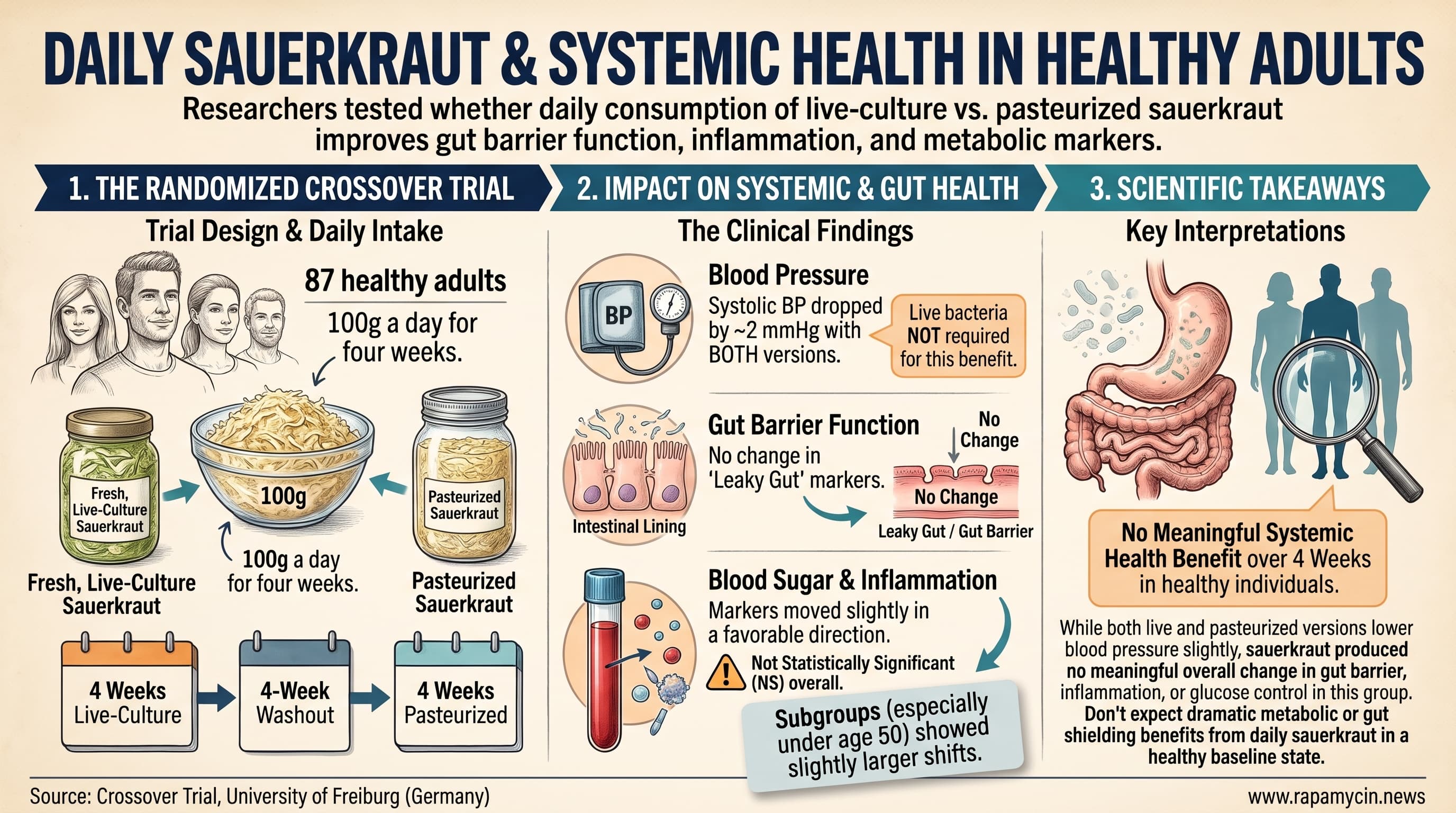
Researchers at the University of Freiburg in Germany asked whether eating sauerkraut every day improves gut barrier function, inflammation, blood sugar control or blood pressure in healthy adults. In a randomized crossover trial, 87 participants ate 100 grams a day of fresh, live-culture sauerkraut for four weeks and pasteurized sauerkraut for another four weeks. Each phase was preceded by a four-week break from all fermented foods. Both versions lowered systolic blood pressure by about 2 mmHg, so live bacteria did not appear necessary for that effect. Markers of “leaky gut” did not change. Inflammation and blood sugar markers moved slightly in a favorable direction, but none of these overall changes reached statistical significance. Some subgroups, especially people under 50, showed larger shifts. The authors conclude that four weeks of daily sauerkraut produced no meaningful systemic health benefit in healthy people.
Fermented foods have a halo. They are credited with sealing a “leaky gut,” calming inflammation and steadying blood sugar, largely on the strength of animal studies, observational data and a few small human trials. This German study puts one of the most familiar fermented foods to a straightforward test, and the results are mostly a reality check.
The design was clever. Sauerkraut sold in jars is usually pasteurized, which kills its bacteria. Fresh sauerkraut keeps them alive. By giving the same people both versions in random order, the researchers could ask two questions at once: does sauerkraut do anything, and if so, do the live microbes matter?
Eighty-seven healthy adults, aged 21 to 69 and mostly of normal weight, took part. Each ate 100 grams of sauerkraut a day, roughly half a cup, for four weeks of each type. Before each phase they spent four weeks avoiding all fermented foods, including yogurt, kefir and kombucha, so each phase started from a clean slate. At the end of every phase, the team measured blood pressure and drew fasting blood for markers of gut leakiness, inflammation and blood sugar control.
The clearest finding concerned blood pressure. Systolic pressure fell by about 2 mmHg after both fresh and pasteurized sauerkraut, and the two versions performed almost identically. Whatever drives that effect survives five minutes of heating at 75 degrees Celsius. Candidates include fiber, organic acids, plant compounds released during fermentation, and peptides that may mildly block the same enzyme targeted by common blood pressure drugs.
The gut barrier story was a clean null. Three markers that track different aspects of intestinal leakiness did not budge. For people who eat fermented foods specifically to “heal the gut,” that is notable, although these were healthy volunteers without obvious barrier problems.
Inflammation and blood sugar sat in between. Fresh sauerkraut lowered C-reactive protein, a general inflammation marker, by about 13 percent on average, and the pasteurized version slightly lowered fasting glucose and insulin. None of these changes was statistically significant for the group as a whole. When the researchers split participants by age, fiber intake, weight and sex, some subgroups showed clearer effects. Adults under 50 saw drops in glucose, a longer-term sugar marker and both blood pressure readings after pasteurized sauerkraut. With so many comparisons, some of those results could be chance.
The study has real limits. Blood pressure was measured in an unblinded setting, and each phase’s baseline was always recorded before its follow-up, so habituation to the clinic could contribute to the decline. The live-culture sauerkraut contained far fewer bacteria than the level usually considered necessary for a probiotic effect. Four weeks is short. The inflammation and glucose markers were not the original trial’s main targets.
Still, the overall picture is useful. Daily sauerkraut is safe, cheap and well tolerated, and it may shave a little off blood pressure. In healthy people, it does not deliver the dramatic gut and immune benefits often claimed for fermented foods, at least not at one serving a day for a month.
Actionable Insights
- Daily sauerkraut, about 100 grams or roughly half a cup, lowered systolic blood pressure by about 2 mmHg from a baseline near 132. A large meta-analysis of blood pressure drugs estimates that each 5 mmHg reduction cuts major cardiovascular events by about 10%. A sustained 2 mmHg drop might therefore translate to roughly a 4% lower relative risk. That is small for one person, but it is nearly free and stacks with other habits. [Confidence: Low to Medium for the extrapolation]
- Pasteurized, shelf-stable sauerkraut worked as well as fresh for blood pressure. You don’t need the refrigerated live-culture version for this benefit.
- Don’t count on gut barrier repair or meaningful anti-inflammatory effects if you are healthy. The CRP drop with fresh sauerkraut (about 0.12 mg/L) was not statistically significant and is clinically trivial at these already-low levels.
- Sauerkraut is salty. Each 100 grams added 0.8 to 1.2 grams of salt, yet blood pressure still fell. If you are salt-sensitive, rinse it or choose a lower-sodium brand.
- If live microbes are your goal, one serving a day of a single food is probably too little. The Stanford trial that found immune benefits used about six servings a day of varied fermented foods over ten weeks.
Context and Source
- Open Access Paper: Fermented foods and inflammation: a crossover intervention trial with fresh and pasteurized sauerkraut
- Institution: Institute for Prevention and Cancer Epidemiology, Faculty of Medicine and Medical Center, University of Freiburg
- Country: Germany
- Journal: European Journal of Clinical Nutrition (Springer Nature)
- Funding: This is a Medium impact journal. It sits at the lower end of Medium as a long-established, mid-ranked specialty journal.
Related Reading:
- Japanese Fermented Tea Boosts Autophagy
- Fiber vs Fermented Foods: Microbiome Scientist Says You Actually Need Both (Simon Hill)
- Pasteurized non-fermented milk is harmful, but fermented milk is good for health
- Guarding the Barrier: Why the Fermented Cabbage Metabolite Cocktail Beats Isolated Postbiotics
- Kefir and Yogurt Show Metabolic Perks; Muscle Benefits Still a Hypothesis
- Feed the Fermenters: Centenarian Gut Microbes Point to Fiber as a Healthy-Aging Lever
- You Are What Your Microbes Eat: The Case for Kimchi, Kefir and the 'Edible Microbiome'