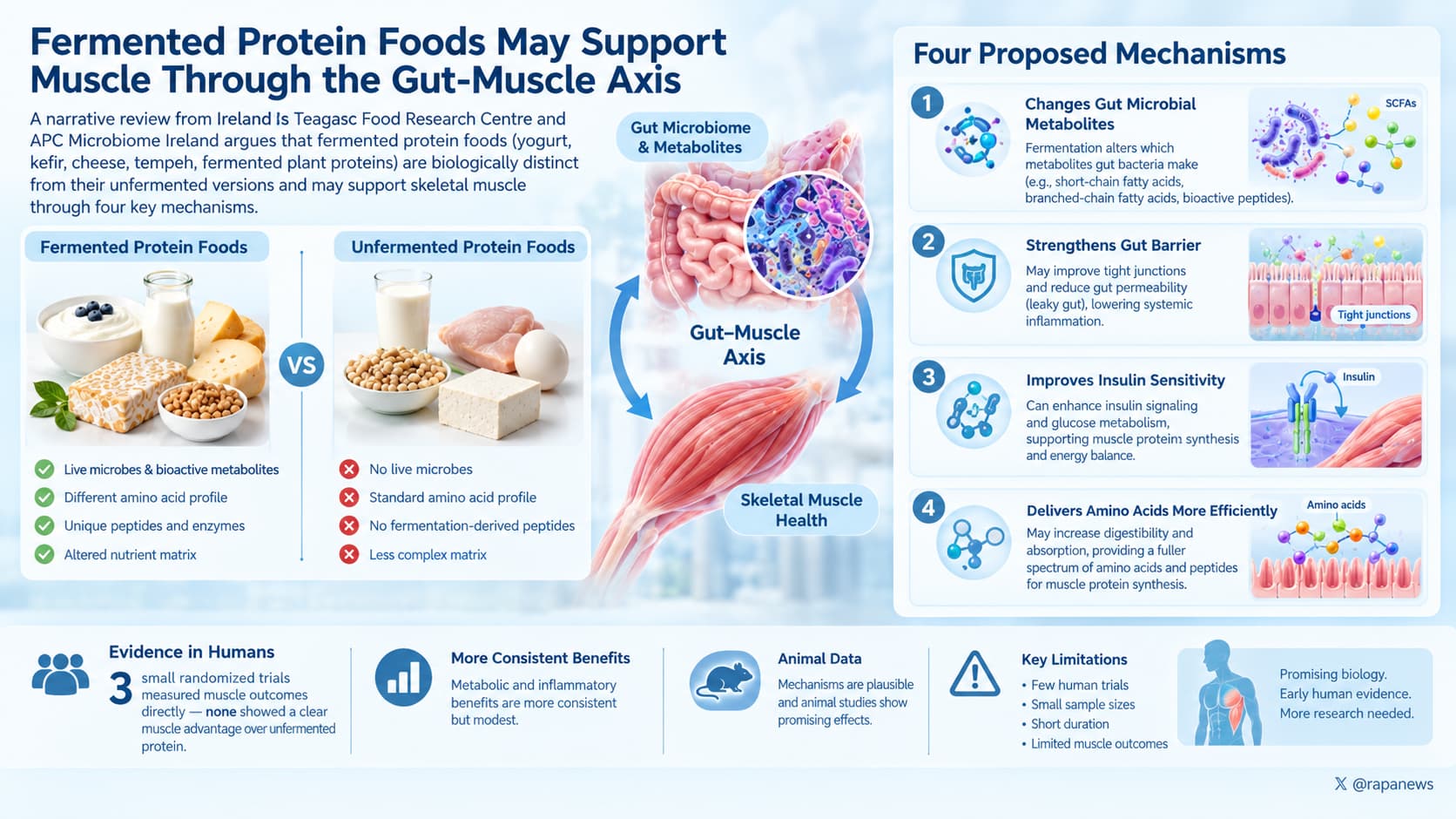
This narrative review from Ireland’s Teagasc Food Research Centre and APC Microbiome Ireland argues that fermented protein foods (yogurt, kefir, cheese, tempeh, fermented plant proteins) are biologically distinct from their unfermented versions. The authors propose four ways they could support skeletal muscle through the gut-muscle axis: changing which metabolites gut bacteria make, tightening the gut barrier, improving insulin sensitivity, and delivering amino acids more efficiently. The mechanisms are plausible and the animal data are interesting. The human evidence is thin. Only three small randomized trials measured muscle outcomes directly, and none showed a clear muscle advantage over unfermented protein. Metabolic and inflammatory benefits are more consistent but modest. The authors call the field promising but preliminary, and they are right.
Walk down any dairy aisle and the pitch is everywhere: kefir for your gut, high-protein skyr for your muscles. A new review in Communications Biology asks whether those two claims might be one story. Researchers in Ireland argue that fermented protein foods could support skeletal muscle through the gut-muscle axis, the two-way traffic between intestinal microbes and muscle tissue.
The case rests on chemistry. Fermentation does more than add bacteria to milk or soybeans. Lactic acid bacteria chop proteins into peptides and free amino acids, break down antinutrients such as phytates in plant foods, and leave behind organic acids, cell wall fragments and sometimes live microbes. In principle, that package could do four things: shift which metabolites gut bacteria produce, tighten the gut lining so fewer bacterial toxins leak into the blood, improve insulin sensitivity, and deliver amino acids like leucine faster. All four routes converge on the same signaling hubs that decide whether a muscle cell builds or breaks down protein.
Animal work makes the gut-muscle link look real. Germ-free mice have smaller, weaker muscles, and colonizing them with microbes partly reverses this. Butyrate, a fatty acid made by gut bacteria, protects muscle in diabetic rodents. One microbe, Veillonella atypica, improved treadmill endurance in mice by recycling lactate.
The problem is the human evidence. They found only three randomized trials of fermented protein foods that measured muscle directly. In 48 Korean men doing structured exercise, fermented whey beat regular whey on a balance test but not on grip strength, lean mass or back strength. In 53 healthy adults, a kefir-derived postbiotic drink with whey nudged grip strength up within the group, but not more than placebo. In 18 young men, fermented milk modestly reduced soreness after a hard weight session. None of these trials measured muscle protein synthesis, took a muscle biopsy or imaged muscle.
A larger set of trials looked at metabolic proxies. Yogurt cut insulin resistance, liver fat and circulating bacterial endotoxin in obese women with fatty liver disease compared with milk. Kefir lowered HbA1c in people with type 2 diabetes. Three weeks of kefir reduced zonulin, a contested marker of gut leakiness. But a 12-week kefir trial in metabolic syndrome showed nothing beyond what plain milk achieved, and several trials compared one fermented product with another, which cannot tell you whether fermentation itself matters.
The most instructive data point comes from a trial that did not use fermented food at all. In PROMOTe, 72 older twins took prebiotic fiber alongside amino acid supplements and resistance training. Their gut microbes shifted measurably. Their chair-rise times did not budge. Changing the microbiome is not the same as changing muscle.
So where does that leave the kefir in your fridge? As a good protein source with plausible metabolic benefits, and as a hypothesis about muscle rather than a proven tool. The review closes with a research wish list: isotope-tracer studies comparing fermented and unfermented protein, muscle biopsies, imaging and dose-finding. Until those arrive, probiotic supplements, backed by several meta-analyses showing modest strength gains in older adults, have the stronger evidence base. One senior author’s lab has received funding from several dairy companies, which readers may want to weigh.
Actionable Insights
Effect sizes below use Cohen’s d: 0.2 is small, 0.5 is medium, 0.8 is large. Where trials reported only p-values, I estimated d from them, which tends to overstate effects in small trials.
- Treat fermented dairy as protein first. Nothing here shows fermentation makes protein build more muscle than the same protein unfermented.
- The metabolic signal is real but modest. In the best fermented-versus-unfermented trial, 220 g/day of yogurt for 24 weeks lowered insulin resistance (HOMA-IR) by 0.53 units and liver fat by about 3.4 percentage points versus milk in obese women with fatty liver. Estimated d is about 0.4 to 0.5, a small-to-medium effect.
- Skip premium fermented whey for strength. The only head-to-head trial found a balance benefit (d about 0.6, likely inflated) and no strength or lean mass advantage.
- Fermented milk after training cut soreness by about 11%, roughly 1.6 points on a 14-point scale. That is a small effect (d about 0.3).
- Eat fermented protein alongside fiber. Protein fermented in a low-fiber colon generates ammonia, p-cresol and hydrogen sulfide.
- Resistance training and adequate total protein (at least 1.0 to 1.2 g/kg/day for older adults) remain the dominant levers.
Context/Source
- Full Title: Fermented protein foods as modulators of the gut-muscle axis: mechanisms, evidence, and future directions (Fermented protein foods as modulators of the gut-muscle axis: mechanisms, evidence, and future directions | Communications Biology), 25 September 2026.
- Institution: Teagasc Food Research Centre, APC Microbiome Ireland, King’s College London, Queen’s University Belfast
- Country: Ireland, United Kingdom
- Journal Name: Communications Biology
- Impact Evaluation: The impact score of this journal is 5.9, evaluated against a typical high-end range of 0–60+ for top general science, therefore this is a Medium impact journal.
Related Reading:
- You Are What Your Microbes Eat: The Case for Kimchi, Kefir and the 'Edible Microbiome'
- Kefir: A Probiotic Shield Against Cavities and Gum Disease?
- Prebiotic + Kefir = Reduced Inflammation (Study)
- Engineered Multi-Strain Yogurt Recruits Commensal Bacteroides to Subdue Inflammaging and Sleep Disturbances