I. Executive Summary
The core thesis of this discussion is that optimizing human immune function, reducing systemic inflammation, and mitigating chronic disease risks require a dual-mechanistic approach to dietary modification: the parallel up-regulation of high-diversity natural dietary fiber and the consistent ingestion of fermented foods. This paradigm moves away from exclusionary or reductionist dietary frameworks, proposing instead a pragmatic target of consuming 30 distinct plants per week combined with three daily portions of fermented foods.
Epidemiologically, natural dietary fiber exhibits a robust, dose-dependent inverse correlation with all-cause mortality, cardiovascular disease, stroke, and specific malignancies. Rather than working via simple physical transit, fiber undergoes microbial fermentation in the large intestine, yielding short-chain fatty acids (SCFAs) and other postbiotic metabolites. These compounds act as signaling ligands that calibrate the host immune system, enhancing its capacity to conduct immunosurveillance against early-stage oncogenesis while preventing aberrant, distracting hyper-inflammation.
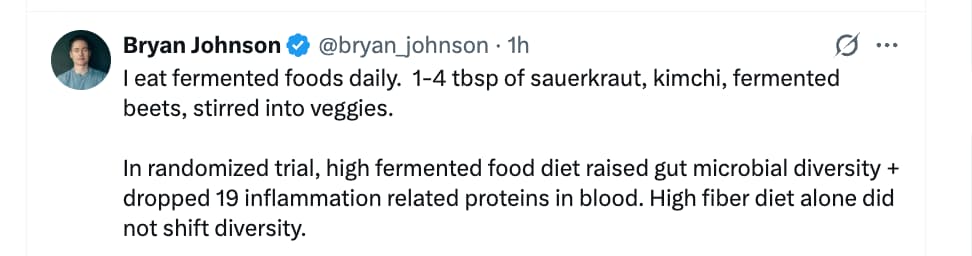
Conversely, fermented foods modulate host physiology via a distinct anatomical pathway. While conventional dogma suggests that live cultures in fermented matrices permanently engraft within the colon, thermodynamic and numerical realities indicate they are structurally overwhelmed by the resident colonic microbiota. Instead, these transient microbes exert their primary therapeutic effects upstream in the small intestine. This organ serves as a massive immune-sensing interface where both live cells and structural fragments from deactivated cells interact directly with mucosal immune tissue. Data from clinical interventions indicate that this process dampens systemic inflammatory cascades, causing a marked down-regulation of circulating inflammatory cytokines.
Furthermore, emerging evidence regarding heat-treated, pasteurized, or deactivated microbes (termed “zombie biotics” or postbiotics) reveals that viable replication is not a prerequisite for immune modulation. Cellular wall fragments, peptidoglycan structures, and heat-shock proteins retain the capacity to stimulate and desensitize mucosal dendritic cells and toll-like receptors, simulating the therapeutic effects of live cultures. Ultimately, because fiber and fermented foods leverage distinct, non-overlapping physiological mechanisms to optimize the gut-immune axis, they must be viewed as mandatory, synergistic components of a longevity-focused protocol rather than interchangeable options.
II. Insight Bullets
- Dose-Dependent Mortality Reduction: Prospective cohort data show that for every additional 5 grams of natural dietary fiber consumed daily, early mortality risks from cardiovascular disease and stroke decrease by approximately 5% to 11%, with no observed upper threshold of efficacy.
- Mechanistic Variance of the Gut Axis: Dietary fiber and fermented foods do not share identical biological pathways; fiber undergoes distal colonic fermentation to yield metabolic byproducts, whereas fermented foods induce direct, proximal immunomodulatory signaling in the small intestine.
- The Engraftment Fallacy: The long-held hypothesis that oral probiotics or fermented food cultures permanently colonize the lower gastrointestinal tract is numerically invalid. Ingested boluses containing billions of microbes are structurally overwhelmed and diluted by the trillions of resident colonic microorganisms.
- Small Intestine as an Immune Interface: The primary therapeutic site for fermented food matrices is the small intestine, where transient microbial cells interact directly with mucosal immune cells to modulate systemic inflammation.
- Immunological Prevention of Oncogenesis: Fiber-derived microbial metabolites calibrate the host immune system to maintain high agility and precision. This helps prevent systemic distractions caused by chronic inflammation and junk food, thereby optimizing the daily clearance of early-stage malignant cells.
- Survival Modulation in Oncology: High-fiber intake and a robust gut microbiome are critical clinical predictors of survival in patients undergoing advanced chemotherapy and immunotherapy regimens, such as those for metastatic melanoma.
- The Stanford FeFiFo Cross-Over Trial: A foundational clinical intervention demonstrated that while both interventions support gut health, a high intake of fermented foods uniquely drove a 25% reduction in multiple circulating inflammatory proteins and cytokines.
- Structural Validity of Inanimate Microbes: Deactivated, pasteurized, or heat-killed microbial cells (postbiotics) retain significant biological utility. Their cell-wall fragments and protein structures mechanically stimulate immune pathways to reduce inflammation, operating much like a non-replicating vaccine.
- Microbial Density in Commercial Cheeses: Metagenomic sequencing of standard commercial craft cream cheese revealed three to four highly resilient, active strains of dairy-loving microbes, confirming that conventional culinary products often retain significant microbial complexity.
- Synthetic Ultra-Processed Food Failures: In contrast to real cheeses, ultra-processed industrial cheese slices show no microbial activity, do not undergo organic decomposition or molding, and provide zero immunomodulatory value.
- High Species Diversity in Whole Food Matrices: Traditional fermented foods regularly exhibit over 50 distinct microbial species when sequenced. This offers a significantly wider spectrum of microbial diversity than standard commercial probiotic supplements.
- The Kombucha Canning Limitation: Industrial canning of kombucha requires filtration, pasteurization, or the addition of artificial sweeteners to eliminate residual sugars and halt microbial replication, which prevents gas build-up and explosive pressure inside the can.
- The “Zombie Biotic” Paradigm Shift: The therapeutic efficacy of pasteurized kombucha and cooked fermented foods (such as sourdough or tempeh) supports the biological reality of postbiotics, showing that cell-wall debris can actively calm mucosal immune responses.
- Industrial Fiber Additive Failure: Historical attempts by beverage manufacturers to enrich commercial beers with functional fibers failed in the marketplace because the additive significantly accelerated satiety, causing consumers to sharply reduce their total volume of consumption.
III. Actionable Protocol
High Confidence Tier (Level A/B Evidence)
-
Natural Dietary Fiber Titration
- Objective: Maximize SCFA production and reduce all-cause and cardiovascular mortality risk.
- Protocol: Gradually scale up whole-food fiber intake to exceed standard guidelines (25g for females, 38g for males) using natural, unprocessed sources. Data confirms a 5–11% reduction in cardiovascular and stroke mortality per 5g incremental increase (Association Between Dietary Fiber and Lower Risk of All-Cause Mortality: A Meta-Analysis of Cohort Studies).
-
Targeted Botanical Diversity
- Objective: Drive microbiome versatility and optimize postbiotic metabolite synthesis.
- Protocol: Consume a minimum of 30 distinct plant varieties every week. This total should include a varied mix of vegetables, fruits, whole grains, legumes, nuts, and seeds to supply a wide matrix of complex carbohydrates and polyphenols.
-
Fermented Food Micro-Dosing
- Objective: Down-regulate circulating inflammatory markers and suppress systemic cytokine cascades.
- Protocol: Ingest three to five distinct portions of live fermented foods daily (e.g., unpasteurized kimchi, wild sauerkraut, traditional kefir, authentic plain yogurt). This approach is directly modeled after the Stanford clinical intervention, which demonstrated a 25% drop in inflammatory pathways via consistent daily exposure (Stanford Medicine FeFiFo Clinical Trial Data).
Experimental Tier (Level C/D Evidence)
-
Postbiotic Integration via Deactivated Matrices
- Objective: Stimulate mucosal dendritic cells and toll-like receptors via structural cell-wall fragments to calm immune activity.
- Protocol: Integrate heat-treated, cooked, or pasteurized fermented products—such as traditional sourdough, cooked tempeh, miso paste used as a whole-food stock replacement, and high-quality pasteurized kombucha—into your regular diet (Effects of Heat-Killed Lacticaseibacillus paracasei MCC1849 on Immune Parameters: An RCT).
Red Flag Zone (Safety Data Absent / Negative Outcomes)
-
Isolated Artificial Fiber Supplements
- Risk / Limit: Clinical translation gaps exist regarding whether synthetic, isolated, or highly purified fiber powders replicate the robust all-cause mortality benefits provided by intact, whole-plant fiber matrices. Avoid relying on synthetic fiber powders as a replacement for whole food.
-
Canned Kombucha and Pseudo-Ferments
- Risk / Limit: Aggressively screen commercial canned kombuchas that have been heavily filtered or pasteurized and then sweetened with artificial or non-nutritive sugars simply to ensure shelf-stability. These products lack live microbial diversity and may contain additives that can disrupt metabolic signaling.
-
Ultra-Processed Cheese Slices and Synthetic Dairy
- Risk / Limit: Completely eliminate processed plasticized cheese slices and highly stable, synthetic dairy products. These products possess zero microbial life, do not undergo organic decomposition, and are entirely devoid of immunomodulatory or gut-health utility.