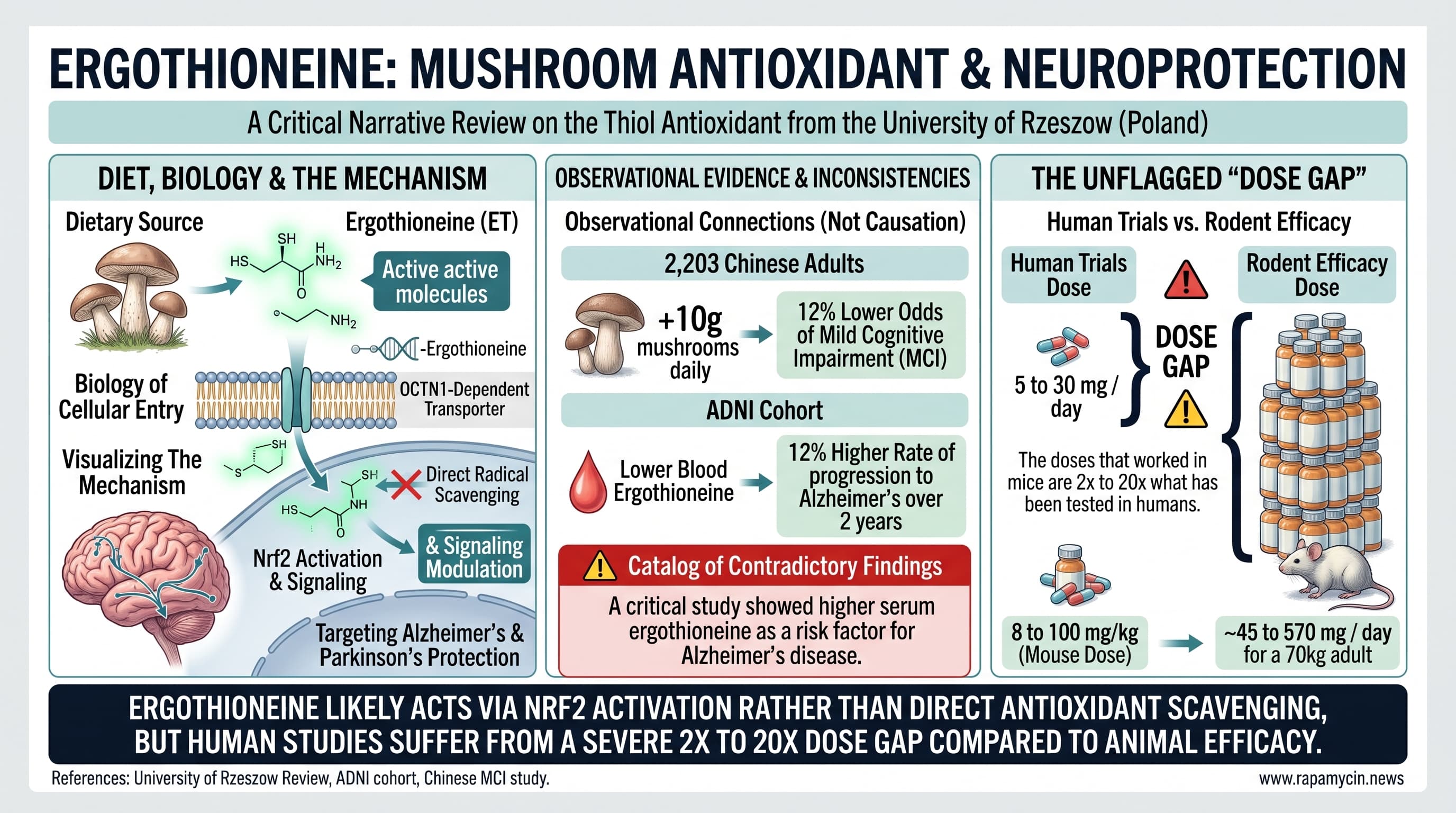
This is a critical narrative review from two authors at the University of Rzeszow in Poland examining whether ergothioneine, a thiol antioxidant obtained almost entirely from mushrooms, prevents neurodegeneration. The authors survey the compound’s chemistry, dietary sources, bioavailability, and OCTN1-dependent transport, then assess cellular, animal, epidemiological, and human interventional evidence across Alzheimer’s and Parkinson’s disease. They conclude that the mechanism is probably Nrf2 activation and signaling modulation rather than direct radical scavenging. The review’s most useful contribution is its catalog of contradictory findings, including one study where higher serum ergothioneine was a risk factor for Alzheimer’s disease.
Ergothioneine has the cleanest story in the antioxidant field, and that is both why it is interesting and why it should be read carefully.
The basics are genuinely unusual. Humans cannot make it. Fungi and some bacteria can, which makes mushrooms the dominant dietary source, accounting for roughly 95 percent of intake in a typical European diet. The body treats it as something worth keeping: there is a dedicated transporter, OCTN1, that concentrates it into cells; the kidney reabsorbs it so that under 4 percent of an oral dose appears in urine; and blood levels keep climbing for at least 28 days of supplementation without saturating. A compound that has a transporter, a retention mechanism, and no endogenous synthesis is a compound the body is acquiring on purpose. That is the observation behind calling it a vitamin-like molecule.
The epidemiology is consistent in direction. People with mild cognitive impairment have lower blood levels than age-matched controls. People with dementia have lower levels than people with cognitive impairment, who have lower levels than the cognitively intact. In an analysis screening 991 blood metabolites against cognition, ergothioneine came out at the top. Two longitudinal cohorts, one of 470 people and one of 1,344 Japanese adults followed a median of 11.2 years, found that low baseline levels preceded faster decline and predicted incident dementia.
Then the review does something most reviews in this genre do not. It lays out the findings that do not fit. Plasma levels did not differ between Alzheimer’s and vascular dementia, which is odd if the mechanism is specifically neurodegenerative. Levels did not differ between elderly people with low and high brain amyloid burden. And one study found higher serum ergothioneine to be a risk factor for Alzheimer’s disease, the opposite of everything else. The authors report all of it.
They also name the right precedent. When they ask whether the evidence justifies recommending supplementation, they answer that it would first require large randomized trials of the kind run for beta-carotene. That is a pointed comparison. Beta-carotene had excellent observational data and then increased lung cancer in smokers in two large trials. It is the standard case for why antioxidant epidemiology does not survive contact with randomization.
Which makes the ending hard to explain. Two sections after invoking that precedent, the conclusions state that supplementation can be broadly recommended for the general population, especially older adults. The abstract hedges differently again, saying the recommendation is not yet adequately supported. Three positions, one paper.
The human trial data are where this matters. Across the interventions the review cites, no randomized trial has shown a cognitive benefit over placebo. The largest, 147 adults on 10 or 25 milligrams for 16 weeks, reported a memory improvement at week 4 that was not sustained and no clear between-group result on its primary outcome. The one thing that replicated was subjective sleep quality, in two trials, by questionnaire.
Insights
What the human numbers actually are. No randomized trial has beaten placebo on a cognitive endpoint. The largest, 147 adults aged 55 to 79 on 10 or 25 milligrams daily for 16 weeks, found a composite memory gain at week 4 in the higher-dose arm that was a within-group change only and had disappeared by week 16. An earlier trial of 5 or 25 milligrams for up to 35 days found only non-significant downward trends in oxidative and inflammatory markers. A one-year trial in mild cognitive impairment enrolled 19 people, 11 on treatment and 8 on placebo, performed no between-group comparison, and its own authors stated the sample precludes conclusions.
The one finding that replicated is subjective sleep. Two trials, 8 milligrams for 16 weeks and 20 milligrams for 4 weeks, reported improved self-reported sleep. Neither measured sleep objectively.
The observational numbers worth knowing. In 2,203 middle-aged and older Chinese adults, each additional 10 grams of mushroom per day was associated with 12 percent lower odds of mild cognitive impairment, cross-sectionally. In the Alzheimer’s Disease Neuroimaging Initiative cohort, lower blood ergothioneine in people with mild cognitive impairment was associated with a 12 percent higher rate of progression to Alzheimer’s over two years. Both are associations.
A dose gap nobody flags. Human trials used 5 to 30 milligrams daily. Rodent efficacy studies mostly used 8 to 100 milligrams per kilogram, which on body surface area normalization corresponds to roughly 45 to 570 milligrams daily for a 70 kilogram adult. The doses that worked in mice are two to twenty times what has been tested in people.
Dietary intake for reference: about 1.1 milligrams daily in the United States, 1.3 to 4.6 across four European countries.
Context and Source
- Open Access Paper: Ergothioneine: A Natural Antioxidant Claimed to Prevent Neurodegeneration., Published: 8 November 2026.
- Institution: Laboratory of Analytical Biochemistry, Institute of Food Technology and Nutrition, Faculty of Technology and Life Sciences, University of Rzeszow, Poland. Single institution, two authors.
- Country: Poland.
- Journal: Nutrients, volume 18, article 3708, 2026. Published by MDPI.
- Impact evaluation: The impact score of this journal is 5.8, evaluated against a typical high-end range of 0 to 60+ for top general science, therefore this is a Medium impact journal.
Related Reading:
- Blood Levels of the Mushroom Antioxidant Ergothioneine Track With a 44% Lower Dementia Risk in Older Japanese Adults
- The Mushroom Molecule That May Rewrite Aging: Ergothioneine Emerges as a Multi-Target Geroprotector
- Why Your Antacids and Smoking Habit are Aging Your Brain, and Why Ergothioneine Might Save it
- Ergothioneine Meets the Treadmill: A New Synergistic Frontier for Brain Resilience